
Nature

You are currently browsing the archive for the Nature category.

Dave distributing a despensaWe’ve returned from our 3 day trip to Tabasco, the region of Mexico that had experienced devastating floods in late October through early November. We loaded up two SUV loads of toys, vitamins, diapers, and powdered milk and drove the 8 hours from Mérida, Yucatán to Villahermosa, Tabasco to bring relief to families, especially those with small children.

Entering the city, we found that life had returned to its hectic pace with people and cars everywhere. The only visible remains of the inundation was the construction taking place to repair and clean roads affected by the floodwaters. Still, the stories we heard were incredible. People told us that many had remained in their homes, thinking this to be just a routine occurrence during the Tabasco rainy season, but that, as the floodwaters rose, they found themselves waiting on rooftops for helicopter rescue. The pastor’s home where we stayed took on more than 5 feet of water. He and his family stayed in the upper level and were able to save the majority of their appliances and furniture, but mold on the walls and ruined tile floors spoke of the work ahead to restore what the flood had ruined.

The countryside surrounding the city was a different story as floodwater remained on the roads and in the low lying areas that surrounded the houses. While no longer threating homes and schools, the stagnant water poses a health threat especially to the small children who choose to play in the contaminated pools and through mosquito borne illnesses. This is where we focused our efforts.

Entering Tabasco on Thursday night, we pooled together with Pastor Ruben, his family and several members of the church to put together relief packages with food, vitamins, diapers, milk and other essentials for the residents of these needy areas. It was touching to see the desire of these people, who were themselves victims, giving of their time and effort to help those who had needs greater than their own.

The following day, we handed out the supplies and toys to the children and their parents. It was for them clearly a “big deal” as at one point we were accompanied by one of their local government representatives. We were given complete access, even the ability to interrupt the activities of a elementary school to meet with the students.

Food was distributed, toys were given away, and much needed supplies were handed out, but something much bigger was accomplished. These victims received a much needed infusion of hope. They received it realizing that they were not alone in their struggle.

There is something amazing in the fact that God touches people to go and share his love with those who most need to experience it. At one point in the distribution, Paul Kazim, a fellow missionary, prayed. I think it was then that the reality of what we were doing came into focus: Jesus ministered to the people in Mark 6:30-44. He did that even though he was experiencing the loss of his cousin and herald, John the Baptist. He did it because he had compassion. In Tabasco, fellow citizens were putting their lives on hold, lives that had themselves been completely changed by the floods, to reach out to those with greater needs. What was the reason? I believe it to be nothing less than the same compassion that Christ portrayed to the 5,000 that were fed in the Galilean countryside.

We’re planning to go back to Tabasco January 10-13 to provide medical treatment and spiritual counseling to the needy suffering in Tabasco, to the people now being overlooked as efforts are being made to restore a sense of normalcy in the region. We as missionaries will take part, but I think the most effective counselors will be those who have lived through these floods. Those who, because of the compassion that only God can provide, have thought of others as better than themselves.

(You can see more of our recent trip by clicking on the picture above or through this link.)

To Tabasco…

We’re on our way for a three-day relief trip to Tabasco with no time to type. What could be a faster way to relay the story? How about a video blog? Take a look at this latest offering and please remember to pray for those affected by the flood in Tabasco.

A Change of Plans

Tabasco Under WaterMondays are usually a low-key day for the Godzwa family. The day after ministry is usually reserved for catching up on household items or replying to correspondence. I had a post planned about the evangelism seminars that we have been leading. But a telephone call from Paul, our mentor missionary here in Mérida, broke the routine. “Dave,” he said, “the situation in Tabasco has gotten out of hand…” The situation he was talking about was the flood that Mexican President Felipe Calderon now calls Mexico’s worst recent natural disaster.

If you have not had the opportunity to see the images of the Mexican state of Tabasco that CNN has been broadcasting, please understand that the inhabitants of this area, which is located about 300 miles from our current location in Mérida, are dealing with a true disaster. Due to unseasonable heavy and continual rain, several rivers have flooded their banks inundating businesses, homes, schools, and churches. News reports put up to 80% of this low-lying state currently underwater. Calls to church leaders in this district have returned reports of lower lying areas completely underwater, of many homes and churches with more than five feet of water in them, and of flooding so high that even people who live on the second floor of a building have found shelter elsewhere because there is no access to their homes.

So to one side moved the household chores and unanswered went the correspondence for one more day so that I could hit the phones to see what I could do to lend a hand to the relief effort being planned here in the Yucatan.

The situation in Tabasco is being described as the Katrina of Mexico. The center-city of Villahermosa is a complete disaster and as a result, those who have been forced to stay behind have nothing. The residents of Tabasco need drinkable water, powdered milk, towels, diapers, canned food, and lots of other basic items. The people of Yucatan are changing their plans to pitch in. Instead of buying food for their family, they’re buying supplies to donate as schools churches and government buildings have opened their doors to accept donations.

Specifically, the church leaders of Tabasco have asked for medical personal with medicines and vitamins to come and offer care. This is extremely important as the floodwaters begin to recede and diseases resulting from contaminated drinking water and inadequate services begin to appear. To respond to this request, God is calling on still others to change their plans. A relief corps of Christian doctors and nurses from Mérida are organizing now to travel in order to provide first-hand relief and the peace of God to those caught in the middle of this crisis. All of these health professionals are sacrificing family-time and their personal goals as they prioritize the needs of their countrymen.

I’m happy to report that my change of plans brought about some tangible results, but a need this great calls out for so much more to be done.

How about you? Do you feel God leading you to be a part of the relief effort?

Comment or email us and we’d be glad to help you with your change of plans.

Photos courtesy of: http://www.flickr.com/photos/kubricka/

Dean the Day After

Dean from SpaceWhat can we say except, “Thank God for his protection!” as we assess the situation here in the Yucatán.
The facts are plain:

  • Dean was a category 5 hurricane, the highest on the scale of hurricane strength.
  • It made landfall with a sustained wind speed of 165 mph the first since Andrew to do so.
  • Dean is now among the top 10 strongest hurricanes on record at landfall.
  • Storms of the magnitude of Dean have the potential to be catastrophic. Andrew, for example, caused 65 fatalities and 38.1 billion dollars worth of damage in today’s economy.

Still the final results are nothing less than miraculous:

  • To date no fatalities have been directly blamed on Dean here in the Yucatán
  • Upon landfall, the storm rapidly lost strength and caused what President Calderon has said was “minor damage.”
  • The Diario de Yucatan (Spanish) called Dean a “dry hurricane.” Most populated areas received high winds but little to none of the rains that were expected to cause flooding across the peninsula. Our contact in Muna, Pastor Julian Puc, held service that same night, while Pastor Santos Reyes, who is in Ciudad del Carmen where the hurricane left the peninsula, has told me that everything is functioning “as normal” after only 24 hours without electricity.

Everything from the landfall over a less populated area, to the speed in which it passed over was beneficial for the inhabitants of the Yucatán.

Again, thank you for your prayers on our behalf and that of the people of Yucatán. Also, thank you to those who wished us well through e-mail, phone calls, comments on our site, and links highlighting the situation. We appreciate each one of you.

Dean RemainsAlthough we are still under a red alert here in Mérida, Dean is now a category 1 hurricane and is passing into the Gulf of Mexico. From our vantage point, the hurricane has proved to be little more than a big blow. We’ve been experiencing high winds since 5 o’clock this morning, but little to nothing in the way of rain. Damage has been relatively non-existent here in the city. In actuality, the Kazim’s who were out a bit this morning reported people on the streets as early as 10 o’clock.

The story is still far from conclusion in the southern part of the state and in Quintana Roo, where Dean made landfall at 3:00 this morning. Nevertheless, there have been no reported deaths and slight to moderate damage, a far cry from the potential catastrophe that we had on our hands yesterday.

We’ll keep you informed as more information comes to light. In the meantime, we’d encourage you to think about getting involved with Convoy of Hope to help those who have been affected by Dean and other catastrophes. Gary and Peggy Pyatt in Jamaica have reported significant damage to ministries and schools in that country, while COH has dispatched a team to begin relief work among the earthquake victims in Peru. Also, if damage proves to be more severe here in the Yucatan, their ministry is ready to respond.

Dean RealityStorm models continue to push the landfall of Dean further south on the peninsula. This means Mérida remains at a state of alert, but hasn’t declared an emergency situation. However, in the south of the state of Yucatan and in Quintana Roo, where Dean is expected to be more of a problem, many are facing the reality of this man in the picture to the left. Several have houses made of little more than sticks or corrugated roofing. While the majority of those in this situation have been relocated into shelters, the chances are that many will have nothing to return to. Please keep these in mind as you remember the people of the Yucatán in your prayers.

The Latest on Dean

Dean CloserWe have received various e-mails about the situation that we are facing in regards to Hurricane Dean. To update those of you following the situation, the meteorologists are forecasting that the storm will take a southerly route across the Yucatan. That puts Mérida out of the range of the 150+ mph winds that will likely accompany its arrival. Still the entire state is under an orange alert which signifies the likely arrival of hurricane activity within the next 18 to 24 hours.

The city is relatively calm, but signs of preparation are everywhere. Shops with boarded or taped windows to prevent breakage. Stores are depleted of survival essentials such as batteries and are short on food, especially bread. The government has sprung into action and has plans to move about 16,000 people in the areas under the highest risk to shelters here in the city or in the surrounding municipalities.

We’ve taken necessary steps such as taking in all of the items that might possibly blow away as well as taping off windows and creating a safe area within our home where we plan to “ride out” the storm. We have food supplies for at least a week and water to drink as well as separate water for cooking and cleaning. We are preparing ourselves to be without power, water, telephone, and internet for at least a week so we ask for your patience as you look for updates or try to contact us.

Please do continue to pray. We are certainly concerned for our safety, but we now focused much more on the well-being of those who are to our south. In our minds are our friends from Muna with whom we ministered in March, and pastors in Ciudad del Carmen in Campeche with whom I studied in ISUM. Pray for their safety as well.

Hurricane DeanFor two Mid-Atlantic transplants living in the Midwest, hurricanes were at most a thing of curiosity. They were the stuff of late summer Weather channel reports. Devastating and cruel to be sure but never in our version of reality. They were events that happened to others. All of that is changing in the face of the now Category 4 Hurricane Dean.

As I am writing this update, Hurricane Dean is now bearing down on Jamaica, and all of the projections place its trajectory directly across the Yucatan Peninsula and the city of Mérida. The entire state of Yucatan is under yellow alert meaning that preparation on everyone’s mind as shoppers filled the supermarkets stocking up on canned food, water, and medicine.

Here in our new home as well we are preparing–determining areas of safety, and trying to make our plans, but even as we plan, we are faced with a mountain of uncertainty and where there is uncertainty, not far behind we find fear.

In all of this I am reminded of that tumultuous voyage of Jesus’ disciples across the Sea of Galilee in Mark chapter 4. There there were being tossed about, grown, sea-hardened fishermen uncertain if they would live or die. As they woke Jesus, who had been sleeping on a cushion, they wondered aloud if he even cared about them. In their fear, they’d failed to recognize that he was the one who had ordered them to set sail in the first place. The storm, more than the setting of a miracle, was their opportunity to recognize that, even though they went through the valley of the shadow of death, they had nothing to fear because with them was their shepherd.

Pray for us friends. Pray for our safety and for the safety of friends in harm’s way. Pray too though that we won’t fail to recognize the presence of our Good Shepherd as we wait here in the gaze of Hurricane Dean.

Having a six year-old and an eight year-old in the house means that the “Tooth Fairy” regularly comes for a visit. Now, this is not a post on whether or not talking about the Tooth Fairy, Santa Claus, or the Easter Bunny are worthy or appropriate topics for a Christian Household. I’ll save that for other more in-depth and witty bloggers like Rich Tatum. No this is about the interesting irony that we experienced here in Mexico.

Waiting for the Tooth MouseWhen, Joseph, our six year-old, began feeling his wiggly tooth, he started planning how he was going to spend his money that he would receive from the tooth-fairy. He told friends and church members alike about his wonderful good fortune. However, in the relaying of his news, we found that the country of Mexico is outside of the Tooth Fairy’s jurisdiction. Mexico is the territory of the Tooth Mouse!

Legend says that the Tooth Mouse, possibly created as a story for a celebration of the lost tooth of the then eight year-old Alfonso XIII of Spain, lived in an over-sized cracker box in the palace of the benevolent child-king Bubi I, protector of poor children, and friend to the mouse. This mouse, named Perez, clad in his straw hat, gold-rimmed glasses, and linen shoes, would visit the rooms of rich and poor alike depositing gifts from his red backpack in place of a lost tooth while avoiding the ever-present threat of cats. (Spanish speakers can read the tale here)

The Tooth MouseQuite a tale! Now although the Tooth Mouse in Mexico doesn’t carry the Perez name, and the fineries he once wore have vanished, his tale continues to be told and his face graces the appointment books and literature of dentists throughout the country. Some other details about the mouse have changed as well, and that is where the irony comes in.

Ever since we moved into our house, we’ve had regular visits from real mice. Yes, those cute, furry little rodents that come in from the cold in search of food and a warm place to spend the night. Of course, we don’t have the habit of leaving large cracker boxes lying around, so our mouse had taken a liking to living inside our stove. The small crevices and warmth provided from our gas oven gave it a comfortable if not traditional space to live in.

Mouse TrapNot realizing his mission was to look for teeth, we went to war against this intruder. Our battle against him employed, not the traditional cat, but large sticky pads with cheese as bait. It seems as well, from the picture above, that although the tooth mouse could avoid the cats, he was no match for the modern technology that we employed.

Of course, we were concerned after learning of the story of the tooth mouse, thinking that perhaps we had destroyed a famous legend and source of joy for countless children. Nevertheless, when Joseph’s tooth was placed under his pillow, he found a ten peso coin, roughly the equivalent of one dollar US, in exchange the following day (The tooth mouse respects the tooth fairy’s going rate). It seems, though, as real mice have the tendency to multiply, so the tooth mouse has engendered a number of descendants in order continue his legacy and the joy that he has brought to many here in Latin America.

So watch out Tooth Fairy! As America’s population turns decidedly more Latin, you may find yourself giving way to this equally benevolent, highly intelligent, and rapidly reproducing Spanish legend.

Chilling out in Mérida

Cold Temps in MeridaThis little weather badge may not mean much to those in the states dealing with snow and temps in the teens, but for those of us who have acclimatized to the tropics, we’re suffering through a real cold snap! For the past three days we’ve experienced temperatures that have struggled to get into the 70’s during the day, only to plummet into the low 50’s a night. (The low this morning was 49!) On top of that rain, clouds, and high humidity have made everything feel that much colder.

For those of you who are ready to pack the trunks and come down for a swim let me give you some perspective. Mérida has yearly average high temperature of 90 degrees and an average low of 70. For further clarification, we go through 339 days of the year with a high temperature above 80 degrees, 238 of those above 90. (You can check out these and other weather statistics at the Mérida Weather Review.) That means that for the past three days we’ve been 20 degrees outside the norm for both the high and low. So you can imagine the complaints that we’ve been hearing. Last night, our pastor’s wife let us know that it is never this cold, and she’s not off by much. The record low, according to my research is 41!

So while you’re scraping the ice of your windshield to go to work, remember those of us in the Yucatán who are suffering with you. Boy am I glad we got our hot water fixed this weekend!

Update 2/26/07: Proving Mexico can indeed get chilly is this article from Jim over at his blog: Finding Direction. It was submitted without coercion.
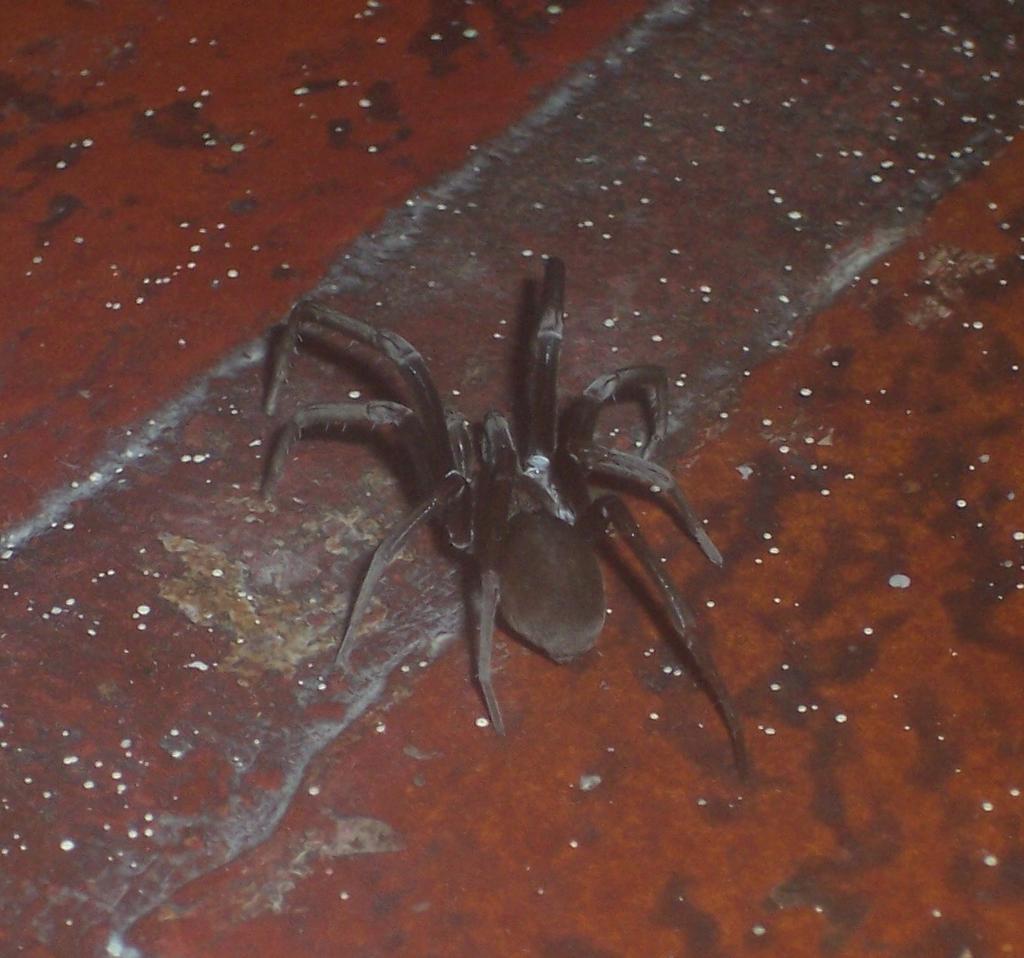
We had the opportunity to travel to Tortuguero last weekend to celebrate Kelly’s 30 something birthday. While we were on the trip, we realized that, besides the green sea turtles, there are other natural wonders that grow to become quite large. Spiders were certainly in that category as was this elephant beetle. Take a look at Kelly’s hand in the video if you think this is just an extreme close up!


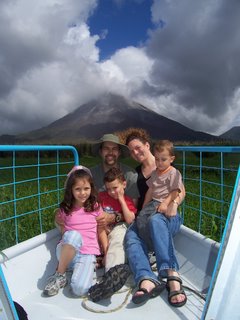
Well even though I have missed video blogging week, as mentioned on Missionary-Blogs.com I thought it was appropriate to put up a video of another visit a volcano, since we seem to be keeping a pretty good catalog of trips to these wonders of nature which you can visit here (Irazú) and here (Arenal).

The day below Poas, which sits above the central valley of Costa Rica, was sunny and bright. But when we reached the park entrance, we were told that the crater was completely clouded over, and at the time of the day that we were visiting, probably wouldn’t be visible. However, with Kelly’s family visiting, and the remembrance of 2 other failed attempts to view the second largest volcanic crater in the world, we were determined to try.

When we arrived, it was as we were told. All we could see was a wall of clouds. But almost as an answer to prayer, the clouds parted, and we were able to see Poas in all of its magnificence. Allow us to show you. Click on the player above to view a Google video file of the appearance of this, one of the most frequented tourist sites in Costa Rica. Note: What looks to be the lake in the center of the video is the principal crater.


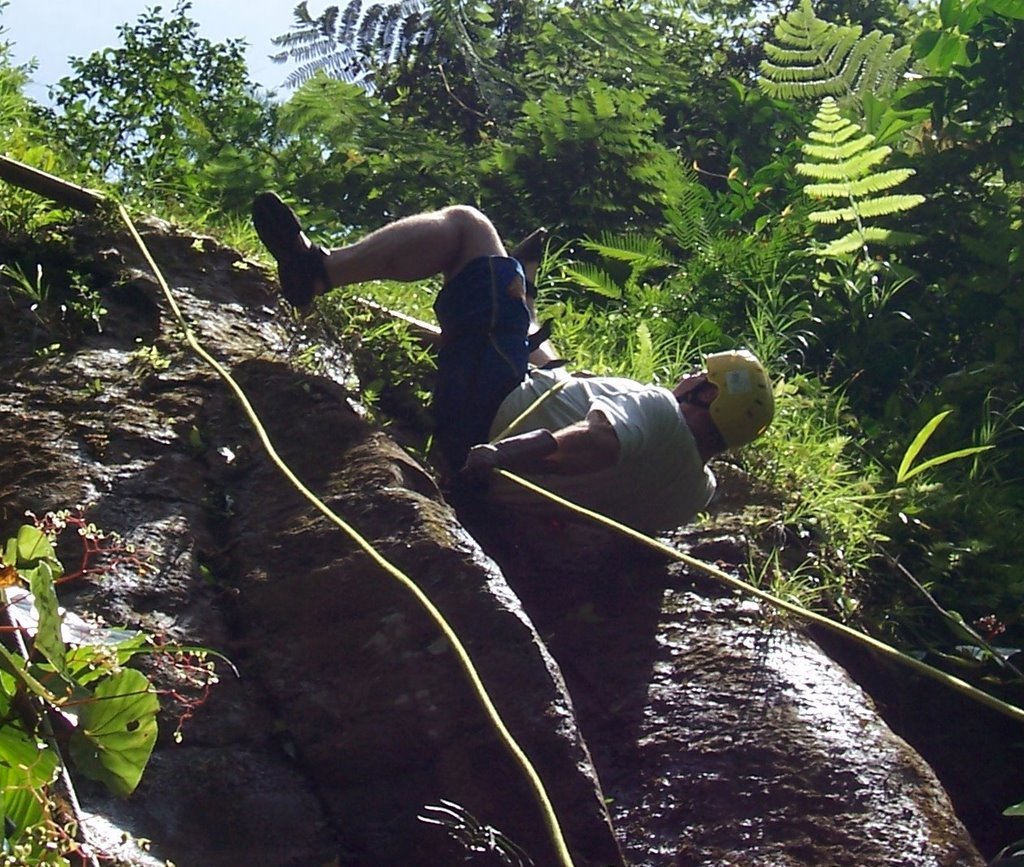
Sometimes, we are on top of the world and think that fluency in Spanish is within our grasp. Other times, we are somewhat like Josh Amiot, hanging on for dear life!

This is the stage that we find ourselves in this week. We are now passing through our “ECHO”s, or Spanish conversation proficiency exams, during which our conversation with one of our professors will be recorded and our level of progress marked. This is one of the most stressful times for the students of CINCEL as we try to bring everything together for this “final exam” for the current term. (Two terms down and one to go!) We appreciate your prayers on our behalf during this time.

Now about the picture. Josh had the unfortunate experience of slipping on the rappelling wall in full view of the camera during our recent men’s retreat. We certainly thank him for the wonderful object lesson, and of course for his great sense of humor!

Last Saturday, we had the opportunity to visit the volcano Irazú. This volcano, located directly east of San José is most generally known for it’s eruption of March 19, 1963, the day the President Kennedy visited the country. At the summit of this now dormant volcano, one can find a strange, cold and almost moon-like surface. As well as a temperature has been known to create frosts in this tropical country. However, few of the group of students that traveled to visit this natural wonder were expecting to see this placard of US culture waiting for us when we arrived.

It appears that the US Department of the Interior once had an earthquake monitoring station here at the summit of Volcán Irazú, and this metal plate was a remnant of their operations. What at one time may have served as a tool for scientists served on Saturday as a reminder of the thoughts and prayers of family and friends back home for a small group of missionaries. And to those who continue to show their love and support we say, “Thank you!”

We felt no “temblors” while we were exploring the terrain, but we did get some great pictures. Take a look at them now by clicking on the picture to the right or by clicking here.

Being the adventurous type, as most missionary families are, we decided to spend our Christmas vacation at one of the most active volcanoes in the world, Volcan Arenal. We drove for about four hours by van over less than perfect roads in order to reach our destination, and what greeted us was nothing less than majestic.

The volcano towers over the town of La Fortuna and dominates all of the surrounding landmarks. But there is much more to this volcano than meets the eye. During the day sounds that can only be described as roars emit from within the mountain as rocks the size of cars are spewed from the cone to tumble noisily down the active face. The nighttime, however, is when the show really begins as the volcano treats visitors to the sparsely populated and rugged west face to a light show that needs to be experienced in order to believe. The molten rocks, which look gray in the daylight, now glow a bright orange and leave trails like rivers of fire as they roll down to be extinguished hundreds of feet below the cone. It is a sight that forces you to appreciate the amazing creative power of God!

Of course, we did more than simply watch the mountain during our vacation. Take a look at our pictures of the trip here.

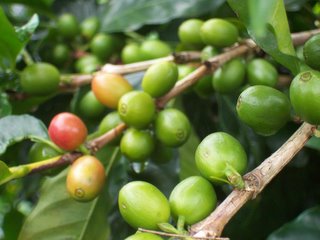
Many of us would be able to finish that verse from the book of Zechariah from memory, and it is a comforting thought that this task of saving mankind has not been left to human devices. Of course, many of us draw strength from a much more earthly source of power as we begin our mornings. That morning motivator, coffee, is in abundance here in Costa Rica, and they don’t just sell it here they grow it here.

We recently had a chance to take a side trip to the Tres Generaciones coffee plantation, and I had a chance to snap some pictures. Click on the picture to take your own tour and sample the latest feature to our website, photo albums! Hopefully, you’ll never take that morning cup for granted again!

Ready for anything has long been the motto of the missionary, and the folks here at CINCEL take that motto seriously. Here we are at Colinas del Poas, about an hour and a half drive north from San Jose, receiving instruction, with fellow Mexico missionaries Ryan and Christy Thomas, about how to cross from treetop to treetop during our rainforest canopy tour.

No roads? No problem. We’re trained to cross any terrain. You know, there might be something here for Speed the Light! Want to see what the experience was like? Click on the picture and hang on!

We thought that you might like a look at one of our house guests here in Costa Rica. With no winter to speak of here in San Jose the spiders have opportunity to grow quite large!

In actuality, there are only two seasons in Costa Rica, dry and rainy. Right now, were in the rainiest month of the year. It rains here nearly every afternoon. This will continue until December when the dry season begins. We have come to find out that the umbrella is a necessary item…sometimes the hard way!