compassion

You are currently browsing articles tagged compassion.

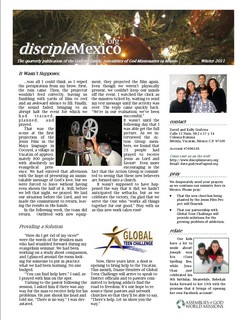
As our thoughts turn to the birth of our Savior, we are reminded that God sent His Son into the world to seek and save that which was lost. What a privilege we have to be used by Him as He carries out His work in Mexico. Take a look at our online newsletter to see just a glimpse of what He is doing among us. Click here or on the picture to read our latest update!

Our online newsletter is viewable as a PDF document. If you do not have the Adobe Acrobat Reader software installed, you may download it here.


Popularity: 1% [?]

Tags: , , , , ,

I’m a fixer. I’ll admit it. It seems as though even before I see a problem, I’m already at work on how I can make it better. I appreciate being able to make something more useful or more efficient. Perhaps that’s why I had gotten such a kick out of my helpdesk days as a geek in the Evangel University Technical Services office.

Still, what I have found out since then is that what works with machines and operating systems rarely applies directly to work with people. Some events that have happened this week have brought this reality into better focus for me.

AGTS Day of Renewal: Each year, the Assemblies of God Theological Seminary has a Day of Renewal, a time when they set aside the day to day practice to focus in on their pursuit of God as a corporate body. This year, being in the US, I had the opportunity to attend the morning service. In it, Dr. Sheri Benvenuti spoke of her impatience with others and what she thought were their petty problems until her eyes were opened through her own suffering. She said that that suffering, combined with the pentecostal experience enables us to comprehend the situation of those around us in a whole new way that facilitates true ministry.

Ezra Chapter 9: My Bible reading has me currently in the book of Ezra. In chapter 9, he is alerted to a grave problem. The Jews who had returned from Babylon were falling into their old ways. They had married wives from among the pagan nations who had led them astray before the they had been taken away to captivity.

Something had to be done. One would expect the scribe Ezra to sit down at his desk and begin dialing the offenders one by one in order to schedule their discipline meetings, but instead he tears his clothes, sits down in the dust and weeps over the situation.

A conversation with my dad: My dad spoke to me today asking for advice: How do you get a person to see the error of their ways and accept the logical solution, be it spiritual or social? So often, he related, he was met with the rejection, “You just don’t understand what I’m going through.”

Each one of these situations seems against us fixers and our desire to rush in with the solution. Of course it’s not that the people don’t need a solution, but rather we fixers forget that true comprehension of the situation is the first step to solving the problem.

Now, I’m not just talking about hearing all sides of the story. I’m talking about feeling the pain of the situation along with those who are suffering. Dr. Benvenuti admitted that she was quick with the solution before her personal pain, but now she more effectively ministers because she’s “been there” with those who suffer. Ezra hadn’t sinned, and certainly he had the right and the responsibility to meat out justice for the wrongdoers, but it was his public display of sorrow, not his administrative prowess that bought about a spontaneous renewal of the population. Furthermore, the offenders were the ones who carried out the solution to the problem, not Ezra.

So it would seem that people need to see more than the error of their ways. They need more than some set of logical steps to a better life. They need someone to weep with them over their present situation. They need to see that there is someone who truly cares enough to comprehend–to treat them as fellow human being and not just as a problem to be fixed.

A challenge for us “fixers?” To be sure. Still, when it comes to people, God has called us to do more than fix; He’s called us to love.

Popularity: 1% [?]

Tags: ,

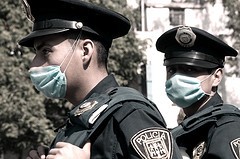
Police Officers don masks for protection.

Police Officers don masks for protection.

The early afternoon is usually a usually a time of hustle and bustle here in Mérida. Students are heading home for “comida” the normal big meal of the day. Families are planning for the rest of the day–sports activities, a trip to the mall, an evening downtown, or school meetings to attend. But everything is strangely quiet. There is noticeably less traffic on the avenue near our home. There is no sound from the loudspeaker that normally broadcasts the names of the students whose parents have arrived to drive them home. That’s because there hasn’t been school since Monday. All public events have been canceled and activities that would gather people together, from churches to team practices have been prohibited, all to prevent the spread of what is now the scourge of Mexico, the Swine Flu.

Our understanding that something was awry began when our friends, Josh and April Amiot notified us that they were returning to Mexico City to attend the funeral of one of their good friends and ministry co-workers. An otherwise healthy mother of three, Nelly didn’t fit the profile of those who die of the flu. Normally the very old or the very young, under six, are those who succumb. Of course, this was just the trickle before the flood. By last Friday the 24th, we had heard of hundreds sick and dozens dead as the Swine Flu spread rapidly across central Mexico. At the end of the weekend, there were reports of sicknesses in 19 of the 32 Mexican States and drastic measures taken to stem the spread of this highly contagious, and surprisingly deadly, conglomeration of three different flu viruses.

Here in Mérida, and across Mexico, all schools have been closed until the 6th of May and all public gatherings have been prohibited until further notice. Labor Day, May 1st here in Mexico, will be observed without the customary parades. Sporting events have been held without fans, and our district convention, set to have begun yesterday has been suspended until a later date. Even church services are against the law. Those that need to work in the public sector have taken to donning masks to protect them against the airborne virus.

But we are not writing to scare you. Our family is well, and to date, no officially recognized case of Swine Flu has been recorded here in Mérida. Still, there is a definite tension in the air as anxiety and fear have taken hold. There is a sense of helplessness apparent as society waits for word of progress against this disease.

But we are not helpless, we can cry out to God and know that He will hear and respond to our requests. So we ask you to join with us as we intercede for this nation. Ilona Hadinger, a fellow Mexico Missionary and the coordinator of our prayer devotions on MexicoAG.org offers these points to guide us in our intercession:

  • Pray for the sick; for an end to the suffering.
  • Pray for families who have lost a loved one to the virus.
  • Intercede for believers as they boldly pray for the sick and proclaim the Good News of eternal life.
  • Ask for the peace of God to be felt across the land, and for many to commit their lives to the Prince of Peace.
  • Pray for pastors, Christian leaders, and missionaries to remain healthy with a steadfast trust in the Lord
  • .

Please join with us during this crucial time.

Photo provided by sarihuella on flickr.com

Popularity: 9% [?]

Tags: , , ,

I just finished up another evangelism conference, this marking my sixth opportunity to hold such an event here in the Yucatán. With more experience comes more confidence in sharing the material, but that experience also brings a certain familiarity with the topic–an anticipation you could say of the inquiries and the reaction of the audience, but during class this last Thursday, a question was asked that I hadn’t anticipated.

We had been studying Mark 6:30-44, the account of the feeding of the 5,000, and contrasting the disciples’ reaction to the crowd’s needs with that of Jesus. Analyzing the context, we concluded that the disciples’ inaction and Jesus action was related to a key element, compassion. Jesus saw the plight of the crowd and the compassion that he felt moved him to action even though he was in the midst of extreme personal sorrow. The disciples, coming off of a successful preaching tour, failed to react because their lack of compassion.

Usually, the anticipated question is “How do we learn to react in the way Jesus did?” a question that I anticipate and answer within the lesson follow-up, but this time an unanticipated question was raised; a student asked: “Should we act compassionately first and then preach, or should we preach first and then display acts of compassion?” Caught off guard, I had to think a bit about the question. I wanted to know what it was that this student was trying to clear up in his mind. His clarification clued me in. Some organizations emphasize compassionate acts, feeding programs, rehabilitation centers, and medical clinics while others emphasize teaching and preaching engagements. This student was trying to understand what stance we should take in the debate between presenting evangelism as a moment of decision or what what some call the “social gospel.”

The question illustrates the danger of thinking in predefined categories. It can cause us to limit our outreaches to traditional activities like preaching, teaching, and passing out tracts while avoiding food distribution or medical clinics in an attempt to show our emphasis on “telling the good news,” or it can cause us to add mandatory evangelistic events to our “social outreach” in order to justify the undertaking, a practice that can lead others to criticize us as evangelicals for opportunistic proselytizing, or can lead to the phenomenon of “Rice Christians,” those who confess Christianity as long as the hand outs keep coming.

Separating compassion and preaching/teaching into separate categories should make us ask the questions: “Is our preaching without compassion?” and “Is social outreach condemned or considered second-class by scripture?” Obviously the answer to both questions is no. The real question, therefore, should not be, “How should our evangelism look?” but rather, “How should our evangelism be motivated?”

Returning to the passage in question, we see that Jesus taught and fed the needy crowd. There was no separation of his actions into evangelistic and social. Rather compassion motivated him to meet the need before him. Jesus wasn’t checking off items on his list; he was instead showing us that the compassionate response considers its recipient as a whole person.

Interchanging the word compassion for love can perhaps clarify the point. Paul, in trying to settle church division in Corinth, culminates his argument for unity with the famous love chapter of 1 Corinthians 13, which he introduces as “the most excellent way.” In his opening words, he lists both “spiritual” (prophesy and tongues and the practice of faith) and “compassionate” (giving to the poor) acts as worthless without love. It’s little wonder then that 1 John 4:12 says that we would be known to be true, not for our excellent Bible teaching or for our hospital building, but rather for our love, and this is fitting because love when perfectly applied led to eternal life. (Jn 3:16)

Reaching out to a lost world in love then enables us to push past the categories and throw away our checklists. Ultimately it allows us to utilize the appropriate means to communicate God’s love, be it through a cup of cold water or an offer to pray the sinner’s prayer.

Learning and encouraging the most excellent way here in the Yucatán,

Dave

Popularity: 23% [?]

Tags: , ,

Dave distributing a despensaWe’ve returned from our 3 day trip to Tabasco, the region of Mexico that had experienced devastating floods in late October through early November. We loaded up two SUV loads of toys, vitamins, diapers, and powdered milk and drove the 8 hours from Mérida, Yucatán to Villahermosa, Tabasco to bring relief to families, especially those with small children.

Entering the city, we found that life had returned to its hectic pace with people and cars everywhere. The only visible remains of the inundation was the construction taking place to repair and clean roads affected by the floodwaters. Still, the stories we heard were incredible. People told us that many had remained in their homes, thinking this to be just a routine occurrence during the Tabasco rainy season, but that, as the floodwaters rose, they found themselves waiting on rooftops for helicopter rescue. The pastor’s home where we stayed took on more than 5 feet of water. He and his family stayed in the upper level and were able to save the majority of their appliances and furniture, but mold on the walls and ruined tile floors spoke of the work ahead to restore what the flood had ruined.

The countryside surrounding the city was a different story as floodwater remained on the roads and in the low lying areas that surrounded the houses. While no longer threating homes and schools, the stagnant water poses a health threat especially to the small children who choose to play in the contaminated pools and through mosquito borne illnesses. This is where we focused our efforts.

Entering Tabasco on Thursday night, we pooled together with Pastor Ruben, his family and several members of the church to put together relief packages with food, vitamins, diapers, milk and other essentials for the residents of these needy areas. It was touching to see the desire of these people, who were themselves victims, giving of their time and effort to help those who had needs greater than their own.

The following day, we handed out the supplies and toys to the children and their parents. It was for them clearly a “big deal” as at one point we were accompanied by one of their local government representatives. We were given complete access, even the ability to interrupt the activities of a elementary school to meet with the students.

Food was distributed, toys were given away, and much needed supplies were handed out, but something much bigger was accomplished. These victims received a much needed infusion of hope. They received it realizing that they were not alone in their struggle.

There is something amazing in the fact that God touches people to go and share his love with those who most need to experience it. At one point in the distribution, Paul Kazim, a fellow missionary, prayed. I think it was then that the reality of what we were doing came into focus: Jesus ministered to the people in Mark 6:30-44. He did that even though he was experiencing the loss of his cousin and herald, John the Baptist. He did it because he had compassion. In Tabasco, fellow citizens were putting their lives on hold, lives that had themselves been completely changed by the floods, to reach out to those with greater needs. What was the reason? I believe it to be nothing less than the same compassion that Christ portrayed to the 5,000 that were fed in the Galilean countryside.

We’re planning to go back to Tabasco January 10-13 to provide medical treatment and spiritual counseling to the needy suffering in Tabasco, to the people now being overlooked as efforts are being made to restore a sense of normalcy in the region. We as missionaries will take part, but I think the most effective counselors will be those who have lived through these floods. Those who, because of the compassion that only God can provide, have thought of others as better than themselves.

(You can see more of our recent trip by clicking on the picture above or through this link.)

Popularity: 27% [?]

Tags: , ,