
We’re on our way for a three-day relief trip to Tabasco with no time to type. What could be a faster way to relay the story? How about a video blog? Take a look at this latest offering and please remember to pray for those affected by the flood in Tabasco.
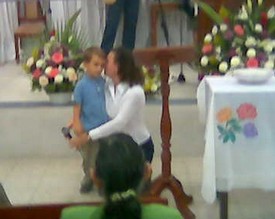 About two weeks ago, (yes, the events of our lives and ministry have taken a toll on my blogging) we celebrated the birthday of our youngest, Jonathan. It was filled with parties–one at school and another here at the house, as well as a mountain of presents, many of which have already made their way to the black hole that our boys call their closet. Of course, all of these things came as no surprise. After celebrating the 19 kids’ parties that we have, from Princess to Bob the Builder to Spider Man to Jungle themes, we’ve come to expect the anticipation, celebration, and sugar withdrawal cycle that each party brings. However, after all of the celebration was over, and Jonathan had time to reflect, he did something unexpected: he decided to testify. In fact it was such a surprise that we didn’t have our camera. The blurry picture was taken with my cell phone.
Now, I know what you’re thinking, testimony night has gone the way of Sunday morning prayer requests in most churches, they’re just not done, but here in Mexico, testimony night is alive and well, and two weeks ago last Sunday a certain recently turned 5 year-old decided to step forward and thank God for another year that God had allowed him to complete.* Not only did he testify, he also sang “Open the Eyes of My Heart” (“Abre mis Ojos, Oh Cristo”) in Spanish.
To me, this is the sign of two things happening:
- that our son is rapidly acculturating: Testifying is expected of church members when they celebrate their birthday. That Jonathan noticed this and wanted to do it tells me that he’s becoming more “Mexican.”
- that our son is recognizing God as part of his life: It was hard for me to choke back the tears as I listened to our “baby” asking Jesus to help him to truly see Him as he is. It’s my desire as a father to be a part of the the answer to that prayer.
*Spanish idea: We don’t “turn” years old as we celebrate birthdays, we complete years or “cumplemos años” hence the Spanish salutation “Feliz Cumpleaños”
This is the third in a series of evangelism training classes to be held at Cristo, la Esperanza in Mérida, Yucatan
Trip to Tabasco to help relief efforts for flood victims
This is the beginning of the new bimester at Bethel Bible Institute in Mérida, Yucatán. Dave will be teaching the course Practical Evangelism to first-year students.
This is the second in a series of evangelism training classes to be held at Cristo, la Esperanza in Mérida, Yucatan
This is the first in a series of evangelism training classes to be held at Cristo, la Esperanza in Mérida, Yucatan
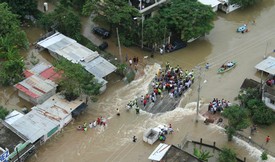 Mondays are usually a low-key day for the Godzwa family. The day after ministry is usually reserved for catching up on household items or replying to correspondence. I had a post planned about the evangelism seminars that we have been leading. But a telephone call from Paul, our mentor missionary here in Mérida, broke the routine. “Dave,” he said, “the situation in Tabasco has gotten out of hand…” The situation he was talking about was the flood that Mexican President Felipe Calderon now calls Mexico’s worst recent natural disaster.
If you have not had the opportunity to see the images of the Mexican state of Tabasco that CNN has been broadcasting, please understand that the inhabitants of this area, which is located about 300 miles from our current location in Mérida, are dealing with a true disaster. Due to unseasonable heavy and continual rain, several rivers have flooded their banks inundating businesses, homes, schools, and churches. News reports put up to 80% of this low-lying state currently underwater. Calls to church leaders in this district have returned reports of lower lying areas completely underwater, of many homes and churches with more than five feet of water in them, and of flooding so high that even people who live on the second floor of a building have found shelter elsewhere because there is no access to their homes.
So to one side moved the household chores and unanswered went the correspondence for one more day so that I could hit the phones to see what I could do to lend a hand to the relief effort being planned here in the Yucatan.
The situation in Tabasco is being described as the Katrina of Mexico. The center-city of Villahermosa is a complete disaster and as a result, those who have been forced to stay behind have nothing. The residents of Tabasco need drinkable water, powdered milk, towels, diapers, canned food, and lots of other basic items. The people of Yucatan are changing their plans to pitch in. Instead of buying food for their family, they’re buying supplies to donate as schools churches and government buildings have opened their doors to accept donations.
Specifically, the church leaders of Tabasco have asked for medical personal with medicines and vitamins to come and offer care. This is extremely important as the floodwaters begin to recede and diseases resulting from contaminated drinking water and inadequate services begin to appear. To respond to this request, God is calling on still others to change their plans. A relief corps of Christian doctors and nurses from Mérida are organizing now to travel in order to provide first-hand relief and the peace of God to those caught in the middle of this crisis. All of these health professionals are sacrificing family-time and their personal goals as they prioritize the needs of their countrymen.
I’m happy to report that my change of plans brought about some tangible results, but a need this great calls out for so much more to be done.
How about you? Do you feel God leading you to be a part of the relief effort?
Comment or email us and we’d be glad to help you with your change of plans.
Photos courtesy of: https://www.flickr.com/photos/kubricka/
Tags: CNN, disaster, Felipe Calderon, flood, relief, Tabasco
 I understand that those who frequent disciplemexico.org are not necessarily interested in baseball, much less in the outcome of the American League Divisional Series. For that reason, I’ve tried to steer clear of baseball subjects throughout the life of this site. Nevertheless, there are several out there who know that I am an avid Yankee fan, and as you can imagine the events that have happened in the course of the past week have left me feeling a bit numb.
Yes, the Yankees lost again. This time manhandled by the Cleveland Indians, a club who just last year wasn’t even sniffing the post season. This of course has had me spending some time looking for ways to deal with another October sans Yankees. You can imagine my surprise when an email from my mother-in-law helped me to put things into perspective.
An avid student of Jewish culture, she came upon a video blog from aish.com titled Isn’t losing wonderful?. In it Rabbi Yaakov Salomon comments on the loss of our beloved Yankees (and the Mets for good measure), suggesting that while “victory teaches you nothing”, “losing can teaching you everything.” He goes on exposit Proverbs 24:16:
for though a righteous man falls seven times, he rises again, but the wicked are brought down by calamity
He states that Jewish interpreters of this proverb suggest that it is not in spite of the fact that the righteous man falls seven times but it is because of the fact that he falls, and the lessons that he learns in the failures, that he rises again.
I think many of us are examples of this interpretation. I know that I, for one, rarely reflect on my victories, but the pain of failure that the sense of loss that follows drive me to determine the source of my defeat and resolve to come back stronger the next time.
So encouragement can be found in the lesson of losing. Of course, now that the Yankees have fallen seven times, I fully expect victory in 2008!
Tags: Baseball, Championship Series, Divisional Series, Loss, World Series, Yankees
The fourth and final in a series of evangelism training classes to be held at Verbo de Dios in Mérida, Yucatán


