May 2006

You are currently browsing the monthly archive for May 2006.

A thing for talking. A thing for taming. A thing for tasting?

It’s funny how things seem to tie together in one’s life, but I recently came upon an interesting convergence of sorts. I was planning for my first Spanish Bible Study, and I was reading in James 3:1-12 where James talks about the tongue as an uncontrollable fire that can burn up our very lives. As I wondering how we could control such a savage beast, Myra, one of our Costa Rican friends, was introducing us to a new dish, tongue! Aha! I said to myself, pull it out and serve it for dinner! Of course, the idea quickly left the table of viable options.

However, As cataloged in one of our classmate’s blog, the tongue of a cow (pictured in Kelly’s hand) is indeed an edible, and actually quite tasty item. It is slow cooked overnight and then simmered in tomato sauce. (Myra used Prego.) The outer covering is removed during the process produce a very soft, pleasant meat.

Of course it may come to mind that what you are tasting may have at one time been able to taste you, but really, how many of us really know what goes into some of the things that we eat…like hot dogs? I highly recommend cow tongue, but if you buy it for the family, be sure to buy a big one, or get two because they shrink when you cook them.

But back to the convergence, the taming of the tongue is a daily process, is it not? We have now been in this stage of language-learning for about 8 months, and one of the more difficult things I have dealt with has been the phonetics involved in producing what I want to say. In Spanish a word with the same letters and different accent can have a completely different meaning. Also, words like “aeropuerto”, or “inmediatamente” were just a challenge for this Gringo to master. At times I’ve wanted to ask where I could buy a Spanish tongue so that I could trade it out with my American one before heading into class, but I have realized that there is no shortcut to pronunciation. It takes time and patience in order to speak correctly a foreign language.

So it is with God’s process in taming the words that we say, be it in out native language or a foreign one. We must admit that we need His intervention to pull out some of our cynicism, sarcasm, and complaining. It is a decision to allow Him to do his work, but it is also a process that takes time and a continual dependence upon the work of the Holy Spirit in our lives. I have more to say on this in my Bible Study (in Spanish).

So there you have it: The tongue: a thing for talking (in languages foreign or domestic), for taming (through time and the work of the Spirit), and, as long as it is tongue of cow, a thing for tasting!

It Lives!

You may have remembered my casualties post, in which I had written about my Pocket PC that met its demise when I fell on it during a practice for the Luis Palau outreach earlier this Spring. Well, it lives again!

Proving that God indeed cares for the details in life, I had thought about purchasing a new screen for the PC after the fall, but the price, nearly $150, the hassle that is involved in shipping anything overseas, and the fact that Kelly philanthropically donated hers to me made me put off the purchase. I put the unit aside and put it out of my mind. On the desk it sat, unusable until our children decided it was time again to explore.

Rebekah, Joseph, and Jonathan are adventurous types. They would rather be anywhere but in their own home. So when Uncle Garritt and Aunt Tara* arrived home, they decided that they need to go upstairs to “see” their apartment, even though they had seen it many times before. The permission granted by the Kenyons allowed the kids to hang out in a different place for awhile, but it also gave the adults a chance to talk.

Garritt likes technology and gadgets abound in his apartment. Blessed with new iPods before coming to the field, he “just happened” to have a Dell Axim x30 that he wasn’t using, not the same exact unit as the one I broke but with the exact same screen. I told him of my situation, and he offered it to us free of charge. So after about 30 minutes of wrestling with both units, I was able to swap the screen of the lesser, functioning model for the screen of my non-functioning unit, and, as the picture shows, the old friend is resurrected!

That a replacement part for my specific Pocket PC could be hand delivered free of charge to Zapote, San José, Costa Rica to our apartment complex is absolutely a miracle. Situations like this remind me that God is truly in control of the big picture and the details as well.

*In A/G Missionary Culture, adults in the missionary family are called Uncles and Aunts by the missionary kids.

Technorati Tags: , , ,

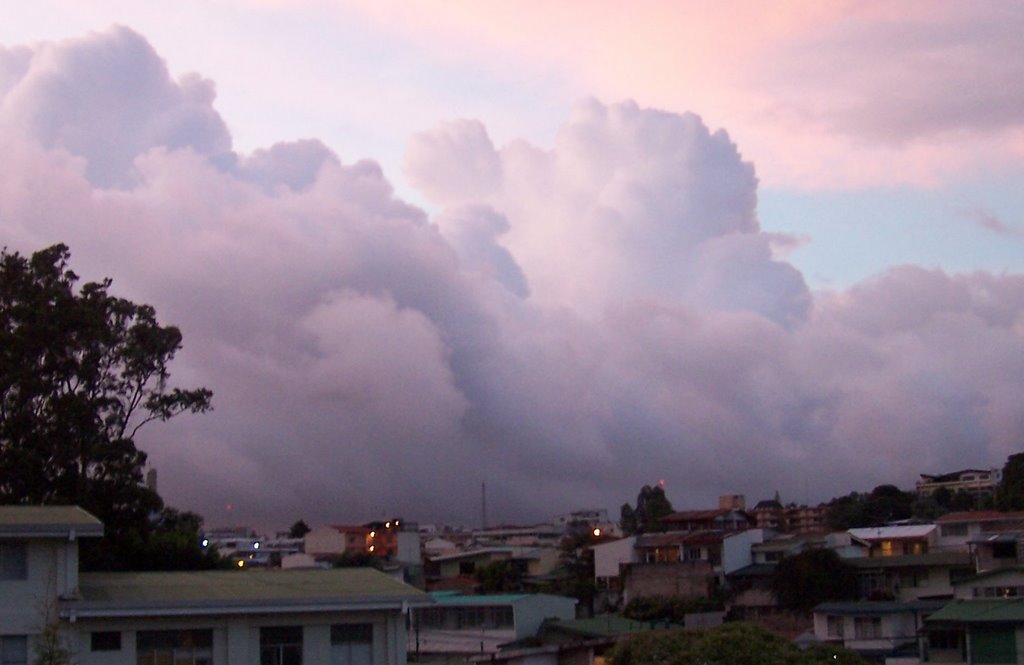
As I had mentioned in a previous post, the country of Costa Rica has only two seasons, the wet and the dry seasons. We have enjoyed about 3 months now of dry sunny weather, but for the past week except for yesterday, it has rained every day. The picture above is a view of the storm clouds rolling in once again.

It’s funny how the changes in the weather can bring about a thoughtful attitude, but activity in the blogsphere has helped push me into a pensive mood as well. A post written by Amy Maxwell has caused me to think a bit about our lives as Christians, and how we view our relationship with God. Her question was a question about how we pray. Amy, along with her husband Joel, is now in the process of a personal storm of trying to pay off the debt of a failed business, and she asked:

Should we pray for sunny days? Praise God IN the storm? Praise God DESPITE the storm? Praise God FOR the storm?

This isn?t just a word game. These are drastically different ways of looking at and dealing with life.

It struck me as an interesting question, and many of us, out of our experiences or studies would be able to respond stating the method we feel that is correct or that more suits our personal style. However, I felt compelled to respond in a different way:

My opinion is that, for questions like these, it is best to turn to the prayer book of the Bible, Psalms. In it we see all kinds of prayers that may not fit with our personal style. There are prayers of questioning, prayers of frustration, and prayers asking for God to bring judgment. Also, there are prayers of praise and prayers that ask for God?s blessing.

What does this teach us? That there are some prayers that are better and some that are worse? I think no. (Perhaps there are some that come from a more mature understanding of God?s ways.) But I think that the important point that Psalms makes is that we should pray. Praise in the good and bad. Pray for God?s peace and blessing, and sometimes just pray in such a way that we spill out everything that is in us before Him.

Sometimes what comes out won?t be pretty, but in all of our laughing and crying, praising and (perhaps) cursing, words of faith and frustration, I believe that God is working something out in us through His Spirit, and we are telling Him that He is more than a heavenly vending machine. He is our perfect, heavenly Father. And, who knows, when we are done, maybe He?ll have time to say something to us.

You see, I feel that we as Christians spend so much time on how we should pray that we fail to actually take time to pray. This is evident even in some of the new, and might I say, well though out missionary blogs that have popped up on missionary-blogs.com. Both The M Blog in this post on Trinitarian Theology and RTBM in “Returning to Biblical Missions” question our methodologies and challenge us to take a new look at our dependence on the Spirit. How better to do this but to bend our knees in prayer?

Who knows, maybe this post was something I needed to write simply to air out some thoughts, but perhaps this question of this mother of 2 in Springfield and the thoughts of two veteran missionaries will do what it did to me: reignite a desire to pray!

Technorati Tags: , , , , ,

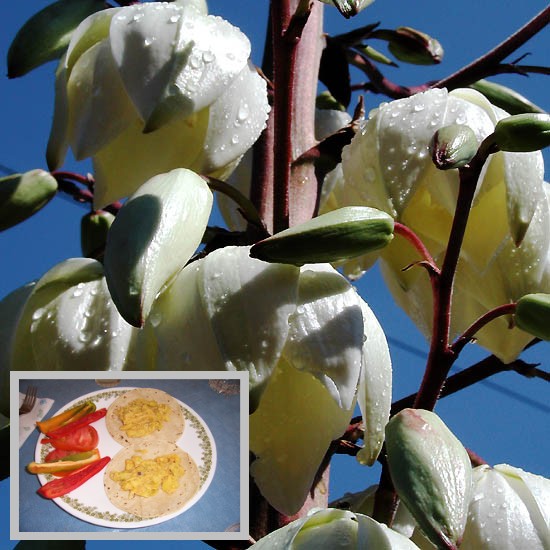
Have you ever eaten a flower before? (No, I’m not talking about the couple of dandelions that you may have swallowed as a child) Well we just had some for lunch!

Here in Costa Rica, a white flower that grows on the Itabo tree (shown in the large photo) is now in bloom, and, on many street corners and country roads, one can see vendors selling bunches of these. Known as “The Flower of the Dead” in Nicaragua, this flower is a regular meal here in Costa Rica.

Our friend Mayra had us get some from the property of CINCEL in order to make what is shown in the inset picture. The green, bitter part is removed, and then the flower is boiled with potatoes before frying with eggs, onions, some pepper, and salt to taste. The resulting mixture is then placed over tortillas in order to make a delicious “gallo”, or snack served over a corn tortilla.

Reactions were mixed here in the household. I enjoyed the meal, eating four of the gallos de itabo. Kelly and Rebekah as well commented that the food was delicious. Jonathan ate all of his, without asking for seconds and Joseph had to be told to finish. All in all, I would rate it a success but designed for more mature taste buds.

Interested in seeing some other interesting dishes? Head on over to missionary-blogs.com to take a look at The Kautz Family Blog’s enty: “La-la-la Lengua

Technorati Tags: , , , , ,

Cinco de Mayo, the holiday celebration that com- memorates the Mexican victory during of the Battle of Puebla, has passed without even the thought of a Mariachi band as pictured in the post. In fact, here in Costa Rica, we had let the day slip until Anthony Scoma, a pastor friend from Texas reminded us. (BTW, Anthony, the Yankees won last night. It wasn’t pretty, but they won!)

Still, we didn’t let the day pass without celebrating. We had the opportunity to celebrate with a Tico (Costa Rican) family who had invited us over for a cafecito. A cafecito is a light meal that takes place as early as 3:00 PM and as late as 5:00 PM, in which there are snacks, sandwiches, and some sweets, and of course, coffee! We had a wonderful time speaking in Spanish for 4 hours as the kids played through the house. Times like these help us realize how far we have come since arriving in Costa Rica back in August of last year.

It is a satisfying thing really. Language school is a transition time, and it is easy to focus on the field so much that we fail to identify with the culture and the people here in Costa Rica. We are glad to have been a part of the lives of so many Ticos, who through their generosity have welcomed us into their lives. The sad thing about it all is that just as we have advanced in our language skills to the point that we the opportunity to form relationships with others, we are looking forward to leaving Costa Rica in 3 short months. Still, we’ll choose to enjoy the time and the relationships that we have.

Update: 5-07-2006 Andy Raatz A/G Missionary to Moldova has some thoughts on transition here

Photo Credits: Java Cafe (2006). Mariachi Dreams. Retrieved 05/06/2006 from https://www.flickr.com/photo_zoom.gne?id=93107466&size=m

There is a saying in Costa Rica that reads, “Lunes ni las gallinas ponen”, which means On Mondays, not even the hens are laying. We certainly can relate to Mondays in that way. With all of the activities and projects, it sometimes seems like we need another weekend in order to rest from our weekend. For this reason, it is important to start off with a good breakfast to get our energy going, and on days like today, Costa Rica’s national holiday of Labor Day, we have the time to prepare it.

For starters:
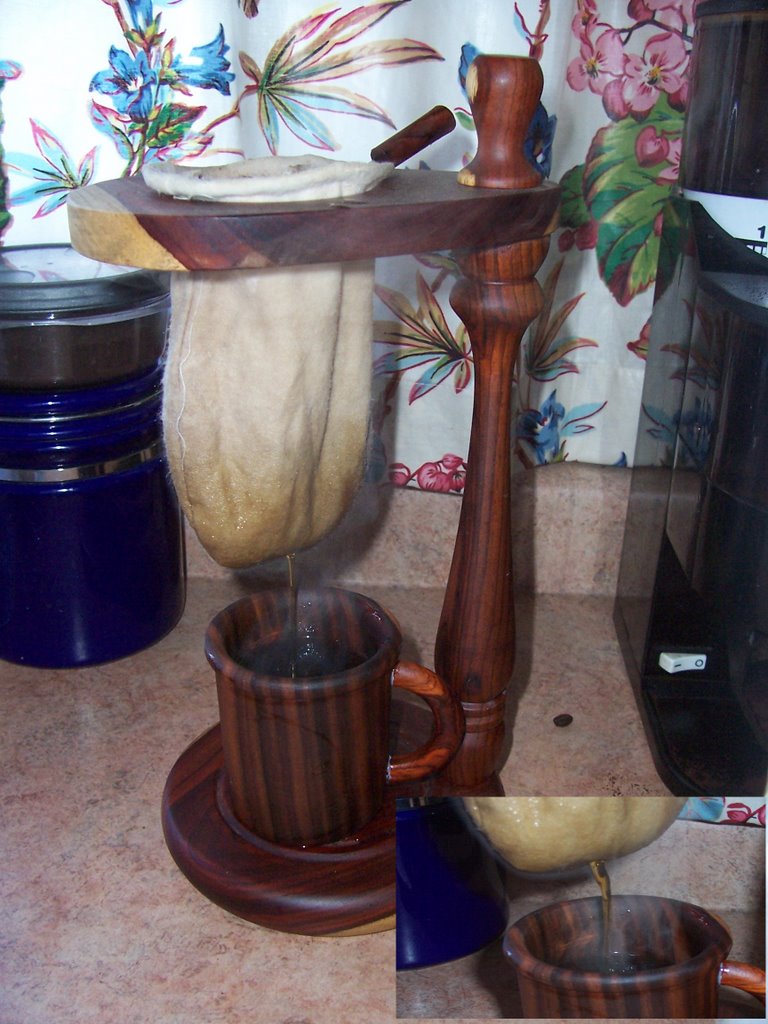
Of course, no breakfast is complete without a good cup of coffee, but how to prepare it? Prepare it Costa Rican style, café chorreado. First, you need a chorreador, the coffe maker pictured in this post, which essentially is a cloth bag suspended by one of a various arry of wooden frames. I picked up what I thought was a fairly attractive one for about $12. The coffee, ground fairly fine, is placed in the wet bag at the desired strength. (I prefer 2 tbls. per 6 oz. of water.) Then, water, just off of the boil, is poured over the grounds slowly, so as to create a stream, or “chorro” from the bag into the cup. The result is a fine brew that allows the natural oils of the coffee to pass through to the cup. And although many Ticos have switched to the “coffee maker” because of convenience, the choreador is still the most repected way to make coffee.

The main course:
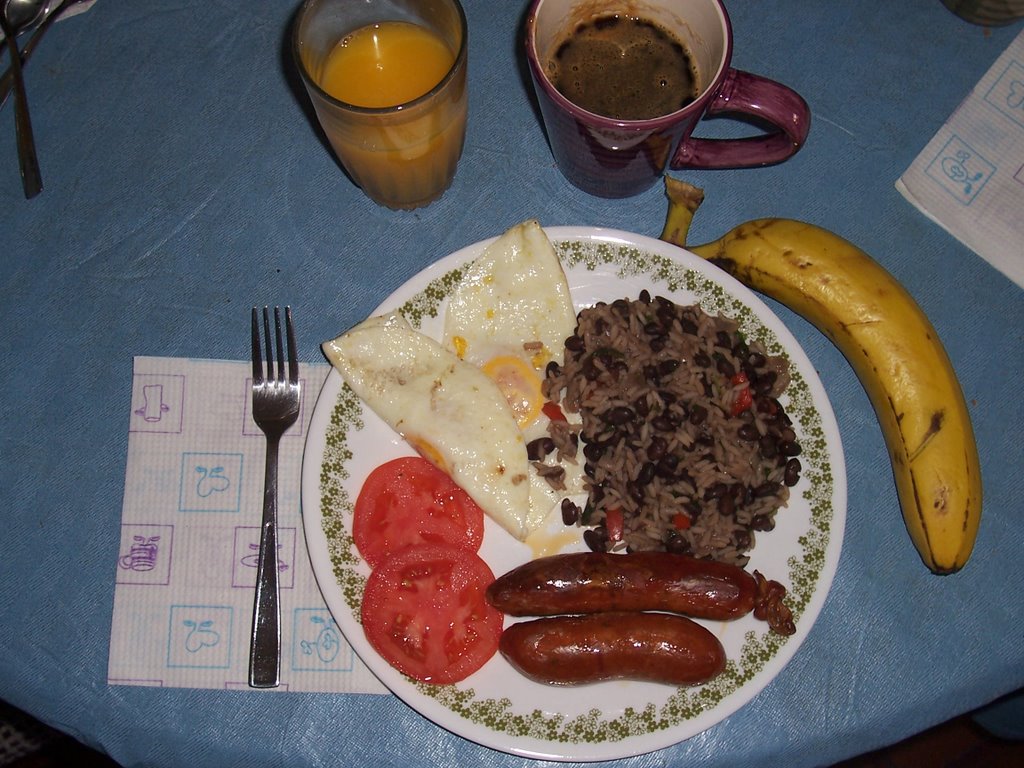
OK, the coffee is taken care of, but what to eat? Gallo Pinto of course! The traditional breakfast food of Costa Rica, Gallo Pinto consists of beans, (normally black) and rice to which is added cilantro, bell peppers, onions, and the top secret ingredient, Salsa Lizano. A truly Tico flavoring that gives gallo pinto it’s charateristic taste. Added to this is usually eggs, the tomato for color, and in this picture, some Mexican chorizo or spicy sausage. We added it to give the meal some Mexican zing. (We are missionaries to Mexico.)

So there you have it, a good Monday morning pic me up. Sorry that this came on Tuesday for those of you who are subscribing via email.