Articles by Dave

You are currently browsing Dave’s articles.

During our time on the itineration trail, we had the chance to share with some groups that missions is a world-wide mandate, that God is calling people from everywhere to go everywhere in His name. We have several examples of this reality here in the English program at CINCEL, people that have been called from nations traditionally classified as missionary receiving countries. One of those examples is Jaime Chacon.

Jaime, together with his wife Jacqueline have responded to God’s call to go to the United States. They will serve South Carolina and the surrounding area by spearheading an effort to raise up missionaries, first to reach the expanding Hispanic population in the region and then to train those who would respond to go to the world.

Jaime and Jacqueline are slated to begin their first term in the U.S. in January 2007. Their main focus will be the creation of a district-wide missions department which will assist with church planting among Hispanics, and then be available to train missionaries called out of the region.

Called into missions at the age of 17, Jaime felt a burden to reach the Arab nations, but as he followed the leading of his heart, it became clear that God was redirecting him to the U.S. to train others who would go: “I believe,” said Chacon “that God blesses those nations that send missionaries, It is our desire that The United States continues to receive that blessing.”

Some interesting facts about the need for Hispanic missionaries to reach into the U.S. from other countries:

  • Hispanics make up the largest ethnic group in the U.S. By the year 2016 they will make up 25% of the total population.
  • These Hispanics living abroad, many thousands of miles away from family and friends are open to the message of the gospel as never before.
  • Hispanics, in some instances, have the ability to go to countries that are closed to U.S. missionaries.

Our latest newsletter is now available on-line in PDF format. Just click on the image, or here to read about:

  • La Tarea
  • From the Family Side

and more!

I was working in the kitchen by the window that overlooks the cul-de-sac between CINCEL and our house, when I saw an ambulance arrive. Concerned that there might be some kind of injury in our park or some kind of emergency, I watched as it came to a stop outside our gate. However, imagine my surprise, when the door opened to reveal teenagers passing out phonebooks.

Yes, things are different here in San Jose than in the U.S. Some other differences include:

  • You have to ask for the bill here in any restaurant. If you don’t, you could be waiting for it the entire night.
  • It is extremely impolite to throw anything. If you need to pass something to someone, you need to hand it to them or have another person pass that object.
  • There are no area codes in Costa Rica. All phone calls to every part of the country are local calls.

I’ll add more to this list as differences come to mind.

A passage I love

In the past weeks I have joined a sort of community of evangelical missionary bloggers whose blogs can be found at www.missionary-blogs.com. I felt that this was a wise move as I wanted to be exposed to what the evangelical community is doing as a whole in regard to mission, and be able to communicate to a broader range of missions prayers, thinkers, and doers (sic.).

Of course part of being in a community is one’s participation in that community. That being said, Jim, the coordinator of the effort has asked us to write about a Bible passage that has been particularly significant in our lives. This is part of an effort to encourage our readers with the Word. Therefore, I have decided to write about Galatians 2:20:

“I have been crucified with Christ and I no longer live, but Christ lives in me. The life I live in the body, I live by faith in the Son of God, who loved me and gave himself for me.” (NIV)

There are several reasons that I love this verse:

1. It speaks of the crucifixion, one of the central messages of the Gospel. The Son of God came to earth to die, taking our sins so that we could be acceptable to the Father. No matter how much I reflect on that concept, it never fails to move me.

2. It speaks of the newness of my life in Christ. It is no longer David Godzwa, the angry, hurt, young man, dealing with the pain of a split household and his own feelings of inadequacy who lives. That boy has died with Christ. Alive now is the man who has found his identity in knowing God and being known by Him, and the peace and security of a relationship with God has allowed me to move in forgiveness, and to live a life that seeks the good of others instead of operating from the pain of past wounds.

3. Finally, it reminds me that, although God’s love is big enough to embrace the whole world (Jn. 3:16), it is also specific enough to touch each person exactly where he or she might be. God loves me. Yes, “For God so loved the world…” but God loves me. I might be insignificant in the eyes of those around me, but God thought that I was important enough to die for.

Costa Rica held its presidential elections this past weekend, an event that occurs here every four years. There were 14 parties (sample ballot) that were running for a chance at the executive post, but, as it is in the United States, only two contenders, Óscar Arias of the National Liberation Party and Ottón Solís of the Citizen’s Action Party had realistic possibilities of winning the election. As of early January, it seemed as though the race would be extremely one-sided, but the elections turned into a dead heat in the final days with Arias falling while Solís gained support. Still, no one was prepared for what happened at the polls on Sunday.

Turn out was lower than normal, with about 36% of those registered abstaining. The streets, normally choked with voters going to the polls were virtually quiet until the late afternoon, but inside the booths, events were happening that would have people talking for years. Because, as it stands now after 90% of the votes have been counted only 3,429 votes separate the top contenders. With the separation this close, The Supreme Elections Tribunal is now begining a manual recount of the votes. (Sound familiar?) The difference here is that there is no Electoral College here in Costa Rica, the president is elected by gaining at least a 40% majority of the popular vote. So, if the margin of victory is only one vote between Arias and Solís, the man with the most votes wins.

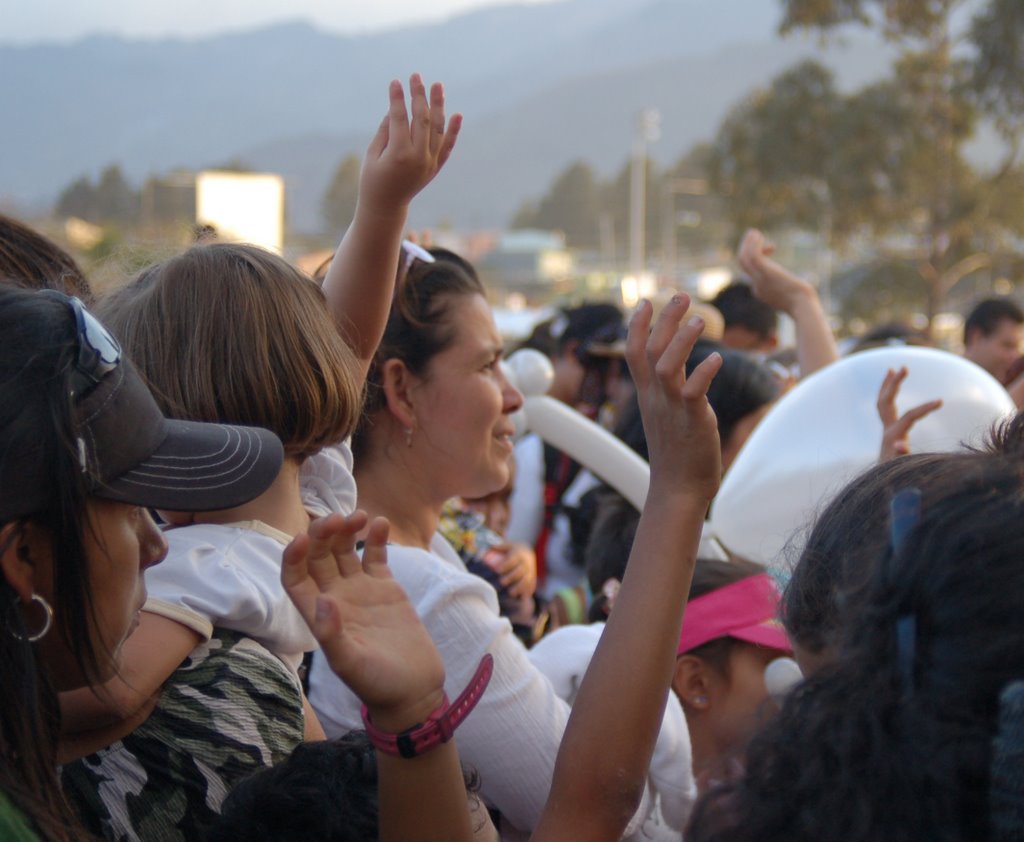
We got a chance to drive through the city on Sunday to view the event with Costa Rican missionaries, and as you can see from the pictures in this post, the people tend to identify with their candidate a bit more than we do in the States. In fact, Election Day, being a Sunday, takes on the air of a festival, with vendors on the streets and people going about displaying their alliances. The only difference is that this is a decidedly dry holiday, as no liquor is sold from Friday until Monday morning, a measure taken to force poll-goers to make sober decisions. Still, as the count went well into the night, with no clear winner determined, several went about their Mondays “hung over” from the indecision of Sunday night.

Coffee is more than a morning beverage here in Costa Rica. It is the product that transformed this country into what it is today. In the 1800s when coffee was first brought to Costa Rica, this country was a small, remote, unimportant part of the Spanish Empire. But when coffee was introduced, the people found that the product flourished in the rich volcanic soil and high altitudes that were readily available.

The superior product soon created a demand, and the Costa Rican government, wanting to speed production, provided incentives for farmers to begin to cultivate coffee. Not only did this bring about the Costa Rican coffee industry that is know world-wide today, but it also created a strong, independent middle-class that has hosted the 2nd oldest democracy on the continent. (US has the oldest.) For Costa Rica, coffee truly is the “bean of gold.”

The students and faculty of CINCEL recently took a trip to Britt, one of the most recognized producers of coffee here in Costa Rica, in order to gain a bit more appreciation for this wonderful drink that has played a large role in the shaping the Costa Rican culture.

Click on the picture to the left, or here to view the photos of the tour.

Tags: ,

If you’ve gotten a chance to look at our About Us page, you know that we are headed to Merida, Yucatan, Mexico, which is the gateway to some of the Maya people’s most popular cultural sites.

Well, I was going through the aggregator at missionary-blogs.com, when I came upon something that just couldn’t wait to be shared. It seems as though a piece of American Culture emanating out of the city of Atlanta Georgia has been so wholeheartedly embraced that it has now become part of a religious ritual.

This Mayan Coke Ritual explained in this video blog shows Coca Cola being used as a sort of “holy water” during a Maya ceremony. Finding this a bit hard to swallow (pun intended) I did a bit more searching, and found this Newsweek article on this same phenomenon. I guess that this is an example of globalization at its finest and a glimpse into the Maya mentality.

Again, here is the Maya Coke Ritual Video at cotrillcompass.com
and here is the Newsweek article

Tarea

Tarea (f)

(Spanish) Work that needs to be done in a limited time (eg. homework)

Homework has been the key word for the past few weeks here in Costa Rica as we continue through our second trimester at CINCEL. And as you can see from the stack of books, there won’t be any let up in sight for a while.
This picture represents the books that we are using during our courses, and each comes with it’s own particular set of tarea. So in addition to the 4 hours of class time that we have each day, we have been working with at least that amount of homework. Add to that the time that we have to spend talking with people on the streets of San Jose, and that makes for a full day!

But this isn’t a post to complain, no it is much more to express our gratitude for the deadlines that God gives to us. I have found that we have a tendency to work better when there is a time frame set in place. So it is with Spanish study. There have been several times in our lives where we have wanted to involve ourselves in learning Spanish. The desire was real, but the deadline was never set. Now here in language school we have the motivation and, for sure, the deadlines. The wondrous thing is, with God’s help, those two elements have combined to result in some tremendous progress. Now for certain, we have far to go, but to be able to understand and to be understood in a foreign language is indeed a tremendous blessing. So the next time that God assigns you tarea don’t look at it as a time to cringe, but rather as a time to grow!

The Feria

Where can you get fruits and vegetables unbelievably cheap and fresh, feed the entire family breakfast for less than $9.00, and get a lession in culture at the same time? The supermarket? No, you need to go to the feria.

Each Saturday and Sunday in Plaza Viques in Central San Jose, and in Zapote, east of San Jose there are ferias, or open air markets, where you can take in the sights and the sounds of the everyday life of the Tico people.
There are farmers selling everything from ajo (garlic) to zanahorias (carrots), chanceros selling lottery tickets to the passersby, and artisans selling handmade jewelry. You can hear vendors yelling prices and people catching up on the latest news and opinions of day in the various stalls along the avenues. Among all of this is the smell of typical Costa Rican food like gallo pinto(beans and rice) and of course coffee! (Unfortunately the booth we stopped at only sold coffee with sugar.) All of the produce that is grown in the country can be bought at the feria.

We had the opportunity to drive to the feria this weekend with the kids and take much of what it had to offer. We came away with full stomachs, great strawberries, watermelon, and carrots, money left to spare, and a new perspective of life here in Costa Rica.

The New Year has begun with a bang, literally, here in San Jose. It all started with a get together in our house, where the language school students, as well as several of the resident missionaries rang in 2006 with some highly competitive games of UNO Attack and Cranium , as the kids stayed up to celebrate amidst the explosions of bottle rockets and firecrackers throughout the neighborhood.

Following a groggy first, I drove for the first time here in San Jose (good thing I had a license), practicing in order to get the new students arriving on the third to the grocery store to pick up their first round of necessities. Following a slight detour onto the autopista, we were able navigate successfully thorough the streets of Curridabat and Zapote, arriving at our house a little wiser, and perhaps older from the excitement.

The new students arrived on the third, full of excitement and wonder as they hit the tunnel leading from the airport and into the Costa Rican night. Memories rushed back of our first days here. It is hard to believe that it has been 4 months since we’d landed. Among the arriving students were Josh and April Amiot and Peter and Delia Breit, fellow missionaries to Mexico, and we got to pass along the favor that Missionaries Mark and Sandra Smith did for us as newbies here at CINCEL.
Some other items:

  • The trimester starts tomorrow with a welcome lunch. We begin classes on Tuesday morning.
  • Mike (my twin brother) was mistaken for me during the World Missions Summit you can read about his experience at his blog.
  • We tried for the second time to view the crater of the Volcano Poas, but we were unsuccessful as the clouds kept us from reaching the top. We did stop at the Tres Generaciones coffee plantation again, this time for the tour. We’ve added more pictures to our coffee collection for your viewing pleasure.
  • Kelly updated her blog with more about the kids and the goings on in the Godzwa household.

« Older entries § Newer entries »