Devotional

You are currently browsing the archive for the Devotional category.

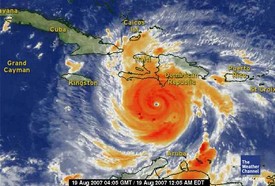
Hurricane DeanFor two Mid-Atlantic transplants living in the Midwest, hurricanes were at most a thing of curiosity. They were the stuff of late summer Weather channel reports. Devastating and cruel to be sure but never in our version of reality. They were events that happened to others. All of that is changing in the face of the now Category 4 Hurricane Dean.

As I am writing this update, Hurricane Dean is now bearing down on Jamaica, and all of the projections place its trajectory directly across the Yucatan Peninsula and the city of Mérida. The entire state of Yucatan is under yellow alert meaning that preparation on everyone’s mind as shoppers filled the supermarkets stocking up on canned food, water, and medicine.

Here in our new home as well we are preparing–determining areas of safety, and trying to make our plans, but even as we plan, we are faced with a mountain of uncertainty and where there is uncertainty, not far behind we find fear.

In all of this I am reminded of that tumultuous voyage of Jesus’ disciples across the Sea of Galilee in Mark chapter 4. There there were being tossed about, grown, sea-hardened fishermen uncertain if they would live or die. As they woke Jesus, who had been sleeping on a cushion, they wondered aloud if he even cared about them. In their fear, they’d failed to recognize that he was the one who had ordered them to set sail in the first place. The storm, more than the setting of a miracle, was their opportunity to recognize that, even though they went through the valley of the shadow of death, they had nothing to fear because with them was their shepherd.

Pray for us friends. Pray for our safety and for the safety of friends in harm’s way. Pray too though that we won’t fail to recognize the presence of our Good Shepherd as we wait here in the gaze of Hurricane Dean.

ISUM SmallThe close of June brought about the end of ISUM, the month-long ministerial advancement seminary held here in Mérida. As we near mid July, I’ve had some time to reflect on the experience and think about my re-entry into the normal missionary life.

ISUM is known by it’s grueling schedule and intense homework. The deadlines seemed to stack on top of each other as we prepared for 5 class periods each evening. Exhaustion was our common enemy as we fought back sleep in order to complete all of our tasks. Still, the struggle had a comfortableness about it. Being a to-do list writer, I found great satisfaction in marking off each assignment as I completed it, and although I routinely hit the pillow around 1:00 or 2:00 AM I did so with a feeling of accomplishment.

The return to normalcy, although less demanding on the schedule, didn’t come with the neat guidelines. A team to receive in late July, finding a house to move into by the middle of July, a youth retreat in August and the accumulation of work needing my attention while I was in ISUM each bring conflicting priorities and a collective clamoring for attention. There are no convenient class plans to follow and no instant feedback in the form of quizzes and tests along the way. These realities pose a problem for my order hungry mentality.

I would say that this may be the life that we all lead. We shout for independence as a youth, but we long for the simplicity of our childhood as adults. We have arrived at the place where we are free to determine our lives but we tire of the responsibilities, the leadership, and the need to hold everything together, and we long for someone to just tell us what to do.

And yet, this is our situation in our walk with the Lord. We face difficult decisions daily. We pray with fervency for direction, but rarely does the answer come in the form of a carefully worded class syllabus or a turn-by-turn Google Map. It’s then that we need to apply the knowledge that we’ve learned in the School of the Spirit of God’s Word, when we need to move from the parable to the person on the street, and that is where we most often fail.

The disciples coming off of a successful tour of ministry, casting out demons and healing the sick, failed the test of the Lord when facing the need of the multitude. “You give them something to eat,” he said. They reached for their calculators instead of their faith. Lk. 9:13

So is our daily struggle, rarely hectic to the point of the exhaustion of ISUM, but rarely as neat and tidy as the daily plan of activities that we received for each class. Still I’m glad we serve a patient Lord. Jesus did come through for the disciples. And, as we continue in our daily training, being formed into more into the image of our Master, I’m glad to know that our rate of success increases.

Erie Merida ConnectionI’m prefacing this post by saying that I’m not one of those people who routinely says “The Lord said to me…” In fact, even when I feel that God is impressing something on me I like to start with the words, “I feel that the Lord is moving me in this direction..,” or “I feel that the Lord would have us…” It is something that Edgar Lee taught us in seminary as a way to offer up our words for the biblically mandated scrutiny of the church, or as the case may be, my wife. So when we experience “coincidences,” I like to offer it up for the opinions of others, in other words, I’m fishing for a few comments.

We had little choice in where we would end up in Mexico. We are first-termers and AGWM, our missions organization has taken to the practice of mentoring all new missionaries. This involves pairing the missionary with another veteran in order to assist them in the transition and the development of their ministry on the field. Because education was to be part of our portfolio, we were paired with Paul and Sandy Kazim.

Paul an educator with 10 years experience in Latin America, was stationed at the time in Villahermosa, Tabasco, but was looking to relocate when he started his new term. There were several options available. Butch Frey, our Area Director had mentioned Veracruz, while Paul and Sandy were looking as well at Mexico City and Mérida, where we are currently.

Paul had discounted Veracruz from the beginning. He didn’t feel that the city was where they needed to be. However, Mexico City was, for him, a viable option. The city was easily accessible by plane, and his travel plans for his upcoming term made this a desirable feature. Of course, there was the problem of what to do once you’re off of the plane. Two hour cars trips as a regularity didn’t excite either Paul or me. On top of this concern was Joseph’s tendency toward asthmatic symptoms which made Mexico City’s famous smog look indeed like a gray cloud on our horizon. Still, we were determined to see God’s direction in our location.

Then Kelly talked to me about a premonition that she had had. It wasn’t a dream or a vision per say, more like a feeling. She told me that she saw us working with indigenous people. Those whom we in the US popularly refer to as Indians. Mérida, one of the famous ancient centers of the Maya civilization, was filled with such people. I filed this in the back of the mind, but I also mentioned that we would have to reach an agreement with the Kazim’s when it came to the place that we would select.

Still, an opportunity came to talk about this premonition that Kelly had. Over the phone with the Kazim’s, Paul resonated with what Kelly was saying, and, adding this to items we were considering, the scale tipped decidedly in Mérida’s favor.

Now, three years later, we find ourselves here in the White City of Mérida, but the surprises didn’t end there. As I was researching information for a response to an email asking for the history of the city, I happened upon a bit of information.

Many cities select sisters cities in other countries, these are connections that are established in order to foster cultural and economic exchanges. For some time, we were aware that our home town of Erie, Pennsylvania had such a relation with Lublin, Poland, as we would hear several reports of student and governmental trips between the cities. However, I was extremely surprised to find that, listed alongside Lublin, was the White City of Mérida.

What are the chances? Sister Cities International the organizer of such relationships reports on their website that there are over 800 communities internationally participating in this program. Assuming that the selection was done completely at random, it would appear that the odds would be about 17 billion to one. Granted, such selection isn’t done at random. but think about the implications of such a number.

So, was it coincidence that our hometown of Erie would have such a relationship with the city in which we are currently ministering, or is it a confirmation of a divine plan? Whatever the response, it seems fitting that a relationship set up to foster cultural and economic benefits would be expanded to offer spiritual ones as well.

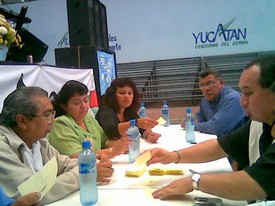
Mesa de EscrutadoresI spent the last half of last week at the Yucatan District council. This 8th District Council in Ticul, a city about an hour south-east of Mérida, included three days of meetings featuring a missions night, where we saw reports from two of the three Yucatan missionaries either on or headed to the field, and the discussion of many items of business. One of those items is pictured above, the election of our district superintendent, assistant superintendent, and treasurer.

I was selected to sit on the “Mesa de Escrutadores” (Table of Vote-Counters), a group of ten pastors and officials that separated and counted each round of votes. I snapped the picture in the middle of the process. Serving as the head of the table was our national secretary, Samuel Vázquez, who is also the son of the senior pastor of our home church. In a fairly tranquil process that lasted only through one morning, we saw all of our current officers re-elected with little to no competition.

While it was good to see our current leadership back in office, it was a bittersweet taste that the council left in my mouth. On the last day, after Silverio Blanco, the director of the Bible Institute, issued a challenging message on the continued need for evangelism in the Yucatan and beyond, an initiative from the District Evangelism Department was struck down. The motion would have appropriated resources to gather information from each municipality in the state, presenting the reality of Silverio’s message and giving the information necessary to strategically target the areas of need. Unfortunately, because it also suggested the investigation of other parts of Mexico, Latin America and the world, perhaps as a comparison, the pastors voted the measure down. Without this initiative, our district may be condemned to fighting blind, seeking to make progress, without touching the real needs.

I think the failure of this motion reflects the failure that we often see in our lives and ministries. Congruence, the correspondence of our thought, speech, and action, is so very difficult to achieve. We say we desire the advance of the kingdom, but we fail to appropriate the time, effort, and resources to go about doing it. We say we want the lost to come to know Jesus, but so often we loose contact with them in our daily lives. We say we desire God’s power, but our prayer lives, weak or perhaps even non-existent, tell a different story.

God help our district, and each one of us in turn, to prioritize your plans, to be the people the you have called us to be, and to truly take an interest in the Great Commission–to go in your power and make disciples of all men.

Topes

TopeThe roads in Mexico are a pleasant surprise compared to the deteriorated byways that we had gotten used to in Costa Rica. We have a wonderfully paved road outside of our home, and it has been some time since I’ve had to swerve like a slalom skier to avoid ramming one of our wheels in a pothole. However, what makes the Mexican driving experience unique are the “topes” (pronounced tow-pays)

Topes are the Mexican version of speed bumps, although an American speed bump can’t hold a candle to a tope. Usually taller than they are wide, they’ll give you a bone-shattering shock if you happen to hit one unawares, bringing about a tongue-lashing from any passenger who just might be in your car. Believe me, it only takes one or two of those experiences to learn to slow down when driving, especially through small towns and neighborhoods.

The big problem with topes is that they are usually in the oddest places. From time to time, you can find them before a busy intersection or at a school or church crossing, but often they’re in the middle of nowhere, and the diamond shaped indication signs usually only give you a few feet of warning before your vehicle crashes into the unforgiving mound of resistance.

Topes, though, have a much larger meaning for the missionary or ex-patriot. The tope signifies the unexpected resistance that we experience as we continue in our work of cultural assimilation. Cruising along a comfortable speed, making strides in language, food, and relationships, inevitably we face topes that remind us that the land that we are in, although each day more familiar, is truly foreign.

We’ve been in Mexico almost 8 months now, and we are comfortably eating the yucatecan food, speaking more aporreado (what is referred to as the yucatecan accent), and building friendships with people in and outside of the church community, but we still experience our topes. Mine most recently has been in the form of our front yard.

Formerly working an 8-5 job in the states, I prided myself with the ability to keep up my front yard. I mowed regularly, trimmed the bushes and spread fertilizer in the spring and fall. Not given to excesses, except one post-season when I mowed the Yankees interlocking NY in the grass, I still felt satisfied in having a green, presentable garden.

Remembering all of this, I fell in love with the small, manageable green space that our current house gave me. I had visions of “working the land” again, and looked forward to the wealth of sermon illustrations that this labor of love would afford me, but the more I got involved in the day to day hustle and bustle of being a missionary in Mexico, the less and less time I had to devote to keeping up the garden.

So, by chance, I happened to find a gardener who could help me at least trim our trees. At less than $17 American, it was a deal that I couldn’t afford to pass up. Then came the tope. Unable to find the same gardener, I asked for a recommendation from our landlord. I contracted one of the two he recommended to trim our trees, this time for what I thought would amount to about $20. The bone-shattering shock came, however, when I realized, after the work was done, that it was to be $20 for each tree. Ouch!

Determined not to fall into the same mistake, but still needing a gardener more than ever, I contacted one after comparing the quotes of our neighbor’s gardener and one other who works in the neighborhood. We were needing help for our heat suffering grass and weed infested flowerbeds. After having negotiated what I thought was a good price, I let him go to work, but soon into the labor, I began to find the hidden costs, $20 more for extra insecticide, $70 for more plants, etc. Can someone say “TOPE!”

We expect blockades in ministry. We anticipate the frustrations that we may have to face in communicating our heart in a foreign tongue, but I guarantee that problems with the care of my front lawn never even entered into my mind. Like topes these complications hit me unexpectedly.

Still, I have to say I’m thankful for my tope experiences. Although they’ve been painful, they’ve slowed me down enough to think about my life and work. They’ve proven to me time and time again, that Dave Godzwa alone can’t get the job done. There needs to be someone else involved with a higher perspective, one who can guide us through even the unexpected situations.

So, although I’m sure that I’ll continue to feel the bumps along this road of cultural assimilation, I’ll thank God for them because I know that they’ll slow me down enough to refocus my vision on Him–the one who’s mapping my course, and who just happens to know where those topes are.

Photo Credits:

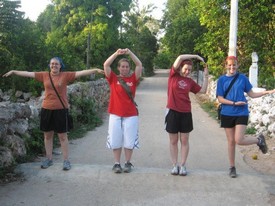
Above: Members of the Chi Alpha Spring Break Missions Team, Julia, Bethany, Ashley and Kelsey spell tope while standing on one. Photo by Bethany Chroniger

In article description: A photo of a common tope warning sign.
We are continuing an ongoing series following the experiences of our first missions team here in the Yucatan

Monday, March 12th

Kelsey PaintingMonday arose with a day of work planned. We were to paint the pastor’s home as they were preparing to tear down the old house standing in the way of the construction of the church. The paint was bought and the team, using rollers, brushes, paint, elbow grease, and Christian camp songs began the work. Little by little the rough walls began to take on their new look. Here you can see Kelsey putting on the first coat. (Unfortunately for us, the paint we used on the first day was totally incorrect, leaving us to repaint what we had done over again, but that is for another post.)

The highlight of the day actually came from a darkened room. An off night of ministry for us, we gathered with the congregation for prayer in their traditional prayer service. When we arrived, however, we were a bit confused. The lights in the church were off. We had thought perhaps that service was canceled. Looking for direction from those in the pastor’s home, we were told that it was the custom of the congregation to pray in this manner. So we entered in to join the many who were already seeking God.

What resulted was impacting. Mike, my brother, mentioned his impression later in this way: When I felt that I had prayed enough, I looked up, expecting perhaps that the congregation would have finished as well, when I realized that they hadn’t, I continued in my prayers the darkness helping me to maintain my focus and the time allowing me to connect with God in a way that our busy distracted lives don’t often allow.

What an irony, that in our week of finding (remember from our last post that our theme was Luke 15) we could actually encounter God in a new way by turning off the lights! We learned in that evening to set aside our i-pods, our power point presentations, and movie clip sermon illustrations for awhile in order to allow God to speak to us in a totally unscripted, unorchestrated way. We also learned that missions trips are not only about giving, but receiving as well. So are you interested in finding God? Try turning off the distractions for a moment and letting Him speak.

Flicker Photo by KogakureIt’s very rare that a movie gives me pause for thought, but those that do usually keep me thinking for some time. That is what happened last night as we settled in to watch a library-borrowed copy of The Bicentennial Man. The film, starring Robin Williams, starts off as a whimsical story of the adjustments of one family to their android helper “Andrew.” However, it takes a dramatic turn into realm of the metaphysical when Andrew begins his quest become human. The interesting point of the movie is that the immortal, self-maintaining Andrew does what most would seem to think ridiculous. He decides to make himself mortal in order to truly share in the human existence and embrace those that he has not only served, but come to love.

Of course, the Christian parallels are obvious. Christ himself shed his omnipotence in order to die in the the place of those that he loved, but I was moved to think from the other perspective. My humanness of late has been real drag. Since we’ve made it back from Mexico City, I have been struggling with a sinus infection, my personal nemesis. I have tried to take care of my work responsibilities, my correspondence, and keep up with my kids, only to see my energies wear out long before my list of to-dos. The aching head and stuffy nose seem like anchors against which I have to struggle an inch at a time. There have been many times when I wished that I could trade in my faulty pieces for robotic upgrades.

Still though, it is funny how God chooses to use our imperfection, our humanness, to work our his purposes through us. I was at the Salvador Alvarado stadium, watching our kids in the track program, when I struck up a conversation with an externally happy but definitely hurting parent. Our conversation started with the everyday, but moved quickly to his disintegrating marriage. He told me that he was hanging on only for the sake of his kids. Reflecting back to the pain that I felt in the midst of the divorce of my parents and the way that God has helped me to recover and rebuild my life helped me to offer him help in finding a way forward through his pain. God used my dysfunctional past, my human experience, in order to minister in this man’s present situation.

How often are we touched by the testimony of determination through pain, triumph over adversity, or recovery against all odds? I am personally encouraged as I watch the progress of Joel and Amy Maxwell, friends who through the grace of God has been overcoming what many would say impossible odds. Parents of two, they are renewing their lives after their humanness led them through business failure and personal debt to Officer’s Basic Training, military deployment and renewed purpose.

The power is not in our perfection, nor in the facade that we might choose to display. It is in the intersection of our imperfection, our weak human condition, our story, and God’s amazing grace that power is displayed to those around us. Like Paul says in 2 Cor. 4:7: we have this “treasure in jars of clay.” We show the reality of God’s power through his redemption of our brokenness, and, as we continue to allow him to work in our lives, he takes our brokenness and makes into something beautiful.

I don’t know how this sinus infection is fitting into God’s plan just yet, but I am certainly glad for the chance to reflect with thankfulness on God’s intervention in my humanness. I guess I’ll delay that order for those artificial lymph nodes.

Habits

PerfectionistLooking out across the blog sphere, there are a lot of people currently writing about habits. My brother, Mike, is talking about his running and how that relates to keeping New Year’s Resolutions. Jim Cottrill, the host of missionary-blogs.com, himself a missionary to Mexico, is talking about Tim Horton’s and the coffee habit. With this “great cloud of witnesses,” writing, I too felt the inspiration to write about habits but not necessarily those habits that we see in our daily routine. Instead, I’d like to talk about those ways of thinking that routinely determine our attitudes and actions as we go about our daily lives.

I tend toward an anal retentive personality, a tendency that has seemed to grow stronger over the years. One case in point: As we were decorating for Christmas, Kelly had purchased stockings for the kids. They were hung from our railing that leads to the upstairs bedrooms. (No need for a chimney here in Merida!) The railing has a design of bars and decoration along its span. When the stockings were hung, I noticed that we could use the design of the railing in order to space the three stockings evenly. For even spacing there was something like 5 bars between each stocking. So, I moved the stockings so that they would reflect this evenness. This of course prompted each of our children, partly to annoy and partly to exert their own sense of style, to rearrange the stockings themselves, resulting in a game that lasted until December 25th.

This tendency of mine also bleeds into other areas of my life. I tend to spend hours cleaning up the details in order to present a cleaner kitchen, a tidier garden or perhaps a more complete presentation. Still, although this attention to detail has its benefits, there are detriments as well. Like the despair that I can face when I lack the time or the resources to make everything come out the way I want, or perhaps the inertia that I have to contend with at the start of a project when I feel that my efforts might not be up to the task.

As a missionary as well, this habit of mine can cause far reaching problems: J Oswald Sanders, the author of the Book Spiritual Leadership reported that the leaders of one mission asked that their missionaries be more coaches than players, modeling and teaching rather than taking up front roles in the work. This kind of thinking is difficult for people like me to live out. Sometimes I find it hard just to let our children undertake a simple task like set the table. How much more difficult will it be for me to hand over a job with eternal consequences, especially if I feel that I am the most qualified to do it. I have heard others say that they’d never hand their work to a national believer. They have their reasons, some of them very good, but if we are truly to fulfill the Great Commission, do we have the luxury to hold on in this manner?

I think that Jesus can be a model for people like us. Himself perfect and surrounded by perfection, he decided to live here on earth with a group of 12 fishermen, zealots, and tax collectors who routinely failed to live up to his expectations. No one would have faulted him for abandoning this bunch at the first chance for some more promising candidates, but he pressed on with them–teaching, modeling, and giving them hands on experience in what it meant to work with God. The 120 in the upper room on Pentecost Sunday might have seemed to be a paltry showing for three years of arduous ministry, but these would prove to be the first-fruits of the church that would go on to affect the entire known world in the span of a generation. Could we hope to accomplish anything greater than this?

Habits. We try to create good ones and destroy bad ones. This New Year this missionary will be trying to conquer my perfectionism, my desire to be in control of the results, and dedicate myself, like Jesus to raising up men and women, disciples, that can carry on the work and in fact have a greater impact than I could ever imagine. Pray for me. I just added spell check to my website. It doesn’t seem to be a sign that this change will come easily.

Guy Muse who writes the M Blog, has started a series on what God is teaching him these days. In part from his inspiration, and in part from the events of this past week, I’d like to chime in and share what God has been sharing with us these days.

Sometimes it takes more than one teaching in order to learn a lesson.

Jonathan went to the hospital last October in order to correct a congenital hernia. Those of you who have been reading this blog may remember this post about the event. He had the operation which corrected the problem, and one would think that we wouldn’t need to revisit the situation again, right? Wrong. This week we found that he had a hernia on the opposite side as well. He went in for the additional surgery yesterday. (He is recovering well. Thannk you to those who prayed.)

To us this has been an example of how, in the same way Jonathan needed two surgeries in order to correct his problem, we often need more than one teaching in order to learn the life lesson that God is trying to teach us. Kelly had the opportunity in Thursday’s chapel to share this reality. We think that we understand how to abide in Christ, and yet God reveals to us that we have much to learn. We feel that we have a handle on how to be a humble servant, and yet we find ourselves in the painful circumstance where we need to humble ourselves in front of others.

Is it some kind of terrible game that God plays with us? Although it feels that way sometimes, I would say no. I guess it is more like what Aslan revealed to Eustace Scrubb in the Chronicles of Narnia book, the Voyage of the Dawn Treader. Converted into a dragon because of his lust for treasure, Eustace found himself alone and pitiful until he had an encounter with the lion Aslan. Aslan took Eustace to a pool where he told Eustace to “undress and wash.” There, in front of the pool, Eustace found that he could shed the dragon skin. So he peeled it off of himself in order to wash in the pool. To his horror though, he found that no matter how hard he tried, the dragon skin would always reappear. It was only when Aslan “undressed him” with the deep cuts of his claws did Eustace find that he was truly free from his dragon skin and the isolation that it had brought upon him.

I believe that God teaches us his lessons in an ever deeper way, so that we too may shed the “old man” the natural, selfish mindset that keeps us from reflecting Christ in this life. His teaches often hurt, wounding our pride and self-reliance, but the product is always worth the price because, in the end, what remains is less of the corruption of this world and more of purity that reflects the kingdom of God.

Technorati Tags: , , ,

In the photo to the left, you see our children, Rebekah, Joseph, and Jonathan smiling. They are smiling, because they believe that the cookies in front of them are going to be eaten in a few minutes after they are placed into the oven. But, you see, these are special cookies, Resurrection Cookies.

This year, Kelly felt it important that we do something more tangible to celebrate Easter with the kids, so using a recipe from the ladies of Calvary Christian A/G in Springfield, MO we introduced Resurrection Cookies to them. These cookies are made in such a way as to give children visual, hands on representations of the passion, death, and resurrection of Christ. Reading Bible verses to accompany each step in the process, we made cookies, but we also reflected on the reasons why Jesus had to die, and the manner in which he suffered for us. Crushing almonds signified the beating that Jesus took on the cross. Vinegar represented the gall that Jesus was offered, and so on until the process was completed.

In all I think the part most significant in the process was the sadness of closing the cookies in the oven for the night and going to bed. As we taped the oven shut, sealing the “tomb”, the children complained. They wanted to have a taste of the cookies before bed, but we wouldn’t relent. Besides there being raw eggs in the mixture, we felt that it was important for our children to experience in a small way, the disappointment that the disciples felt as the tomb of Jesus was sealed shut, as all of their hopes and expectations of something great were dashed. Our three saw their treats being taken away from them, the disciples, their very lives.

The joy and the excitement of Easter morning couldn’t have been more real then as the seal of death was broken and the tomb was empty. Jesus was alive and hope was reborn. Our children weren’t expecting to go to bed in disappointment, but they will wake up tomorrow to perhaps an unexpected sweetness. In the same way, Jesus didn’t fulfill the earthly expectations of his band of followers, but the new life that his disciples tasted on that Sunday morning could not have been more sweet.

The wonderful thing is that all of us get to share in the benefits of the finished work of the death and resurrection of Christ, and the flavor that forgiveness can bring to life cannot be compared!

« Older entries § Newer entries »