
Devotional

You are currently browsing the archive for the Devotional category.

It’s a common scene, actors, tears streaming down their faces, holding their award, reciting the list of people who contributed to their success, and although recent years have seen limits placed on award acceptance speeches, we’ve come to expect the laundry list of names; we’ve come to think of it as a natural part of graciously recognizing that one’s accomplishments are not achieved without the contributions of others. It’s funny though, when we think on special occasions, like the Father’s Day that we just celebrated last Sunday, we tend to bask in the attention and forget those who’ve made us the fathers that we are, our kids.

As I woke up Sunday morning, on the breakfast table sat the new desk set that Kelly had purchased for me–a letter organizer, a pen holder, and a nifty paper clip dispenser, but what gave me pause was a picture frame holding the image that you see above. Immediately, it put the day in perspective. If it wasn’t for my kids, I wouldn’t be a father. So permit me to brag on them a bit in this post.

Rebekah our oldest, aside from being the beautiful 9 year old that she is, is a voracious reader and extremely intelligent individual. When it comes to trivia, she loves to be right, and usually is. Not limited to book knowledge, however, she’s amazingly creative and has style all her own. She’s a lover of animals like her mother, especially horses, who she hopes to treat one day as a veterinarian.

Joseph is our dreamer. He’s got big plans and the persistence to achieve them, but he doesn’t just have his head in the clouds; he’s firmly planted on the ground, often on all fours inspecting the latest insect that has caught his eye. We expect him to take up a career as an electrician, planning skyscrapers or as a biologist studying the nature that he loves.

Jonathan, our youngest, is a happy-go-lucky kind of kid. He knows no strangers and is quick to converse with whoever might be around. He has a natural kindness and an attention to detail that enables him to know just when to use it, be it to give the timely hug to lift a parent’s spirit or the well placed comment to receive the sip of juice or cookie that he’s had his eye on. We expect him to take up a career in public relations.

Yes I’m a proud father, and although it’s come with it’s challenges I’m thankful for the ones who have made it possible for me to be called Dad. And while I have them with me, I’m intent on enjoying every moment.

Tags: ,

I just finished up another evangelism conference, this marking my sixth opportunity to hold such an event here in the Yucatán. With more experience comes more confidence in sharing the material, but that experience also brings a certain familiarity with the topic–an anticipation you could say of the inquiries and the reaction of the audience, but during class this last Thursday, a question was asked that I hadn’t anticipated.

We had been studying Mark 6:30-44, the account of the feeding of the 5,000, and contrasting the disciples’ reaction to the crowd’s needs with that of Jesus. Analyzing the context, we concluded that the disciples’ inaction and Jesus action was related to a key element, compassion. Jesus saw the plight of the crowd and the compassion that he felt moved him to action even though he was in the midst of extreme personal sorrow. The disciples, coming off of a successful preaching tour, failed to react because their lack of compassion.

Usually, the anticipated question is “How do we learn to react in the way Jesus did?” a question that I anticipate and answer within the lesson follow-up, but this time an unanticipated question was raised; a student asked: “Should we act compassionately first and then preach, or should we preach first and then display acts of compassion?” Caught off guard, I had to think a bit about the question. I wanted to know what it was that this student was trying to clear up in his mind. His clarification clued me in. Some organizations emphasize compassionate acts, feeding programs, rehabilitation centers, and medical clinics while others emphasize teaching and preaching engagements. This student was trying to understand what stance we should take in the debate between presenting evangelism as a moment of decision or what what some call the “social gospel.”

The question illustrates the danger of thinking in predefined categories. It can cause us to limit our outreaches to traditional activities like preaching, teaching, and passing out tracts while avoiding food distribution or medical clinics in an attempt to show our emphasis on “telling the good news,” or it can cause us to add mandatory evangelistic events to our “social outreach” in order to justify the undertaking, a practice that can lead others to criticize us as evangelicals for opportunistic proselytizing, or can lead to the phenomenon of “Rice Christians,” those who confess Christianity as long as the hand outs keep coming.

Separating compassion and preaching/teaching into separate categories should make us ask the questions: “Is our preaching without compassion?” and “Is social outreach condemned or considered second-class by scripture?” Obviously the answer to both questions is no. The real question, therefore, should not be, “How should our evangelism look?” but rather, “How should our evangelism be motivated?”

Returning to the passage in question, we see that Jesus taught and fed the needy crowd. There was no separation of his actions into evangelistic and social. Rather compassion motivated him to meet the need before him. Jesus wasn’t checking off items on his list; he was instead showing us that the compassionate response considers its recipient as a whole person.

Interchanging the word compassion for love can perhaps clarify the point. Paul, in trying to settle church division in Corinth, culminates his argument for unity with the famous love chapter of 1 Corinthians 13, which he introduces as “the most excellent way.” In his opening words, he lists both “spiritual” (prophesy and tongues and the practice of faith) and “compassionate” (giving to the poor) acts as worthless without love. It’s little wonder then that 1 John 4:12 says that we would be known to be true, not for our excellent Bible teaching or for our hospital building, but rather for our love, and this is fitting because love when perfectly applied led to eternal life. (Jn 3:16)

Reaching out to a lost world in love then enables us to push past the categories and throw away our checklists. Ultimately it allows us to utilize the appropriate means to communicate God’s love, be it through a cup of cold water or an offer to pray the sinner’s prayer.

Learning and encouraging the most excellent way here in the Yucatán,

Dave

Tags: , ,

I have the pleasure of reading some excellent blogs about missions and discipleship. Recently, I came across this excellent post from Guy Muse a Baptist missionary to Ecuador. He writes:

Everyday for the past two weeks and continuing for two weeks more, our team has been teaching groups of fifteen pastors who are coming to Guayaquil from all over the coastal region of Ecuador. They are being introduced to our COSECHA (Harvest) discipleship/church planting training materials that will be used to reach the goal of 1-million disciples in one year.

The heart of the training is making disciples. The only way to win/disciple a million in a year is to begin making disciples that make disciples. Nothing new. But are we doing it? Am I doing it?

If we are out there everyday exhorting everyone about the priority of making disciples, who am I discipling? My biggest fear everyday in the trainings is that someone will bluntly ask me who I am discipling!

These strong soul-searching words hit home. We solicit funds saying that we are going to reach the lost, and yet, as we look at our schedules, our calendars are full of spiritual retreats and Bible conferences. Our to-do lists include research for Bible school classes and fund raising for church projects, but discipleship, defined as reaching and training followers of Christ, seems surprisingly absent. If we were to truly provide evidence of meeting our goals of reaching the lost based on our professional activities, it is highly possible that we’d come up short.

But why? God forbid that we would have intentionally mislead churches into thinking that we were doing something that we are not. I think that we hit the ground intending to see lost people saved and an impact made in the community where we live. So what keeps us from being able to see the results that we so desire?

One reason I believe that this happens is because of our dependence on the local church as we get our “feet on the ground” in ministry. As we arrive in the community where we minister, we look for people to help us establish our lives in the foreign context. We need everything from furniture to handymen to help us to get started and build a secure environment for our families and a base from which we can work. Being representatives of a religious organization, more often than not we find that help coming from Christians.

This in itself is not a bad thing of course. There are few things more assuring to a man or woman who is dealing with his or her second complete move in a year to two separate and absolutely foreign environments than to be able to delegate important tasks to another believer who will treat him or her honestly and amicably as the missionary stumbles through cultural adaptation and adjustment. However, the downside to all of this is that we begin our experience in that new culture by building a cloistered environment for ourselves that keeps us from relating with neighbors who do not have a relationship with Christ and may be seeking the message that we came to share.

Further complicating the matter is the fact that these Christians generally introduce us to other Christians who then invite us to address any number of groups and participate in any number of events generally frequented by other Christians. Before we know it, we are deeply entrenched in a Christian culture and, although busy, have severely hindered ourselves from having a real first-hand impact on the predominantly non-Christian world that we live in.

Now don’t get me wrong, I believe that those of us who serve a predominantly Christian audience, doing leadership training and pastoral conferences, do a great deal of good. Nevertheless, there is a question that haunts me: Does my professional schedule exempt me from fulfilling the Great Commission?

Another often repeated concept is that most of what is learned, that is what is transferred and actually applied to a person’s life comes through the teacher’s ability to model what he or she is communicating. In other words, that which is learned is more often caught than taught. This serves as well to make the reality all the more convincing, we as missionaries can’t just train disciplers we have to be disciplers ourselves.

But how? How can we who have been caught up in the busyness of the ministry refocus our lives in order to prioritize discipleship ministry? I have a few ideas:

  1. Don’t stop preaching discipleship. Our continued involvement and reflection on the theme will continue to motivate us to “practice what we preach.” It will also enable us to explain our inability to fulfill expectations that others may try to place upon us that do not enable disciple-making ministry to take place
  2. Expand our circle of influence intentionally to include non-Christians. This requires an honest look at our lives in order intentionally create relationships with those who do not know Christ. Are we truly like our Master who was known as a friend of sinners?
  3. Look for opportunities everywhere. Discipleship opportunities can take place over a play-date with the kids or a late night greeting across the street. But we need to look out for them, recognize them for what they are, and utilize them to bring seekers closer to a relationship with their God.
  4. Be in constant prayer. When I prepare for a meeting or a teaching, I can control the elements. I pick the theme, the illustrations, and the length of time that I am going to speak. As a discipler, I don’t have these luxuries. I have to rely on the Holy Spirit for direction and clear insight into the matter at hand. Hearing his voice is only enabled as I practice acknowledging his presence in every moment.

These things are coming to pass in our lives as we have evaluated our ministry and daily life here in Mérida. I’m happy to report that we can count many non-Christians now as our friends. Pray for us as we engage ourselves in their their lives and adjust our schedules to keep discipleship a true focus of our ministry.

Tags: , ,

Easter Cross

Many thanks to all who were instrumental in prayer during this trying week. Kelly and I were both down dealing with different sicknesses. Hers was an amoebic infection while I was flat on my back for many days as the doctors tried to determine which antibiotic was going to vanquish my dreaded nemesis, the sinus infection. We are both back on our feet again, the blessed recipients of the care and concern, (thanks Kazims), prayers (thanks especially to Carlos who called and prayed with me), and the understanding of 3 wonderful kids (thanks Rebekah, Joseph and Jonathan.)

During my convalescence, I had little to do save read, and read I did, voluminously. My most profound experience came through the words of Philip Yancey in his book “The Jesus I Never Knew.” It is an excellent work on the Jesus that came near, analyzing his personhood, teachings, miracles, and legacy.

A concept in this book spoke to me as I lay there waiting for my body to respond to treatment, waiting for my healing to come. There were moments of despair, frustration and to be sure pain. I was “in-between.” I had been given what I had needed in order to heal. I had the promise of health from the doctor, I just needed to wait. However, as the moments stretched to hours and the hours to days, the waiting was difficult, tedious, dreadful. I was tired of the delay.

We who hope for redemption are in this state of “in betweenness,” the time between Christ’s ascension and His return. Yancey says it is a sort of Saturday. He states that both the other two days, Good Friday and Easter Sunday have names on the Church calendar. But we who live in this time live on Saturday, the day with no name, the time between the promise and the fulfillment, and to be sure we fret, and become frustrated, and we despair. All around us are the signs of the decay of this world–sickness, corruption, poverty. Even our own bodies remind us that, despite our struggle to overcome, we’re made of the stuff of this earth. Yancey explains:

What the disciples experience in a small scale–three days in grief over a man who died on the cross–we now live on a cosmic scale. Human history grinds on, between the time of promise and fulfillment. Can we trust that God can make something holy out of a world that includes Bosnia and Rwanda, and inner-city ghettos and jammed prisons in the richest nation on earth?

And I ask myself: can I trust that God can make something holy out of my setbacks, my failures, and even my infections?

It’s Saturday on planet earth; will Sunday ever come?

Yet in the same way that three days of grief came to an end that Easter morning now over 2000 years ago. Our promise too will be realized because:

Easter opened up a crack in the universe winding down toward entropy and decay, sealing the promise that someday God will enlarge the miracle of Easter to a cosmic scale.

My waiting of sickness is over. My body has responded, I’m recovering, and thankfully, so is Kelly. Still, in the meantime we wait; we wait for all to be set in order, we wait for our final redemption while we hold out hope to a world increasingly reluctant to respond. But we know, despite what Paul calls our light and momentary troubles, our waiting is not in vain. Our King will come!

Photo by jaqian

Tags: , ,

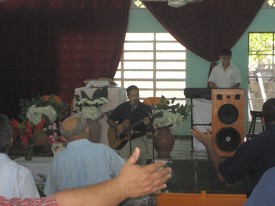
Leading Worship

Even after a year and a half here in Mérida, God still finds ways of stretching us. In January, while chatting with pastors before a sectional meeting, our president asked if I played an instrument. I responded that every now and again I played the guitar, while I had considerable experience on the drums. He followed up that question with a request that I lead worship that meeting. Now, I had lead worship in the past, but always in English. (I think the number of choruses that I know on the guitar in Spanish could be counted on one hand.) Therefore, I did what any self-respecting perfectionist would–I put him off, until the next month.

I used that time to gather the some more choruses, practice, and pray. (It’s amazing how the weeks fly when you’re anticipating something like this.) Of course, I second guessed my decision. I almost breathed a sigh of relief when I thought that perhaps the meeting had been canceled for the month, but, regardless of my doubts, the event came. The end result this last Monday certainly wasn’t perfect, but it was a beginning. I was able to sing (staying on key for the majority of the service), play the guitar, and I actually felt that I had led others in worship.

When I began my Spanish classes, I looked forward to the day when I would be able to do this very thing, but for one reason or another, I had put it off. Not enough time, other responsibilities more pressing, the list could go on. Isn’t it great that God doesn’t forget those dreams? In fact, I’ve found He sometimes uses others to push us into realizing them.

Tags: , ,

Salsipuedes Ministry

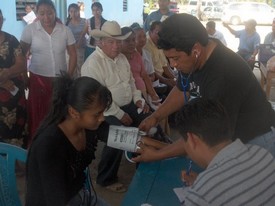
“Leave if you can!” That is the translated name of Salsipuedes one of the two towns that we visited on our medical relief trip to Tabasco. The village of Salsipuedes is situated on the Grijalva River in the Centla of Tabasco, a wetlands region of the state that’s three hours from the capital, one hour on good roads and two on what many would consider “off-road conditions,” but even more overwhelming than the distance to reach this place was the need that we met when we arrived. Sandy Kazim, the organizer and one of the medical providers of the trip told us that for much of the time she felt as though she was running an ER instead of a medical clinic. Four children in the same home with bronchitis and a woman who had recently miscarried were some of the most difficult cases, but case after case of skin infection and other diseases kept the medical providers working long past sunset, the time that we were told we had to leave for the sake of our personal security. Equally as tragic was the spiritual condition of the site. There were reports of active witchcraft taking place and a general look of hopelessness on the faces of many. “Leave if you can” –the name seemed to fit.

Still, that’s the funny thing about the God that we serve. Of all of the needy places that we could have gone, He sent us to the town of Salsipuedes. I think perhaps it was because, even though others had given up on that “Godforsaken” place, He hadn’t. He sent us there as an extension of His love in a tangible way.

I had the chance to enter into homes with several of the students of the Bible Institute while the medical team treated the sick. And as we passed from house to house, entering into their world, I thought of what Christ did for each one of us. He left His glory to live among us, to experience what we experience and to give us the hope that comes from a relationship with God. We in turn were serving as his representatives, offering the same hope that we now enjoy in a place where hope seemed for many to be a distant memory.

I spoke to many and told them that, although they might not have expected it, God had sent us to them specifically to let them know that He had decided to stay in Salsipuedes and that he was looking for hearts in which he could live. We prayed with many as they wrestled to take those first steps toward a relationship with their Creator.

What will happen is hard to determine. The routine of the life poverty has a grip that is relentless. C.S. Lewis once said it this way:

Indeed, if we consider the unblushing promises of reward and the staggering nature of the rewards promised in the Gospels, it would seem that Our Lord finds our desires, not too strong, but too weak. We are half-hearted creatures, fooling about with drink and sex and ambition when infinite joy is offered us, like an ignorant child who wants to go on making mud pies in a slum because he cannot imagine what is meant by the offer of a holiday at the sea. We are far too easily pleased.

So is the work in Salsipuedes; the population is run down, too tired to hope, too tired to dream of something better, and perhaps easily placated with the counterfeits that false religions or momentary escapes like drugs and alcohol can provide. Still, I believe that something began in the heart of those that we touched on that Friday. They received a taste of the love of God, and I believe that through the persistence of the pastor and the congregation that is serving that town, together with the regenerative power of the Holy Spirit, the very character of that town can change. In fact, I’m looking forward to the day when they invite us to the official name changing ceremony.

Tags: , , , ,

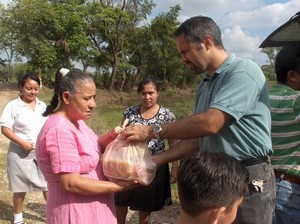
Dave distributing a despensaWe’ve returned from our 3 day trip to Tabasco, the region of Mexico that had experienced devastating floods in late October through early November. We loaded up two SUV loads of toys, vitamins, diapers, and powdered milk and drove the 8 hours from Mérida, Yucatán to Villahermosa, Tabasco to bring relief to families, especially those with small children.

Entering the city, we found that life had returned to its hectic pace with people and cars everywhere. The only visible remains of the inundation was the construction taking place to repair and clean roads affected by the floodwaters. Still, the stories we heard were incredible. People told us that many had remained in their homes, thinking this to be just a routine occurrence during the Tabasco rainy season, but that, as the floodwaters rose, they found themselves waiting on rooftops for helicopter rescue. The pastor’s home where we stayed took on more than 5 feet of water. He and his family stayed in the upper level and were able to save the majority of their appliances and furniture, but mold on the walls and ruined tile floors spoke of the work ahead to restore what the flood had ruined.

The countryside surrounding the city was a different story as floodwater remained on the roads and in the low lying areas that surrounded the houses. While no longer threating homes and schools, the stagnant water poses a health threat especially to the small children who choose to play in the contaminated pools and through mosquito borne illnesses. This is where we focused our efforts.

Entering Tabasco on Thursday night, we pooled together with Pastor Ruben, his family and several members of the church to put together relief packages with food, vitamins, diapers, milk and other essentials for the residents of these needy areas. It was touching to see the desire of these people, who were themselves victims, giving of their time and effort to help those who had needs greater than their own.

The following day, we handed out the supplies and toys to the children and their parents. It was for them clearly a “big deal” as at one point we were accompanied by one of their local government representatives. We were given complete access, even the ability to interrupt the activities of a elementary school to meet with the students.

Food was distributed, toys were given away, and much needed supplies were handed out, but something much bigger was accomplished. These victims received a much needed infusion of hope. They received it realizing that they were not alone in their struggle.

There is something amazing in the fact that God touches people to go and share his love with those who most need to experience it. At one point in the distribution, Paul Kazim, a fellow missionary, prayed. I think it was then that the reality of what we were doing came into focus: Jesus ministered to the people in Mark 6:30-44. He did that even though he was experiencing the loss of his cousin and herald, John the Baptist. He did it because he had compassion. In Tabasco, fellow citizens were putting their lives on hold, lives that had themselves been completely changed by the floods, to reach out to those with greater needs. What was the reason? I believe it to be nothing less than the same compassion that Christ portrayed to the 5,000 that were fed in the Galilean countryside.

We’re planning to go back to Tabasco January 10-13 to provide medical treatment and spiritual counseling to the needy suffering in Tabasco, to the people now being overlooked as efforts are being made to restore a sense of normalcy in the region. We as missionaries will take part, but I think the most effective counselors will be those who have lived through these floods. Those who, because of the compassion that only God can provide, have thought of others as better than themselves.

(You can see more of our recent trip by clicking on the picture above or through this link.)

Tags: , ,

Losing AgainI understand that those who frequent disciplemexico.org are not necessarily interested in baseball, much less in the outcome of the American League Divisional Series. For that reason, I’ve tried to steer clear of baseball subjects throughout the life of this site. Nevertheless, there are several out there who know that I am an avid Yankee fan, and as you can imagine the events that have happened in the course of the past week have left me feeling a bit numb.

Yes, the Yankees lost again. This time manhandled by the Cleveland Indians, a club who just last year wasn’t even sniffing the post season. This of course has had me spending some time looking for ways to deal with another October sans Yankees. You can imagine my surprise when an email from my mother-in-law helped me to put things into perspective.

An avid student of Jewish culture, she came upon a video blog from aish.com titled Isn’t losing wonderful?. In it Rabbi Yaakov Salomon comments on the loss of our beloved Yankees (and the Mets for good measure), suggesting that while “victory teaches you nothing”, “losing can teaching you everything.” He goes on exposit Proverbs 24:16:

for though a righteous man falls seven times, he rises again, but the wicked are brought down by calamity

He states that Jewish interpreters of this proverb suggest that it is not in spite of the fact that the righteous man falls seven times but it is because of the fact that he falls, and the lessons that he learns in the failures, that he rises again.

I think many of us are examples of this interpretation. I know that I, for one, rarely reflect on my victories, but the pain of failure that the sense of loss that follows drive me to determine the source of my defeat and resolve to come back stronger the next time.

So encouragement can be found in the lesson of losing. Of course, now that the Yankees have fallen seven times, I fully expect victory in 2008!

Tags: , , , , ,

September marked for us the end of one year of ministry here in the Yucatán, and to celebrate, we brought back a best of disciplemexico.org so that you could revisit some of the highlights of our journey thus far:

Dead of the Dead Thumbnail1. Day of the Dead–Written as a response to a request of an friend, this post is by far our most popular post of the past year, and, with the celebration of this event less than a month away the hits are building again. This piece reveals the difficulty that we have as we try to understand the culture of the Yucatán and their ancient traditions.

Bicentennial Man2. Oh the Humanity!–is a piece I wrote about how God uses our humanness, something very evident to me as I suffered through a prolonged sinus infection, to reveal his perfect power.

Bike Lesson Thumbnail3. Like riding a bicycle–is a family update/reflection on what it is that we do as missionaries. By the way, mastery of the bicycle is something that our kids are still working on. Come to think of it, we’ve still got a lot to learn about missions as well.

Tope Thumbnail4. Topes–Life has a way of springing surprises on you, much like speed bumps that seem to appear when you least expect them on roads here in Mexico, but, as this post suggests, the jolts bring with them valuable learning experiences.

Erie Merida Connection5. Coincidence or Confirmation?–This post about our providential guidance on the way to Mérida generated some lively if not completely related discussion.

As I look through these posts, one thing becomes increasingly clear. The job that we have been called to is not an easy one, but the God that has called us continues to guide and form us so that we can accomplish His work.

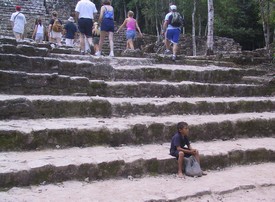
Left BehindNeed. It confronts. It demands to be met. Take for example a stone in our shoe. Even the tiniest pebble can cause reduce our gait to a hobble. What’s the response? Well, it’s impossible to negate, and limping to avoid the stone usually only lasts a few steps. Basically our feet demand that we sit, take off our shoe and get rid of the stone.

Here in Mérida, poverty is a need that demands to be met. The poor stand in doorways and wander the streets looking for those who will help them out of their situation. Even those that do work are trying to make ends meet on $5 US each day, and unlike the tourists in the picture above, we can’t leave their need behind when we return to our hotel or board our plane.

After my run in with the Ronald, the con-artist that took us for $8 in Costa Rica, I searched for a way to avoid the needs. I believed that a policy would help protect me, or maybe I would be able to direct people to ministries that could lend them a hand in their situation. Still, the need kept nagging.

Reading the Bible didn’t help either. Jesus, when confronted by the clamoring masses, would usually reply, “What is it that you want me to do for you?” He had no policies, no list of places to which he could direct them and wash his hands of their problems. He was personally involved–feeding, healing, touching.

Today, I was on a search for some items to get our house finally set up. Taking the wrong way to get to Home Depot, I stopped at a local hardware store. In the parking lot, there stood Raul, a disabled, middle-aged man, who, along with his wife, had been looking for garden work so that he could pay for his kids’ school supplies and uniforms. He asked me if I could help him. My schedule was free, but my impulse was to say that I couldn’t. After all, I had just cut my lawn the day before, and my ministry is equipping not compassion. Still, his need was clamoring for attention, and the example of Jesus from my devotionals was fresh in my mind. “What do you want me to do for you?” I asked.

I decided to get personally involved. I talked to him and called one of the references that he had given me. Then I spent the next 30 minutes praying and driving them to the places that they needed to go. As we said good-bye I gave him about $20 towards the uniforms and some dry goods that we had been carrying in the car so that his family would have food to eat. He gave me his address and an invitation to visit him.

Did I do the best thing? It’s hard to tell. I would rather have taken him to buy the shoes and uniforms that he needed, but at that moment I couldn’t. So perhaps I settled, or perhaps I was used as one response to the prayers of a desperate couple with a need that wasn’t going away.

Photo Credits: “Left Behind” a photo taken by gerriet available at: https://www.flickr.com/photo_zoom.gne?id=43491111&size=l and used under a Creative Commons License

« Older entries § Newer entries »