Language

You are currently browsing the archive for the Language category.

2009 Bethel Graduation

2009 Bethel Graduation

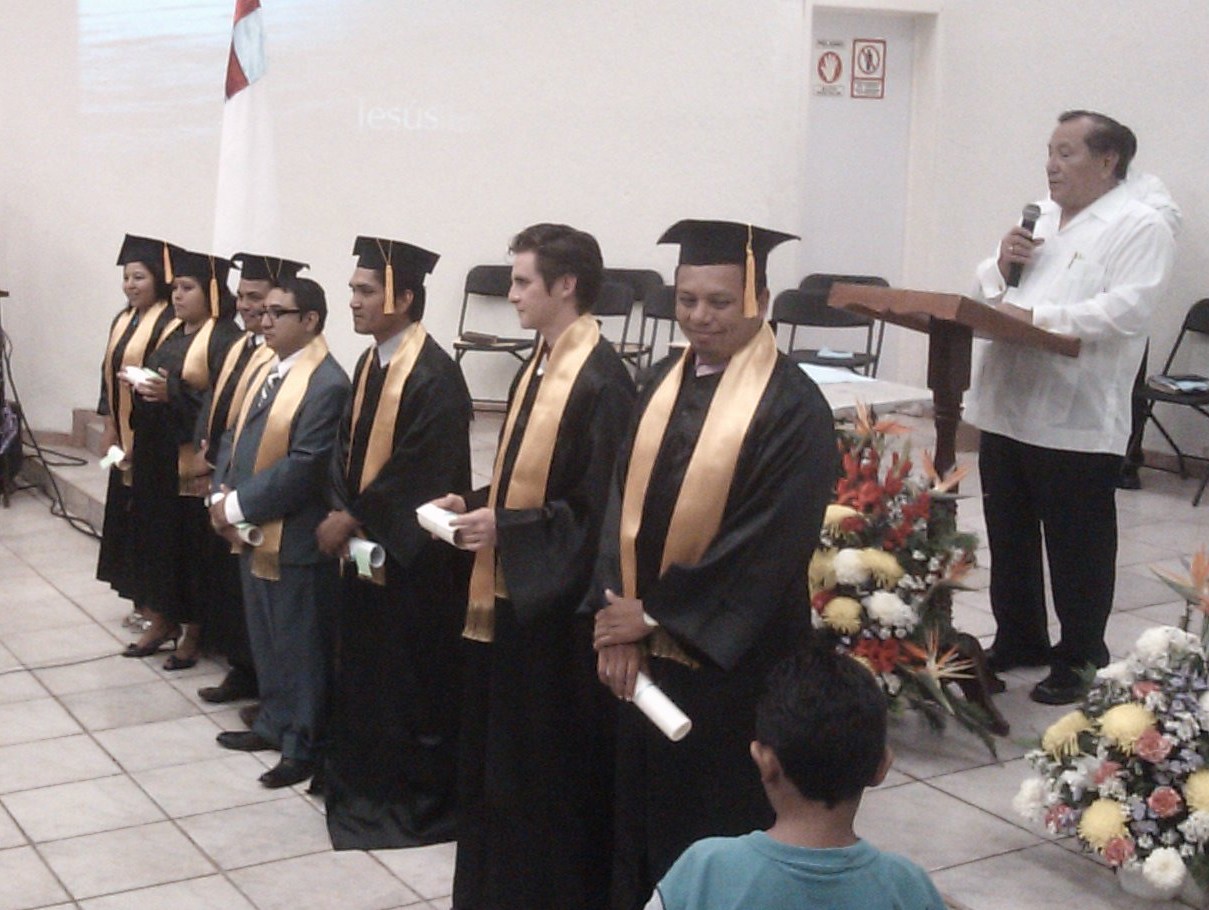
Since we’ve been in Mexico, we’ve witnessed the passing of a generation. No, we haven’t been here in Mérida for 20+ years, although looking at the growth of our kids during this term has made me wonder at times. I’m talking about the recent Bible Institute graduation service celebrated this past Monday, where Generation 06-09, walked the platform to receive their diplomas from the District Superintendent. This marks a milestone as it means that the students that I had the chance to teach from the first year of their Bible school experience are now being launched into ministry. The freshmen from my Personal Cvangelism course of December 2006-February 2007, my first solo class taught in Spanish, are now moving into their vocations.

Watching them receive their charge as graduates I had mixed feelings. There is a sense of joy in knowing that I had a part in their formation as ministers, but there is also a sense of regret. So often I had wished that I could have had certain sessions over again, where my lessons could have been more polished. On more than one occasion I’ve wish that I could have another chance at conversations that I’ve had knowing now that my Spanish could have been more understandable. In spite of my wishing, though, what was taught was taught, and the encouragement, advice, and prayers have been spoken. And that’s OK, because I believe that, though at times stammering or searching for the words, we communicated. As we learned we grew, each one of us offering to the other what we could not acquire on our own.

It wasn’t by chance that God brought me together with this generation at this moment in our lives. I so as I said goodbye to each one I prayed that as we part our ways, the graduates to their respective positions, and my family and I to the US to intinerate, that God will help us to remember the ways in which our being together expressed the manifold wisdom of God (Eph 3:10) that saw fit to join us together during their generation in the Bible school.

Maya Language School Itzamná

Maya Language School Itzamná

Ma’alob k’iin. Bix a beel’ex. Having trouble responding? That’s because what my greeting was written in Maya. It reads, “Good morning. How are you?” (There are no question marks in Maya)

Here in the Yucatán the official language is Spanish. For this reason, we spent our first year of this term in Costa Rica learning Spanish so that we could live and work here in Mérida. Nevertheless, there are times, like this past month when we journeyed to the town of Tekax, that even speaking in perfect Spanish isn’t enough. That is because, in several towns in the state of Yucatán, many still speak the traditional indigenous language which has changed only slightly from the time of the pyramid builders of Chichen Itza to the present. Others are bilingual, having learned Spanish in school, but clearly function better in their native language.

So how do we respond to this fact? Well, we could rely upon those who are bilingual to translate for us, hoping that they will correctly interpret the meaning of our message. But what does this teach the Maya speakers? I feel it teaches them that the gospel is something foreign. Something that requires special abilities in order to understand, and that salvation is reserved for those who earn it by learning this foreign system. I don’t believe that our God is like that.

From the beginning, with the question, “Adam, where are you?”, we know that God initiated his plan of salvation. Romans 5:8 says that while we were yet sinners, Christ died for us. And John 1:14 says that Jesus, the very Word of God came near, and lived among us. We are not those who search for Him says Romans 3:10-11, He comes after us.

How does this translate then as a reaction to the situation of the Maya here in Yucatan? Years ago, before archeology became the force that it is today, many thought that the Koine Greek, the language in which the New Testament was written was a sacred tongue. This was thought because the texts available to the scholars at the time, that of Classical Greek was different from what they saw in Bible. However, as more research came to light, they found that the New Testament Greek was not a sacred language after all. In fact, it was the common speech–that which the housewives used to write out their shopping lists. So, in fact, we see that the very Bible that we read is another aspect of God “coming near” to us. He didn’t speak through the elite of the society or through a priestly class, He instead spoke through the common tongue of the merchants, the peasants, and the slaves.

Understanding this, if we are to “come near” as Christ’s ambassadors and show the Maya that this message is in fact for them, that Christ came to save every, tribe, tongue and nation, then we in turn should take the steps to learn to share this salvation in their native tongue.

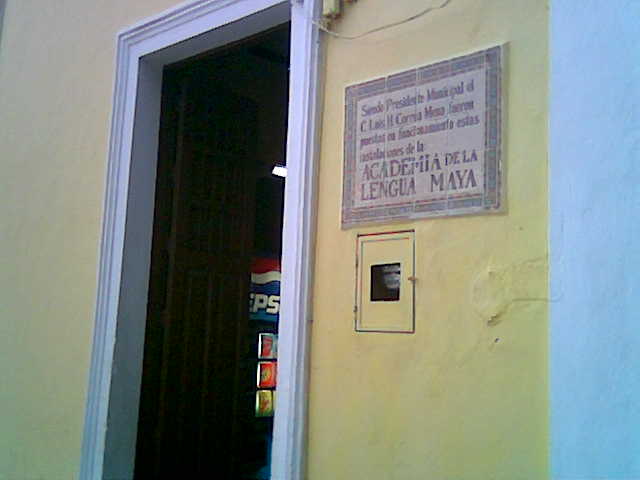
So that in fact is what we are doing. Every Monday and Wednesday for two hours, I am traveling to the “Ermita”, a plaza south of town, to learn to speak and write the Maya language. (The picture in this post is a shot of the entrance to the building.) The municipal government has established a course in which they teach citizens and foreigners at beginning, intermediate, and advanced levels for only $5 a month. Having extended for a year, and having scheduled outreaches into these Maya speaking regions, this was an offer that we couldn’t refuse.

So here I am again learning anew how to function in another language, struggling to come up with the words to respond to the teacher. However, when I consider what Christ did for us, coming to us as a baby, unable to speak, to function on His own, in order to live among us, I say that my struggle is worth it if it allows me to live among this people and reveal to them the God that we serve, the God who came near.

By the way, a fellow Mexico Missionary just sent us a link to an example of the power of “coming near” to an unreached people group. You can check out the video on You Tube

Leading Worship

Even after a year and a half here in Mérida, God still finds ways of stretching us. In January, while chatting with pastors before a sectional meeting, our president asked if I played an instrument. I responded that every now and again I played the guitar, while I had considerable experience on the drums. He followed up that question with a request that I lead worship that meeting. Now, I had lead worship in the past, but always in English. (I think the number of choruses that I know on the guitar in Spanish could be counted on one hand.) Therefore, I did what any self-respecting perfectionist would–I put him off, until the next month.

I used that time to gather the some more choruses, practice, and pray. (It’s amazing how the weeks fly when you’re anticipating something like this.) Of course, I second guessed my decision. I almost breathed a sigh of relief when I thought that perhaps the meeting had been canceled for the month, but, regardless of my doubts, the event came. The end result this last Monday certainly wasn’t perfect, but it was a beginning. I was able to sing (staying on key for the majority of the service), play the guitar, and I actually felt that I had led others in worship.

When I began my Spanish classes, I looked forward to the day when I would be able to do this very thing, but for one reason or another, I had put it off. Not enough time, other responsibilities more pressing, the list could go on. Isn’t it great that God doesn’t forget those dreams? In fact, I’ve found He sometimes uses others to push us into realizing them.

We’ve certainly heard that line before. Whether we’ve used it or had someone use it on us, we know that something inappropriate had been said, something that didn’t fit in the conversation or context. Now, many of us would relate that unfortunate language to various four letter words that we may have heard throughout our lives, or perhaps to the childish giggles that accompany the use of “potty words” outside of their appropriate place, but today I’d like broaden the application of this phrase.

Alejandro, one of students in my evangelism class was testifying of a recent encounter. It wasn’t a report of “salvation” or “re-dedication,” but a reflection on his overly technical spiritual vocabulary. He was giving his friend a Bible that he had purchased when she asked him where to begin reading. He mentioned that the book of Matthew was a good place to start. Disappointed, she explained that she wanted to read about Jesus and not about Matthew! He had to take a minute to collect himself and explain that the gospels, although titled with the name of the writer were actually records of the life and work of Jesus. In his testimony, he shared with us that he was going to take the time to work through his thoughts, making sure that his communication with those who were not followers of Jesus would not only be correct, but also clear and understandable. He was committing to watch his language.

This testimony is a good reminder to all of us. We have a tendency to slip into routines in our speech. One story, related to me by fellow missionary Paul Kazim, is about a group of Bible School students traveling together. When stopping for gas, one of the students sticks his head out of the car to say, “The gas prices have really gone up, Amen?” Now while that line is certainly not out of place in the church, it would have a group of people scratching their heads at the local 7-11. Are we watching our language, or are we thoughtlessly separating ourselves from those we should be reaching with the use of a “sacred dialect.”

We missionaries must especially guard against this kind of behavior as much of our Spanish language habits are being built within the working environment of the church. Phrases like “Dios le bendiga (God bless you)” or “Bendito sea su nombre (Blessed be His Name)” are lines that can bring instant reaction in a worship service, but lose much of their significance when spoken in a secular context.

My brother’s post on the Bible knowledge of an AU student is proof that in the US as well, the need to clearly explain our God speech is more necessary than ever before. More and more, we are facing the same cosmopolitan, multicultural, and very often secular society that Paul faced in his missionary journey to Greece. In light of this, it would be a good practice to adopt Paul’s methods of explanation and the use of cultural references as he spoke to the crowd in Athens (Acts 17:16-31), meeting them in their context in order to share with them about their need to be in right relationship with God.

Like Alejandro, I realize that I need to remember to watch my language. I need commit to clearly relate to others (in Spanish or in English) what God has done in my life, and welcome them into the discussion by decoding my technical “God-speak.” Won’t you join me in the process?

How about you? Do you have a story to tell? Post a comment and share with us when you had to watch your “language.”

Graduation

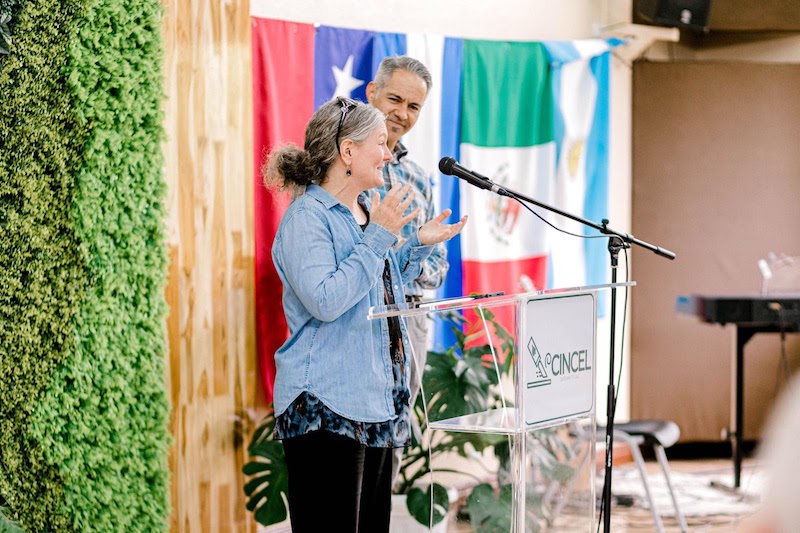
Yes, we have finally made it to the end of our language school experience. This Friday, Kelly and I, along with 15 other missionaries and university students graduated from the CINCEL program. More later, but we’ve got to get some sleep. We just finished packing and we leave for the airport at 4:30 AM tomorrow

Technorati Tags: , ,

Final Exam

Keeping with our theme of lasts, we’d appreciate your prayers today (Friday) as we go through our “final exam” here at CINCEL. Kelly and I will each be sitting down with a professor for a “conversation” of sorts in order to plot our oral proficiency in Spanish. That’s the reason for the photo of Joseph’s mouth above. Please pray that we will be able to put into practice all that we have learned in the past year, and that the results of this exam will be an encouragement for the both of us to continue our learning even after we graduate from our program.

As language school students for the past year, we’ve had the benefit of taking a lot from the people around us. We’ve received 4 hours a day of lessons, we’ve stopped people along the street, in shopping malls, and in church in order to have conversations, and we’ve received advice and insight into the latin culture, but we’ve not often had the opportunity to give back. That’s why, when we have the opportunity to contribute, we feel that it is blogworthy.

This month Kelly headed up a program at CINCEL to help seniors in high school (colegio in Spanish) prepare for their math exit exams. She did interviews at the colegio in order to asses their areas of need and then was available for the past 4 weeks in order to give them the help that they needed. I also got a chance to contribute to the English program that fellow missionary Ron Marcotte has been offering to the community, I translated from English into Spanish for the beginning students during the teaching sessions and then helped as a conversation partner as each student worked on their alphabet, their numbers and various simple phrases.

I think that the most special opportunity that we had this past month was the birthday that we celebrated with our friend Mayra (pictured with the cake above). She was celebrating her 60th birthday, but with her children in Florida she was looking to spend her day completly alone. Kelly planned a small celebration with several students who knew Mayra, and Mayra was touched deeply.

It’s interesting. We’ve grown up in a consumer culture and have been bombarded with commercials about the things that we need to acquire, but the older I get (32 years and counting), the more I realize that we have been created to give. Nothing creates a better feeling of satisfaction, and nothing more positively reflects the image of Christ that so many others in our society need to see.

Technorati Tags: , ,

A thing for talking. A thing for taming. A thing for tasting?

It’s funny how things seem to tie together in one’s life, but I recently came upon an interesting convergence of sorts. I was planning for my first Spanish Bible Study, and I was reading in James 3:1-12 where James talks about the tongue as an uncontrollable fire that can burn up our very lives. As I wondering how we could control such a savage beast, Myra, one of our Costa Rican friends, was introducing us to a new dish, tongue! Aha! I said to myself, pull it out and serve it for dinner! Of course, the idea quickly left the table of viable options.

However, As cataloged in one of our classmate’s blog, the tongue of a cow (pictured in Kelly’s hand) is indeed an edible, and actually quite tasty item. It is slow cooked overnight and then simmered in tomato sauce. (Myra used Prego.) The outer covering is removed during the process produce a very soft, pleasant meat.

Of course it may come to mind that what you are tasting may have at one time been able to taste you, but really, how many of us really know what goes into some of the things that we eat…like hot dogs? I highly recommend cow tongue, but if you buy it for the family, be sure to buy a big one, or get two because they shrink when you cook them.

But back to the convergence, the taming of the tongue is a daily process, is it not? We have now been in this stage of language-learning for about 8 months, and one of the more difficult things I have dealt with has been the phonetics involved in producing what I want to say. In Spanish a word with the same letters and different accent can have a completely different meaning. Also, words like “aeropuerto”, or “inmediatamente” were just a challenge for this Gringo to master. At times I’ve wanted to ask where I could buy a Spanish tongue so that I could trade it out with my American one before heading into class, but I have realized that there is no shortcut to pronunciation. It takes time and patience in order to speak correctly a foreign language.

So it is with God’s process in taming the words that we say, be it in out native language or a foreign one. We must admit that we need His intervention to pull out some of our cynicism, sarcasm, and complaining. It is a decision to allow Him to do his work, but it is also a process that takes time and a continual dependence upon the work of the Holy Spirit in our lives. I have more to say on this in my Bible Study (in Spanish).

So there you have it: The tongue: a thing for talking (in languages foreign or domestic), for taming (through time and the work of the Spirit), and, as long as it is tongue of cow, a thing for tasting!

They say, all good things in life must come to and end, and life in language school is no different. There were a several things that came to an end in the past week that we’d like to fill you in on.

First of all, the trimester of school finished this Friday when we said goodbye to 13 graduates and 1 instructor. Fellow Mexico Missionaries David and Carolyn Huneycutt, Ryan and Christie Thomas and Terisa and Fredy Vasquez were among those who said goodbye to Costa Rica to head to their appointed destinations in order to begin their ministries. We wish them well. Also leaving the school was 13 year veteran grammar teacher, Iris Chavarria (pictured in this post from last year). She was our teacher for our two trimesters, and we owe all of our knowledge of the functioning of irregular verbs and the uses of the subjunctive to her. Gracias por todo Iris, será extrañada.

Second, the end of the trimester also means that we received our evaluations from our Oral Proficiency exams that I mentioned in this previous post. Both Kelly and I finished well, scoring above normal for our group. Not that language school is a competition, but the ability to advance more quickly here will mean that we will have an easier time adapting to the language in Mexico when we arrive. We want to take a moment to say thank you to our teachers (pictured above),thanks to you for your prayers on our behalf. Without those, we are certain that we would not have made it this far.

Finally, yesterday meant the end of my 31st year, and what a year it was! We finished our itineration by speaking in over 55 services, travelling by car to each one, participated in the first ever commissioning of new candidate missionaries at the 51st General Council in Denver, CO, moved twice, arrived in Costa Rica in August, and survived a couple interesting trimesters which saw us through sicknesses, and accidents, but also has brought us closer to ministry in Mexico. Through it all, we have to marvel at the faithfulness of God and His people as we have received the help of so many that they would prove too numerous to mention. My 31st year is over, and, if it served as any indication, 32 should prove to be wonderful!

Wrapping this post up, we realize that good things do come to an end, but as we finish one thing, we find that God continues to offer us new beginnings, which bring rewarding challenges and opportunities to view his faithfulness.

Sometimes, we are on top of the world and think that fluency in Spanish is within our grasp. Other times, we are somewhat like Josh Amiot, hanging on for dear life!

This is the stage that we find ourselves in this week. We are now passing through our “ECHO”s, or Spanish conversation proficiency exams, during which our conversation with one of our professors will be recorded and our level of progress marked. This is one of the most stressful times for the students of CINCEL as we try to bring everything together for this “final exam” for the current term. (Two terms down and one to go!) We appreciate your prayers on our behalf during this time.

Now about the picture. Josh had the unfortunate experience of slipping on the rappelling wall in full view of the camera during our recent men’s retreat. We certainly thank him for the wonderful object lesson, and of course for his great sense of humor!

Que Vergüenza

Vergüenza is the Spanish word for embarrassment, and a classmate and I had a somewhat embarrassing run-in with the law today. As I had mentioned in my post on tarea, one of assignments in CINCEL is to talk with the people that we meet in San José. Ron Marcotte, missionary to Ecuador, and I were doing just that, interviewing passers-by in a shopping center, when we were approached by a security guard. After asking us what we were doing, he told us that we would have to follow him to the administration office where we would have to petition for approval for our interviews.

Upon arrival at the office, we were summarily questioned, in Spanish of course, about our activities, and our notes and responses were scrutinized. Finally, we were given permission, only if we would present identification and letters of reference from CINCEL stating who were were and what we were doing. Needless to say, we are crossing that mall off of our list of places to go to chat.

Of course, there was an upside. We did manage to talk to 7 people before we were “taken into custody,” and we did realize that we had the ability to survive in particularly stressful situations in a foreign language. So thank you to those of you who have had faith in us. That faith is paying off. Also, thank you to CINCEL for preparing us to face the situations that may come our way. Of course, come to think of it, we wouldn’t have been in that situation if CINCEL hadn’t put us up to it…

So what do you think? Are you ready for language school? Leave us a comment.

Tarea

Tarea (f)

(Spanish) Work that needs to be done in a limited time (eg. homework)

Homework has been the key word for the past few weeks here in Costa Rica as we continue through our second trimester at CINCEL. And as you can see from the stack of books, there won’t be any let up in sight for a while.
This picture represents the books that we are using during our courses, and each comes with it’s own particular set of tarea. So in addition to the 4 hours of class time that we have each day, we have been working with at least that amount of homework. Add to that the time that we have to spend talking with people on the streets of San Jose, and that makes for a full day!

But this isn’t a post to complain, no it is much more to express our gratitude for the deadlines that God gives to us. I have found that we have a tendency to work better when there is a time frame set in place. So it is with Spanish study. There have been several times in our lives where we have wanted to involve ourselves in learning Spanish. The desire was real, but the deadline was never set. Now here in language school we have the motivation and, for sure, the deadlines. The wondrous thing is, with God’s help, those two elements have combined to result in some tremendous progress. Now for certain, we have far to go, but to be able to understand and to be understood in a foreign language is indeed a tremendous blessing. So the next time that God assigns you tarea don’t look at it as a time to cringe, but rather as a time to grow!

Out with the old…

As all of us approach a new year, we are looking forward to a new trimester of studies here at CINCEL. We celebrated graduation here on Friday, and said goodbye to twelve of our classmates, including Brian and Dena Norvell, missionaries to the state of Sinaloa Mexico, and Mark and Sandra Smith, missionary associates to the Mexican border. We are sad to see them go, but glad that they are now moving on to the work!
Kelly and I, meanwhile, received our marks for the current trimester on Friday. We have both advanced well, receiving high marks in our oral examination as well as in our classes. We have also noticed advancement as we go about our everyday activities. It is nice to be able to talk intelligibly with the people in street instead of playing charades! Thanks for your prayers on our behalf for this area of our ministry. They are working!

We are now able to rest for a bit before the new trimester begins in January. Actually, we’re looking forward to catching up on a few things that have been neglected since school began in September!

Get on the Stick!

The popsicle stick that is! We’ve been subjected to some strange exercises in order to get our mouths into the correct condition for speaking Spanish, but none have been as odd or humbling as the popsicle stick.

English speakers don’t open their mouths habitually as they speak. Therefore, we have trouble with several of the Spanish sounds that require an open mouth. The popsicle stick helps us “feel” the way that our mouths should be positioned. Of course, both the look and the sound produced by this practice were absolutely hilarious. Click here or on the picture to hear a sample of what we were doing in the classroom. In case you can’t make it out, I’m reading 1Tim 2:5,6 in Spanish

If there is one thing that we have learned so far here at CINCEL it is that life goes on even when you have left the country.

As we looked forward to language school, we expected the rigors of classes, the hours of homework, and the difficulties of navigating through a new culture, but you never quite grasp the effects of culture on everyday life until you attempt to live your everyday life in another culture.

While we were in the United States itinerating, we were blessed with wonderful health. However since we have landed in Costa Rica, four out of five of us have seen the doctor! In fact, Kelly just returned today from an appointment for Rebekah. We are also facing the prospect of minor surgery for Jonathan, our almost 3 year-old, in the coming weeks.

None of these situations are emergencies, and yet, when compounded with the rigors of language and culture acquisition, they serve as “extra stress”–that is Spanish, by the way, for extra stress–that can lead us into despondency.

Still with all of the things being thrown at us now, we are thankful for what we have: a comfortable house, food to eat, an opportunity to fulfill God’s call on our lives, and supporters like you to continue to hold up our needs to the Lord. So we choose to be thankful. As Dan Betzer’s byline stated today: “I cried for the lack of shoes until I saw someone without any feet.”

So we continue the struggle that is language school, realizing that life does not stop during this process, but eternally thankful for the strength that God gives us to accomplish all things…including scheduling a doctor’s appointment in Spanish!


We have made it to San Jose, Costa Rica! We have been in Costa Rica since Tuesday and are now getting settled into a routine before classes begin on Tuesday. We are relieved and excited to be here although a bit overwhelmed at the realization that we now have the equivalent communication skills of a two-year old!

However, even though we have left the United States, we find that are thoughts are constantly brought back as we continue to hear reports on the damage and the situation on the Gulf Coast. We ask that you would continue to remember us, be we hope that you would find time to remember the victims of Hurricane Katrina in your thoughts and prayers. Also, if you feel so lead, I know of two excellent organizations that will facilitate your relief contributions: Convoy of Hope and Rural Compassion. Both are Assemblies of God ministries, and both are playing a large role in facilitating relief, spiritual as well as physical, to these distressed people.