Articles by Dave

You are currently browsing Dave’s articles.

image

There’s been a theme recurring in my mind for the past few weeks; it’s the idea of a God who keeps his promises,  a God who doesn’t forget.

Last week, I had the chance to preach on Mephibosheth, an obscure name in the story of David, but an important example of the God who remembers. David had made a promise to his closest friend, Jonathan,  who just happened to be the son of his fiercest enemy, Saul.  He promised to be kind to Jonathan’s family when came to power.

Now, there would have been a pretty remote chance to see his promise come to pass had David reflected the kings of his day. They were known to conspire against their enemies and wipe out any trace of their descendants, lest one of them think of the possibility of rebellion and a shot at regaining the throne. But David was not like the kings of his day; he was a man after God’s own heart, And how does God act? He keeps His promises.

The story resumes years after the promise was made, years after Saul and his sons, including Jonathan, had been killed.  David finally establishes his reign, and when that work was done, he looks for a opportunity to keep his promise.  He seeks out Ziba, an old servant of Saul, and inquires of him the location of Jonathan’s son, the crippled Mephibosheth. He sends for him, and then, in all of his magnanimity, restores to him all of what had belonged to his grandfather.

He didn’t need to do it. There was no one alive to hold him to his promise. It was, to say the least, a unexpected act for a Middle Eastern monarch. But David was more than that, he was a king whose temporal rule was to point toward the eternal Kingdom of the Heavens and the God whose kingdom it is, and that God is a God who doesn’t forget.

Flash forward to 2002, when a town called “Tigre Grande” was flooded by Hurricane Isidore. During the storm, water from rivers of the state of Campeche surged in, filling lowland farms to the tops of telephone poles. At the time, a small church was taking shape, but, because of the floodwaters, the town was displaced, and its residents are disbursed throughout the county. The town was later reestablished and rebuilt, but, unfortunately, the little church did not survive.

Anyone else could have easily forgotten the little town of Tigre Grande, lying 50 kilometers away from the nearest good road, anyone that is, but God.

It was 12 years in the formation, but God’s promise to build his church was fulfilled. Early this year, God stirred the heart of a young missionary couple, Rangel and Claudia Vázquez, for Tigre Grande. They took a trip to investigate. What they found was astonishing. They had asked about the possibility of starting a Bible study in the village. When word had spread and the day of the first event arrived, a group of townspeople, 22 in number, were there to be a part. They had been waiting for them and the message they brought that day. Rangel and Claudia were able to say that just as the townspeople had not forgotten the the church that had begun years before, neither had God.

Kelly, the kids, and I had a chance to meet the group and share in a small service in garage of one of the houses that had been rebuilt by the government after the storm. The kids and adults found seats or stood in the little space, a dog stretched out in front of the table that served as a pulpit. As we sang, and prayed, and studied the scriptures together, we saw the signs of a church reforming, and we heard the testimonies of lives being transformed in that small village, down but not out, lost to some but not forgotten by God.

But that’s who He is, the God who keeps His promises, the God who doesn’t forget–not then, three thousand years ago with Mephiboseth, not now in the case of the Town of Tigre Grande, not ever.

Tags: , ,

imagineGroup

“Imagine” is a song written by John Lennon. In it, he encourages us to dream about a world without absolutes, divisions or possessions. The hope, it seems, is that this idea might somehow motivate us to make this world a better place. It’s a nice thought, and a pretty catchy song as well, evidenced by the fact its popularity has bridged at least three generations. Nevertheless, the reality that the three generations who have known the song have experienced proves that the song’s premise is flawed. To make the world a better place, we must move beyond our imagination and the self righteous criticism of that which we deem to be the problem. True, vision is required, but we must have a firm grip on reality while we work to put thought to action. Ironically, we find the the ones who are doing just that are the ones that “Imagine” criticizes the most.

imagineCollageSmall

This past week, in the town of Sucua, Ecuador, I had a chance to meet with fellow missionaries, representatives of true religion, all of whom are committed to not simply making the world a better place, but to its very transformation. There, we took part in the first ever A/G Latin American/Caribbean Consultation on Unreached People Groups (UPGs)

The UPG Consultation was an opportunity to hear about what was taking place, assess what has yet to be done, and to pray and strategize to accomplish the Unfinished Task.  There was a sense of celebration as we saw what was being gained through missionaries Joil and Leah Marbut, who have spearheaded an effort to reach the Shuars of southern Ecuador. There was a sense of urgency as we heard of the over 400 different people groups comprised of over 16 million individuals without an adequate witness of hope, and there was a sense of determination as we committed ourselves in prayer and purpose to reaching those groups.

imagineSaint

There was no avoiding the historical significance of the event either. Taking place on the centennial anniversary of the General Council of the Assemblies of God that would establish that organization as the proponent of “the greatest evangelism that the world has ever seen,” it was fitting that we were reevaluating our mission to accomplish that goal. In the heart of the country where, almost 60 years prior, five missionaries gave their lives to reach the isolated and violent Huaoroni, known as the Auca (savage) people, it was appropriate that we would dedicate anew our lives to continuing that work.

Still, as we left that place, we knew that what was accomplished there would not be enough. As we said our goodbyes and made our way by car, bus, or plane to our adoptive homes, we turned ourselves to work– to reach, to plant, to touch, and to equip lives in order to fulfill our role in the extension of the Kingdom of God. We had met to gain perspective, but we go to wholeheartedly engage with the One who is able to do more than we could ask or imagine through our coordinated effort.

Interested in seeing more? Take a look at our gallery of photos from the event.

Tags: , , , ,

Joy Unspeakable?

SustainHopeSmile

Holy Week has come and gone. If you’re like us, you’re probably still basking in the joy that comes with the comprehension of Christ’s work of redemption on the cross and the hope of eternal life that His resurrection brings. More than that, the afterglow of Easter Sunday Morning encourages us to share with others the reason for this hope that we have (1 Peter 3:15), but the increased urge to share comes the with the urgent need to know how. So many times it can seem like we have a joy unspeakable, to borrow the words of the the old hymn, a hope that we feel we’re unable to share.

In 1 Corinthians 9:22 Paul states: “I have become all things to all people so that by all possible means I might save some.” It is a call to enter in, to identify and empathize with a community as a means to reach them. It’s easy enough to agree with this concept, but difficult to put into practice. However, our time with the ministry of Sustain Hope has made the emulation of Paul’s message a bit easier.

From March 28th to April 6th, Andy Rogers and Frank Mayes from Sustain Hope held services and workshops designed to teach pastors and other leaders how to use simple methods to solve big problems, from water purification to food preparation all the while building bridges to help present the gospel.

fly trap

One such example was a simple fly trap, made from a common plastic bottle and a piece of fruit or a dollop of honey. During the rainy season, from June to November here in the Yucatán, flies can be a big problem, especially in the open air kitchens that many still use throughout the state. The trap provides a simple solution to a common nuisance, but it also serves to illustrate the danger of sin. In the same way that the flies are attracted to the bait of fruit or honey, so sin can be very attractive, but just as the fly is unable to escape from the trap, so sin can have grave even lethal consequences for those who fall under its influence. Imagine the lasting impact such an illustration can have as flies accumulate within the trap!

In this and many other ways, Frank and Andy shared throughout the week. It was a joy to host them and translate for them as they brought new ways for our ministers to get involved with their communities meeting physical needs while conveying spiritual truths.

Interested in seeing more? Take a look at our photo gallery from the week. If you like, you can also download our latest newsletter in PDF format, featuring Sustain Hope.

Tags: , , ,

image

You’d have to question the appropriateness of the phrase as well after having spent the week that I did with these college students! As I had mentioned in my previous post, we hosted a 10 person team of Chi Alpha students and staff from American University as they spent their Spring Break here in the Yucatán. However, contrary to preconceived notions about the time period, these youth did anything but rest!

Following their arrival on Saturday the 8th, we hit the ground running with services in the morning and evening to kick off the week’s events. Our morning service was hosted by La Casa de Oración, the year-old mission in the town of Sierra Papacal of one of my former students, Guadalupe Campos. It was a time of welcome and preparation for the work among the kids that would take place during the week. The evening service was held at Eben-ezer, a church in Mérida, pastored by Gabriel Gongora, the current director of Instituto Biblico Bethel. There, I had the privilege of translating for my brother, Mike, as the team was highlighted for the construction work that they would undertake in the Bible Institute.

IMG_20140312_112210363

On Monday, the construction began. Partnering with the Bible Institute students, we worked each morning until Wednesday to lift 1500 concrete slabs into place as part of the structure that will serve as the second story roof, effectively topping our three and a half year expansion project of the institute’s dining, classroom, and library facilities.

Each afternoon we worked together to bring Vacation Bible School activities to the children of Sierra Papacal. Following our prep time on Monday, we worked Tuesday and Wednesday in the church facilities, teaching, making crafts, singing, and playing exclusively with the kids. However, on Thursday afternoon, we were able to serve the entire community with free haircuts, hygiene checks, and lunch to boot. Our closing rally in the evening was a blessing as several of the kids to whom we ministered responded to the call to pray to receive Christ.

image

We couldn’t have been more pleased with the results as Mexicans and Americans worked shoulder to shoulder to see God’s purposes advanced in the Yucatán. It was truly a team effort!

And, speaking of team efforts, I’d like to thank all those who had responded to our call for prayer prior to the trip. We were witnesses of God’s faithfulness in every aspects as:

  • There were no injuries whatsoever in our construction project or mishaps on the road as we traveled from place to place. In fact, I don’t even remember being asked for a band aid during the entire trip!
  • All stayed perfectly healthy; even Montezuma’s revenge was kept at bay.
  • The integration among the groups was stellar. In each aspect of the trip, both Mexicans and Americans joined together to get the job done.
  • The response in Sierra Papacal was enthusiastic. New kids were reached with the message of the gospel, kids who are now being channeled into newly formed discipleship groups.

image

Of course, none of this would have been possible if this team of university students hadn’t forgone their break in order to invest in the Yucatán. So thanks, Mike, and the entire AU Chi Alpha team. Rest assured your work is appreciated!

Did you enjoy the post? Be sure to take a look at the pictures as well!

Tags:

OnTheRoof

Although up north the freeze is still in effect, here in Mexico, we’re preparing for spring. Spring Break, that is.

This Saturday, 10 members of the Chi Alpha Student Fellowship of American University will be descending on the city of Mérida, Yucatán to do a bit of construction and outreach while they thaw from this year’s deep freeze. In the mornings, we’ll be working at Instituto Bíblico Bethel, to put into place the beams and slabs that will serve as the structure for the roof of the second floor of the multipurpose building. In the afternoons, we’ll be returning to Sierra Papacal to assist the efforts of my former student, Guadalupe Campos, in the church, Casa de Oración. My favorite part of the trip, however, is the opportunity for our Bible school students to work hand in hand with our visiting Chi Alpha workers.

We’re preparing a warm welcome for our guests, but we certainly don’t want to leave you out in the cold. We’d like to extend an invitation for you to get involved, too. Here’s how:

  1. Pray for the trip’s success:
    • Pray for safety in our work and travels.
    • Pray for the health of all involved. (Pray against sickness!)
    • Pray for the effective integration of the different groups.
    • Pray for an enthusiastic response among the people of Sierra Papacal.

  2. Send a special gift

    The Chi Alpha students have a goal to bless the ministry that is taking part here in the Yucatán. You can be a part of helping them realize that goal.

    Navigate to our giving page and send a special gift. Put AUXA in the comment section, and we’ll be sure to designate that gift to the projects in which they’re taking part.

While you might not be able to bask in the Yucatecan sun with us, we’re sure that your participation, in one or both of these areas, will bring some warmth to your weary winter days, and, just maybe, you too might be thinking that spring is in the air!

image

It’s an image that I can’t shake from my mind, there He was, larger than life, glooming down at me from above the altar of my grandmother’s church, an image of God the Father as an old man, His foot resting on the world below him, His staff of justice in His hand. He seemed so distant, so aloof, so unconcerned about my insignificant existence, except, as it was in my six-year-old mind, if I were to disobey, then I would surely face the wrath of the old man.

It’s taken time for me to shake that image, to understand that the same God who caused Isaiah to cry out, “Woe to me, I am ruined!,” is the same Heavenly Father who loved the world so much that sent His one and only Son, that we might have eternal life. It took several years of experiencing His divine grace, of reflecting on the perfect peace that He grants before I was able to stop looking over my shoulder for the blow of heavenly punishment.

Some time ago, the image of the angry God resurfaced, but this time here in Mexico. It’s not hard to see why. The role of the father is traditionally a distant one. Long hours away from the family at a demanding, low-paid job leave little time for the family. Add alcohol to the mix and the situation becomes worse, even to the point of violence. It’s no wonder then, that when one believer attempted to motivate a change in the behavior of a person living in sin, he declared that if he wouldn’t repent, God would exact punishment on his family!

Now, while I would be the first to admit that the sins of the father translate into serious consequences for his children, does this image of the punishing God correspond to one who is rich in compassion and abounding in mercy? Does this image of God motivate the man to run back into the arms of the one who loves him passionately, or does it cause him rather to hide from the wrath of the one who knows only how weigh out justice on evil doers? Just which God are we presenting?

Granted, one could say that that certain believer in question was emphasizing the justice of God, while you emphasize his mercy, but I would contest that the justice that God demanded was satisfied at the cross, any thought that God would punish us as a way to make us pay for our sins is simply against His character. The debt our sins incurred were paid in full at the cross. Through Jesus Christ, the way was made for us to come home. Are our cultural imports to the gospel blocking the way?

It’s a tricky thing to tease our traditions and upbringing from the biblical view of God, but as ambassadors of the King can we afford to allow our erroneous ideas to misrepresent Him?

Photo courtesy of Polonia Music (https://www.poloniamusic.com/Polonia_Photos.html)

Tags:

I don’t get chance to feature Kelly very often on our updates. That’s because she’s usually behind the camera.

This particular Monday morning, however, we were able to switch roles, and she was able to operate in one of her special giftings, reptile control!

Hit the link or the play button to enjoy the video!

*|YOUTUBE:[$vid=dt7mPssM1-g]|*

Tags: ,

What if…

questionSM

When it comes to progress in evangelism, I like to celebrate as much as any other believer. I’m not one to criticize any effort especially when, looking at current trends, so little is being done. Still, I’m not content to simply celebrate, I want to evaluate as well. I want to ask the questions of myself and my students that will help us maximize our effectiveness as we share God’s story, the gospel, with our families, friends, and neighbors.

A case in point is what happened just yesterday. One of my students, who hasn’t been able to visit his home church for a while due to distance, was happy to see that five new families had started attending the church since his last visit. One of them had been attracted to the service by the sermons that they could hear broadcast through the loud speakers attached to the church building. We celebrated with him, but afterwards I asked, “What if we knew our neighbors and had assessed their spiritual needs so that the messages that they heard were not only touching but truly touched them?”

I feel there is a tendency to assume certain conditions are present as we address nonbelievers, but although those conditions may be felt generally throughout the society, each individual’s needs may be radically different. That’s why, when we share God’s story with individuals, it’s so much better to know where they are coming from before we try to direct them in the way that they should go.

That same class, I had the pleasure of directing my students to the Engel Scale of Receptivity. This tool will enable them to quickly assess the spiritual need and accommodate their message so that this who receive it can understand and take positive steps toward discipleship. I hope you find it useful as well.

Its my prayer that these steps of evaluation, combined with useful tools, will encourage all of us to continue to share the gospel in an increasingly effective manner.

How about you?

  • Have you taken time to evaluate your involvement in the work of evangelism? What have you found?
  • Are there any tool that you have found to be helpful in sharing your faith? Let us know where to find them!

Tags: , ,

image

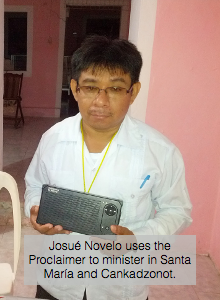
It’s been four months since the delivery of the first Proclaimer, an audio Bible programmed with the New Testament in the Mayan language. Since that time, we’ve distributed seven devices throughout the Yucatan, with encouraging results.  Here are some of the comments we’ve been receiving:

From Chemax: “It’s so uplifting to be able to understand the Word of God in our own language.”

From Santa Maria: “Our group members enjoy listening to the audio Bible because they are able to understand it without any explanation.”

Not only are they understanding the Bible, they are being touched by its message. Again, from our participants:

“One of our members was moved when he heard about the need to pardon his neighbor.”

Moments like these lead those who experience them to live out the implications of the message, a message that is able to reach them now that the barriers to its understanding have been removed.

Thanks for helping remove obstacles to the gospel and build bridges to its understanding and application here in the Yucatan.

Christmas 2013

We wish you and yours a very Merry Christmas and a Happy New Year!

« Older entries § Newer entries »