Official holiday that commemorates Mexico’s Constitution.
Source:Mexonline.com
Official holiday that commemorates Mexico’s Constitution.
Source:Mexonline.com
An official Mexican holiday that kicks off a five-day celebration of the libido before the Catholic lent. Beginning the weekend before Lent, Carnaval is celebrated exuberantly with parades, floats and dancing in the streets.
Source:Mexonline.com
Religious holiday that is celebrated with processions, dancing, bullfights in certain cities, and the blessing of the seeds and candles.
Source:Mexonline.com
New period of classes begins at “Betel” Bible Institute in Mérida Yucatán
The second and final session in a series of Evangelism Training Classes to be held at “Lirio de los Valles” in Muna, Yucatán
This is the first in a series of evangelism training classes to be held in Opichén, Yucatan
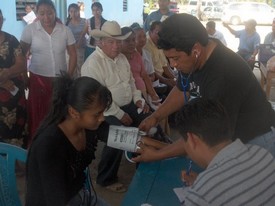
When one thinks of the needs that arise after a major natural disaster, several things come to mind. In the case of floods, for example, I think of material possessions being ruined or swept away by flood waters, no clean drinking water for awhile, unavailability of food, loss of homes, and possibly the loss of life – both people and animals. Recently, the state of Tabasco was hit by major flooding. Thankfully, several people came to their aid, both from the government and through organizations. However, when we inquired concerning the needs of the people, we were told that they had received a lot in the way of provisions, but that medical attention would be needed down the road. That’s where we come in … Last week our family had the opportunity to join with fellow missionaries Paul and Sandy Kazim, medical professionals and Bible school students from the state of Yucatan in order to go to meet the medical and spiritual needs of their fellow Mexicans in Tabasco. We were hosted by pastors and church members during the 4-day trip while we focused the outreach on 2 towns that had requested help in these areas. Not only was medical help available, but our team also provided ministry for the children, youth, and adults through skits, songs, balloons, sharing of the Word of God, door-to-door evangelism, and prayer.
Upon returning to Mérida, I reviewed some of the videos and photos from the trip and would like to share a short film that hopefully captures the essence of our visit. You won’t see me since I was behind the camera, and you won’t see Dave, either, since he along with some of the Bible school students visited homes, meeting the spiritual needs of those who couldn’t come or who hadn’t heard about the medical outreach. But you will see our kids involved in ministry as they played an important role and were a blessing to many. Also, the film is set to music, a song done in Spanish. The song speaks of being available and ready to be used by God for the things He wants us to do, giving Him our time, our hands, our voice, not wanting Him to pass over us because we are available for His purposes. It is sung by Jesus Adrian Romero from his album, “El Aire de Tu Casa.” My prayer is that this short film serves as a reminder of the needs all around us and that we, through the help and grace of God, are the answer to those needs. May God bless you as you allow Him to use you.
You can view it in this post above or on GodTube.
With the close of the year comes the barrage of top fives, tens, twenties… and while most of the lists are the best of (insert item here). I thought that you’d might enjoy another look at some of our favorite posts over the last year. They may not be the most popular, but they’re definitely worth another look:
In the personal reflection category among my favorites are:
Oh the Humanity: This personal reflection on the mystery of God’s involvement with our humanness came through a time of prolonged sickness. It’s words continue to ring true especially during this season as we celebrate the incarnation of our Lord.
Topes: With insight into Mexican culture, and cross-cultural ministry in general, this post reminds me that God is in control.
From the out of the ordinary category I would have to note:
A Visit From the Tooth Mouse: This tongue-in-cheek post presents the Latin alternative to the tooth fairy as well as some of the difficulties we face as we live in the city of Mérida.
Coincidence or Confirmation: This post takes you through some of the “coincidences” that we’ve experienced in the journey to the mission field.
In the final missions category three of my favorites include:
Conversations: is a reflection on what missions means to this missionary. It’s received a bit of attention, and I hope that it serves to help us, as Byron Klaus says: “Keep the main thing the main thing.”
Dia de la Virgen and Our Missionary Methods: just happens to be one of my latest offerings. It’s a wondering post, asking questions and providing little in the way of answers, but more than that, it’s an invitation to open discussion about what we’ve done and what we should plan to do as missionaries.
Back with a Story to Tell: is the first in a series of posts that details, day-by-day, the impact of a short term missions trip.
We hope these posts will serve as a representative look back on our year in ministry, while they inspire you to dream, pray, and get involved in what God is doing in you, in your community, and in the world.
Prospero Año Nuevo!
Tags: Missions, Reflection, Year end review
We were driving back from a planning meeting in Muna last Tuesday, where we’ll be hosting my brother and his Chi Alpha team, when I noticed, all along the roadway, bikers, runners with torches, and support vehicles flashing their lights and honking their horns. There were hundreds of people in the hour long stretch that we traveled.
It resembled some kind of Olympic procession. It was as if this group was ushering in the torch to light the first ever Yucatan Games, but looking closer I noticed that each one was wearing a t-shirt displaying the symbol of Mexican religious devotion, image of the Virgin of Guadalupe.
Researching further, I learned from YucatanLiving.com that these “antorchistas” are youth that have made a personal vow to the Virgin, and last week on December 12th, the Day of the Virgin, they ran or biked in order to complete their vow. The trek is a point to point journey, with more favor bestowed for greater distances. Apparently, the bicycle was introduced as a way for the working devotee to cover more ground in a shorter amount of time. (Read fewer days off from the job.)
Of course, we have the tendency to dismiss all of this as a misguided devotion, a practice to abandon as pure paganism. Still, one has to admire the determination, the organization, and the passion of those who would exert themselves for their faith. We evangelicals, a group lacking the presence of young men in our congregations, can’t help but ask, “How do we instill this type of enthusiasm, this type of devotion in our faithful?”
I would suggest that the answer lies within the pages of the Bible in the example of our Lord. It would seem that we are more famous for what we don’t do (drinking, smoking, dancing) than for what we do, for what we are against, than what we are for, but Jesus didn’t seem to be this way. “This man welcomes sinners and eats with them,” was the complaint of the Pharisees and scribes. What I see from Jesus isn’t a prohibition type religion. I see a radical redefinition of religious and social symbols.
To Peter and Andrew, fishermen by trade, Jesus says follow me, and I’ll make you fishers of men. To the woman at the well, Jesus says I am the one who gives living water. At the Last Supper, Jesus redefines the traditional passing of the cup and bread during the Passover meal into a remembrance of his sacrifice on the cross and celebration of the unity that we now have in the Church, the body of Christ on the earth. In other words, Jesus doesn’t seem to separate a person from his or her culture, rather he transforms the culture in much the same way that he transforms the individual.
This to me says that we as missionaries have a need for wisdom and God-given creativity when it comes to engaging a culture. What is truly anti-Christian, and what is simply an expression of culture? How can we contextualize, not just the presentation of the message of the gospel, but also its expression in worship and everyday life?
One case in point of an interesting attempt to accomplish this redemption of culture was in the Chota Valley, a culture of Ecuadorians of African descent. This people group had a dance that utilized a bottle, worn on the head and, if I remember correctly, filled with alcohol. In the bottle would be placed items that represented the pain and suffering that the person experienced in life. Missionary Joe Castleberry and his team, instead of prohibiting this cultural expression, redefined it. Gone was the alcohol and in the place of the symbols of pain and suffering was a flower to represent the new life the Christ brings.
I’ve not had the opportunity to see the “Freedom Valley” project first-hand, but I feel that it touches on an area that all missionaries need to consider. Did we do a disservice in our clothes-line style holiness of the 1900s? Have we relegated ourselves to the fringes of society though our lists of rules and prohibitions? How does it come across in the 21st century? On the flip-side, how does this redefinition of culture look, in Africa, in Mexico, in the US? Also, how do we know that we are truly redefining culture and not just compromising for convenience?
Granted, this task is not something that a simple post can solve, nor the work of one individual, but I think discussion is necessary and helpful if we are truly seeking to change the world.
Note: Picture was taken from YucatanLiving.com. (It’s kind of hard to drive and take pictures at the same time.)
Tags: Antorchistas, cross-cultural ministry, Dia de la Virgen de Guadalupe, Missions