Devotional

You are currently browsing the archive for the Devotional category.

2009 Bethel Graduation

2009 Bethel Graduation

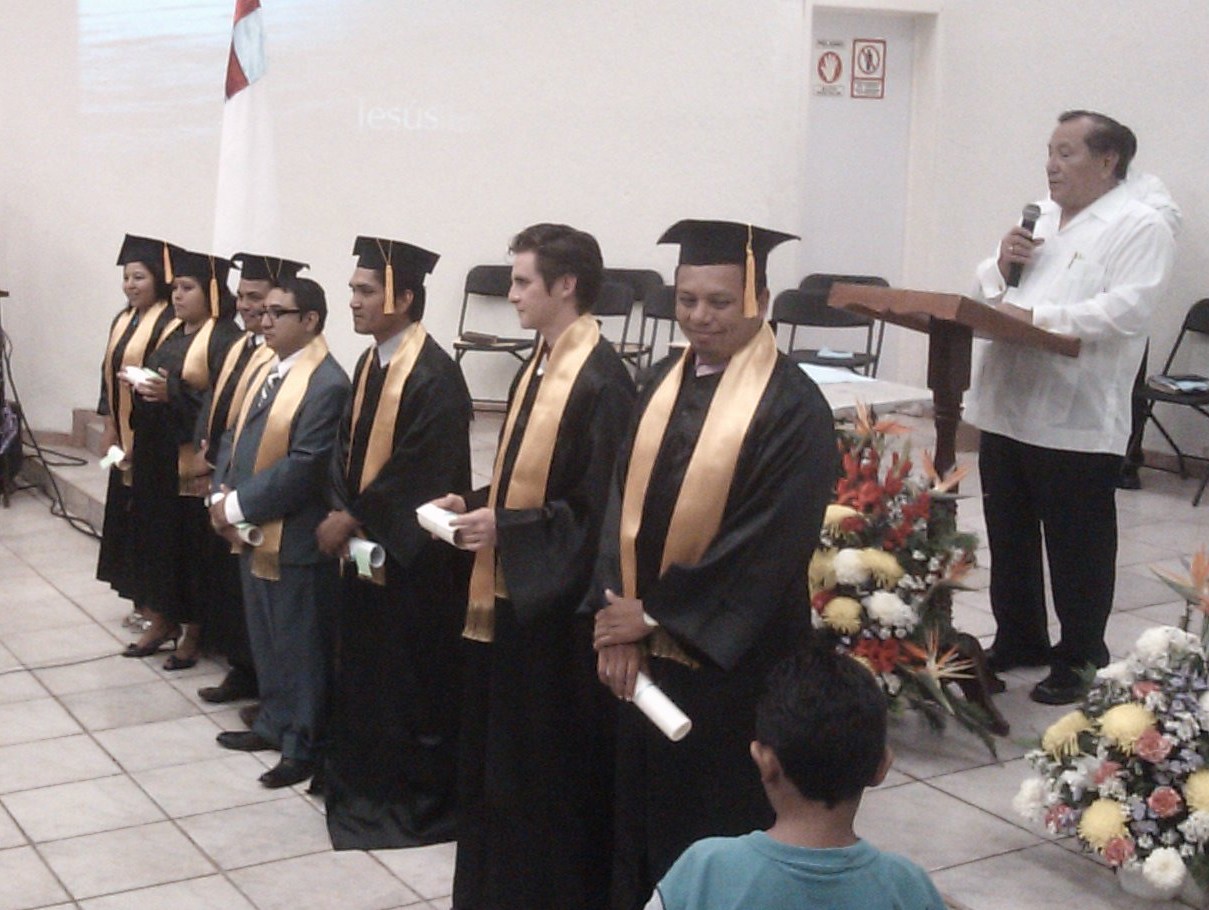
Since we’ve been in Mexico, we’ve witnessed the passing of a generation. No, we haven’t been here in Mérida for 20+ years, although looking at the growth of our kids during this term has made me wonder at times. I’m talking about the recent Bible Institute graduation service celebrated this past Monday, where Generation 06-09, walked the platform to receive their diplomas from the District Superintendent. This marks a milestone as it means that the students that I had the chance to teach from the first year of their Bible school experience are now being launched into ministry. The freshmen from my Personal Cvangelism course of December 2006-February 2007, my first solo class taught in Spanish, are now moving into their vocations.

Watching them receive their charge as graduates I had mixed feelings. There is a sense of joy in knowing that I had a part in their formation as ministers, but there is also a sense of regret. So often I had wished that I could have had certain sessions over again, where my lessons could have been more polished. On more than one occasion I’ve wish that I could have another chance at conversations that I’ve had knowing now that my Spanish could have been more understandable. In spite of my wishing, though, what was taught was taught, and the encouragement, advice, and prayers have been spoken. And that’s OK, because I believe that, though at times stammering or searching for the words, we communicated. As we learned we grew, each one of us offering to the other what we could not acquire on our own.

It wasn’t by chance that God brought me together with this generation at this moment in our lives. I so as I said goodbye to each one I prayed that as we part our ways, the graduates to their respective positions, and my family and I to the US to intinerate, that God will help us to remember the ways in which our being together expressed the manifold wisdom of God (Eph 3:10) that saw fit to join us together during their generation in the Bible school.

Tags: , ,

New Life We needed to replace the grass in our front yard about two weeks ago. A busy schedule and low water pressure had taken it’s toll on our previous lawn, and all that was left after the dry season that we’ve had was a lot of dust. So, after a change to our water system was completed, what was left of the old lawn was removed, and new grass was brought in.

As the Agustín, the gardener, was removing the remnant weeds, he looked over what used to be a flower border. “You want me to take these out too?” he asked. The border was a disaster; it looked like a mess of limp grass. Still, I said, “Let’s keep it. Maybe it’ll grow back.” So the limp-grass-once-upon-a-time-flower-boarder remained. Perhaps just to suck up water that would be better spent on the new lawn, I thought, but I had hope.

And that hope wasn’t disappointed. After about one week of watering, one sunny morning I was greeted by the picture above–dozens of tiny white flowers where once only limp grass stood. It was amazing to see the power of life in what seemed to be a hopeless situation.

Nevertheless, a dying flowerbed pales in comparison with the hopeless situations that many of us face. While we’ve been on the field, we’ve watched sadly as many of our friends were hit with what seem to be knock-out punches–unemployment, sickness, and divorce just to name a few. They are situations that are devastating for the parties involved and that leave those of us who must watch confused and questioning. “What is going on?” we ask, “Where is God in all of this?”

Of course, we have just celebrated the triumphant outcome of another seemingly hopeless situation–the resurrection of Jesus after a his death on the cross. The disciples had fled for their lives. Peter had gone as far as denying that he had ever known his former teacher. Jesus Himself, while dying cried out “My God, my God, why have you forsaken me?” The situation was irrevocable, or so it seemed. Nevertheless, just when it had seemed that God’s plan had been checkmated, the table was turned and the outcome was forever changed. That is the reality of Resurrection Sunday, the reality that still reverberates even two thousand years after the event.

I was reading Amy Maxwell’s blog the other day, when I happened upon some free music downloads. One of the songs, Rescue, by Ten Shekel Shirt, caught my attention when I was in the middle of thinking about one of my friends’ seemingly hopeless situation. The chorus of the song reads, speaking of God’s power:

You rescue, you redeem
You save, you intervene
You rescue, you redeem
Our lives, the stories of our lives.

It’s true. As the flowers reappeared from the dust of our yard, so God is able to redeem us even in the most difficult of situations. Like the prodigal son who’d cast away the riches he’d demanded, if we turn to Him, God is ready to receive us and restore us as His sons and daughters, even if we have squandered the chances we’ve been given.

So, if you have a chance to download the song, I highly recommend it, and if you happen to be in one of those seemingly hopeless situations, or know someone is going through one, renew your hope in the fact that God redeems. His empty tomb stands as a testimony to the fact that a restored life is possible.

Tags: , ,

Today during the afternoon service, I will be sharing about two of the seven words from the cross that Jesus spoke. I’d like to share one of those with you on this day that we remember our Saviour’s death:

Father, forgive them, for they do not know what they are doing. –Luke 23:34

Easter CrossBeaten, bloody and tired, Jesus now hung from the cross. Just hours before, He moved freely about the city, teaching and celebrating the Passover with His disciples, but now He had been arrested, judged, and condemned. The hands that had healed the sick, the arms that had reached out to children, the feet that had walked in search of the lost had been stopped–nailed unjustly to the wood.

Jesus, the only truly innocent one of all now paid a debt that He didn’t owe. He never blasphemed God, yet the priests handed Him over to Pilate for this offense. He never tried to raise up a rebellion against Rome, but over His head was the charge, “Jesus, King of the Jews.”

In this moment, He exemplified the classic picture of a victim: a man who, for no fault of his own had to suffer. Nevertheless, Jesus Himself rejected this description. Moments before, Jesus redirected the pity of the women who had met him on the way saying, “Don’t cry for me. Cry for yourselves and your children instead.” In front of Pilate, Jesus rejected his intervention, explaining that that the authority that He recognized came from a place higher than Rome, and in the Garden of Gethsemane, Jesus allowed His power to flow when the soldiers who came to arrest Him fell down before Him. Obviously, it was something else that held Him to the cross.

It was love. It was the power of the only One who knew what He was doing. Among all of those who played a part in His crucifixion, Jesus was the only one truly free. The others were like the priests, who had been blinded by their rage, or like Pilate, deceived by his supposed authority, or like His disciples, trapped by their fear. Jesus suffered from none of these delusions.

From the beginning, Jesus understood his purpose–to give His life as a ransom for us all. Whatever doubt that he had held on to left at the Garden with his declaration, “Father, not my will, but yours be done.” Now with these words, “Father, forgive them,” He shows the culmination of His power. Jesús, as the only one who never sinned, as the only one who remained pure, as the only God-Man, refused His right of vengeance, and in that moment, in that act of pure love, He granted them their pardon.

He freed those who were still cursing Him, those who couldn’t understand that that man on the cross was their only hope They didn’t know what they were doing, but Jesus knew. He knew that it would mean His humiliation and His death but even so, He did it. What is more, in His love He removed their guilt.

But it wasn’t only the soldiers and the priests and Pilate that crucified Jesus on that day some two thousand years ago. You and I are responsible as well. The Bible says that all of us had gone astray to commit sin, and Jesus carried all of those sins on the cross. He died for us even when we had not yet realized our need for Him. In other words, while we were blind like the priests, or deceived like Pilate or tormented like His disciples, Jesus extended His forgiveness to us. He removed our guilt for His death from us as well.

In addition, with the words, “Father forgive them,” Jesus extends to us an opportunity. Jesus promised, before He returned to the Father that, in this word we would have trouble, but counseled us to take heart, for He had overcome the world. But, how did He overcome? Certainly not by His miracles or by His teaching, because, having done all of that they still crucified Him. No, He conquered it through His love–the love that put up with rejection, that endured the Roman lashing, and that suffered the crucifixion, the love that gave forgiveness instead of condemnation. And we, being His hands and feet can follow Him in His example.

What problems do we have? Abandonment? Rejection? Pain? Jesus suffered all of these, but never became their victim. Now, what will we do? We have the opportunity to triumph with Jesus. We have the opportunity, today, to extend forgiveness. Maybe those who have mistreated us don’t deserve it, but neither did we, and we accepted it. Let’s follow Christ then. Let’s be victors and offer, like Him, forgiveness.

Tags: , ,

Seminar participants raise The Lord's cell phones.

Seminar participants raise The Lord's cellphones.

Stuff. We all have it, and it seems that there is no end to the amount that we accumulate. From flat panel giant screens to the latest GPS system for our car, there are countless items on our wish list as “must haves” that weren’t even on our radar screen a few years ago. Now, as we can justify the usefulness of such items, we ask, as we watch what the future holds , do we really need them?

It’s really no different here in Mexico. Case in point: I was doing holding a talk in the town of Chunchucmil. As I was nearing the place we were to hold the meeting, I reached for my cell phone to make a quick call to the pastor. However, in this small town near the Campeche/Yucatan border, there was no signal. Nevertheless, as I entered the church, I noticed that it seemed that everyone, including some kids, had cell phones. Behold, the power of advertising! The basic idea is this: you need a cell phone, even if you can’t use it where you live.

It all boils down to this question: our stuff–are we controlling it, or is it controlling us? I’ll be the first to admit my love for gadgets, but has this “technolust” boiled over to the point where we’ve scalded our reason? A family loses its house because it can’t pay the mortgage, but it owns two large screen TVs. Another can’t put food on the table, but owns three computers. What’s going on?

Our priorities are out of whack. For that reason, we’ve been excited to have been able to tour the district with our stewardship seminar. It is a two part series, based on the Howard Dayton book, Your Money Counts. It’s goal is to get its participants to understand that in order to achieve freedom to follow God’s will for our lives, we must recognize and submit to His plan for our finances.

Part of that plan is turning over everything that we have to it’s rightful owner, namely, God. It’s a liberating exercise in that it helps us to relinquish the worry that our stuff produces in us, and to depend upon God again for our needs. It also inoculates us from the power these things can have over us, helping us to recognize that proper stewardship, which leads to the freedom to follow God wherever He leads, may ask us to forgo certain items, like say recharging that cell phone instead of paying down debts.

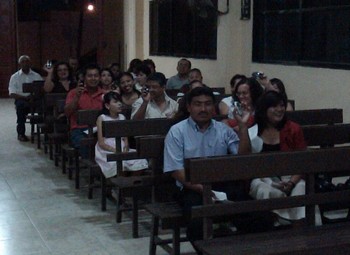
The picture above is of our most recent event, where I asked the question following the exercise, “How many of us are carrying the Lord’s cell phone?” It’s encouraging to see the response as those who perhaps had previously lived “compartmentalized” began to recognize the role that God plays in every facet of our life.

How about you? In this economic crisis, have you taken time to reflect on your stewardship practices? If you have a minute, why don’t you drop us a line and share with us what you’ve discovered.

Tags: , , ,

Dave Teaching

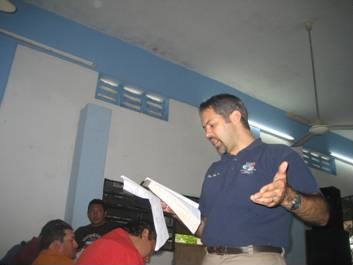
Teaching in Opichen

Around this time of the year, I start to get anxious. It’s been almost three months since the end of the World Series, and we’ve got only a few short weeks until pitchers and catchers report to start the 2009 baseball season. I’m looking forward to the date with anticipation, knowing that soon they’ll be playing baseball, and hoping that this will be the season that the Yankees win it all again.

In order to prepare, I start to watch baseball movies. One such movie is The Rookie , that Disney released some years ago. It’s the story of a high school science teacher who gets another shot at playing in the majors. In one scene, travailing in the minor leagues, traveling the lonely miles and feeling the pressure of his responsibilities at home, he decides to throw in the towel. “I’m just wasting my time,” he says to his wife over the phone. She asks back, referring the the game, “Do you still love it?”

He hangs up the phone and goes for a walk to think it over once again. Along the way, he encounters a night little league game, and in it he finds the joy and the hope in the game that he played as a child and had been given a chance to return to as an adult. With a renewed outlook, he heads back to the locker room. As he enters he asks another player, “Do you know what we get to do today?” Then, answering his own question he says, “We get to play baseball.”

Why am I waxing eloquent about baseball? Because I’ve been thinking about our job as missionaries. Lately, we’ve been really busy, rushing from place to place. I celebrated my daughter’s birthday on Saturday and directly after I was teaching our first session of the District Stewardship conferences that I had been invited to teach. Since that time, I’ve been on the road 3 of the past 4 nights, getting to bed later each night. When this finishes, I’ll be on the road again, this time to help in an evangelistic campaign that will take place two hours outside of Merida, where we have our home.

At times like these, I find myself missing my family, looking forward to getting home, and sometimes wishing that the events would be over. But then I have to ask myself what it is that I am actually doing. I received the call to missions when I was 15 years old, and since that time, my life had been centered around making it to the field. We prepared ourselves, obtained the necessary approvals, and raised funds for the purpose of becoming missionaries. Now, we’re doing it. How many times have I hoped, prayed, and dreamed of the day that God would allow us to make it to the field, and now it’s a reality.

Thinking about it again I’d have to say that, sure there are times when we find it hard, but we’re doing what we’re called to do. God’s fulfilled our dream, and every moment that we have here is another moment that we get to step out into another adventure with our Lord.

So I want to say thanks to all of you who have had a part in helping us to get here and stay here. I’d also like to ask you to pray for us. Pray that the words that we say would be what God would ask us to share, and pray that these events will reach the people that He’s preparing. And while you’re doing that, stop for a moment and thank God for the journey that you’re on with Him. After all, “We get to play baseball!”

Thumbnail appearing on the excerpt of this article from B Tal’s photostream on Flickr.com

Tags: , ,

The following is a sermon that I preached last Sunday. I felt that I wanted to share it as well with you.

While they were there, the time came for the baby to be born, and she gave birth to her firstborn, a son. She wrapped him in cloths and placed him in a manger, because there was no room for them in the inn.
–Luke 2:6-7

The temperature has dipped and another page on the calendar has turned. The holiday sales have begun, and the bonuses are being paid (“El aguinaldo” or 13th month of pay is a right of the worker in many Latin countries.) It’s official, the holiday season has begun. In our house, the tree is trimmed and the manger scene has been set as our thoughts turn toward December 25th and the celebration that is Christmas.

Still, though, I’ve been wondering lately. Although it seems that this is a season that we anticipate from the start of the year, could it be that it has caught us unaware? Although we’ve made the preparations in our homes and our budgets, have we overlooked Christmas in our minds and hearts? Will Christ be relegated to the outer confines of our lives because there is no room for the what He desires to bring into our lives?

Two thousand years ago, Jesus left the glory of heaven to become flesh and live among us. God literally broke into history to take up residence here on earth. Luke allows no questions about this fact, dating the time, “in the days that Caesar Augustus issued a decree” and the place, “Bethlehem the town of David,” that Immanuel, God with us, was born into this world.

The God who fills the heavens had come down. He who in the Old Testament could not be approached but once a year, and only then according to a strict ritual, had decided to take up permanent residence among us. He who invoked fear in the hearts of His people who dared not come near to the Mountain of the Lord in the book of Exodus, now invited this world to reach out, to touch Him, to hold Him near to their hearts.

Still, we read that this God-child received a less than wholehearted reception. Instead of a royal palace and a team of mid-wives to ensure a successful delivery, his birthplace was a less than accommodating stable. Luke, the physician, mentions no attendants at the birth of the Savior, instead we see the image of a solitary woman wrapping her new-born in the cloths that she could find and placing him in a bed borrowed from the animals that dozed nearby. A misfortune wasn’t it, that Joseph couldn’t find a spare room on this night of nights, or was it? Was the holy family turned away because they lacked reservations or because the innkeeper simply didn’t want to receive the new-born king?

No room could mean a lack of space, but it could also mean discrimination. The Jews during the time of Jesus followed strict laws of ceremonial purity. Those who desired to worship had to follow a strict dietary code as well as avoid situations–sicknesses and certain household uncleanliness that would contaminate this purity. One of those situations that a faithful Jew needed to avoid in order to maintain their ceremonial purity was the birth of a child.

The woman who gave birth during this time would be unclean for at least seven days. For those seven days, she would have to withdraw herself from contact with others. Those who were unfortunate enough to have contact with her would be subjected to a bath and be unclean at least until the end of that day. So it would have been in the best interests of any self-respecting businessman or head of the household, if in fact the inn was nothing more than a guest room, to shut out the hassle and potential contamination that a first-century birth would bring. Therefore, it is a distinct possibility that the conditions that Mary and Joseph faced were brought about because the people who received them just didn’t want to be bothered.

The shepherd boy: Truth or Fiction?

The shepherd boy: Truth or Fiction?

This certainly seems to work together with the surrounding details. Directly following the account of Christ’s birth we read of the angel’s announcement to the shepherds. For this reason, our Nativity scenes usually include a rosy-cheeked boy with a lamb around his shoulders–a placid picture of what we consider a pleasant occupation, but reality presents a different situation. Shepherds in this day were the outcasts of society, a smelly dirty lot, so disdained that they were inadmissible as witnesses in a court of law. And therein lies the irony, who better to witness to the birth of an outcast king than this society of outcasts?

There we have the original Christmas scene. Jesus, God made man had come down, but instead of receiving Him, His own people shut him out. They looked on Him as a problem to be avoided, a situation to be deal with instead of a King to be worshiped.

Over two-thousand years have passed since that day, but still the question nags me. Have we truly received the Christ that we celebrate during this season, or have we continued to shut Jesus out in the cold? Of course, it’s possible that each of us place the nativity scene in a central location in the house, and we might proudly wear our buttons that read “Jesus is the reason for the Season,” but does He still exist on the fringes of our lives? Many of us adore the child of Christmas, but have we prepared ourselves to receive the Christ of Christmas?

A case of mistaken identity

One time, I was walking on the campus of Evangel University. I was working there while a group of Chi Alpha campus pastors were meeting. In this group were several that knew my twin brother, Mike, but had never met me. On this day, as several members of this group approached me, they began to greet me as if we had know each other for some time, but I was, in their eyes, oddly silent, unable to return their greeting. When I asked them if perhaps they had mistaken me for my brother, they thought that I was joking. Only when I produced my driver’s license did they understand their error.

How do we see the Christ of Christmas?

How do we see the Christ of Christmas?

Perhaps, as we get closer to Christmas, we’ve committed the same error. Perhaps we’ve mistaken Jesus for someone He isn’t–a baby and nothing more, or much worse just something to fit into our schedules that are overwhelmed with activities, gifts to buy, and family to visit.

Jesus is so much more than that, but in order to find out who this Christ of Christmas, we need to open our Bibles to the ninth chapter of the book of Isaiah and the sixth verse. There, we find the hope of a Messiah that the Jewish people had, and there we find the complete identity of the Savior whose birthday we celebrate.

For to us a child is born,
to us a son is given,
and the government will be on his shoulders.
And he will be called
Wonderful Counselor, Mighty God,
Everlasting Father, Prince of Peace.

Wonderful Counselor (With recognition given to Dallas Willard for much of this content.)

The age in which we live is called the Information Age. CNN the 24 hour news network has as it’s tag line, “Because you need to know. Always.” (Translated tag line from CNN en español.) Those that know, win. Those that don’t, lose. Therefore, when we look for someone who can give us advice, we usually look for those who are the most up-to-date in our area of need.

But what happens to Jesus in this Information Age? If he remains as a baby in a manger, we push him aside. Statistics state that the majority of Christians don’t consider Jesus as someone who has reliable information about their lives. Not even one in a 1,000 people would describe him as well-informed, brilliant, or intelligent, but could we imagine that Jesus could be Lord if he wasn’t intelligent? Being divine, could he be dumb? I believe that our response has to be no.

Like Isaiah says, this child, our Savior Jesus Christ is the Wonderful Counselor. Paul the Apostle says that Jesus is the one in whom is hidden all of the treasures of wisdom and knowledge. Still, how do we accept Him in this way if we’ve lost our respect for Him as one who can inform our present situation? We can start by letting Him redefine our existence.

During the Christmas season, I believe more than the rest of the year, we experience the struggle between the world’s way of thinking and that of the Bible. The world tells us that the children that have the most gifts are the happiest, as are the parents that are able to buy them, but in this commercialization of Christmas, we can see the world’s philosophy–the lust of the eyes and the boasting of what man can do–creeping into our hearts and minds.

On the other hand, Jesus says to us that we are more than our bank account or the sum total of our possessions; we are eternal beings that need to know God more than the latest fashions. Therefore, if we really are eternal beings, we must understand that true happiness doesn’t come from what we can get at Wal-Mart on Black Friday but instead from our growing dependence on Christ’s counsel for our lives.

A stanza of the hymn “The Steps of the Master” reads:

I want to follow the steps of the Master.
I want follow my King and my Savior,
And allowing Him to mold my character
I sing with joy to my Redeemer.

When we reach the point of recognizing the Christ of Christmas, our Wonderful Counselor, we won’t only sing these words, we will live them.

Mighty God and Everlasting Father

This seems to be the paradox of all time. How I wish that I had been with Isaiah when he penned the those words. How can a child be God Almighty and a baby the Everlasting Father? Certainly the innkeeper couldn’t understand that the child that Mary carried was his Creator. If he had, he certainly would not have denied Him a room on that day.

Jesus’ neighbors couldn’t recognize this either. When He taught them, years later, in his hometown of Nazareth they marveled at His words and asked, “Isn’t this Joseph’s boy?”

Even His disciples, those who had placed their faith in Him, failed to understand who He was. Philip, one of the twelve who had been with Jesus from the beginning asked, “Lord, show us the Father and that will be enough.” He couldn’t see that Jesus was, as the writer of Hebrews tells, the radiance of God’s glory and the exact representation of His being, sustaining all things by His powerful word.

And we as we unwrap and hold that porcelain figure of the baby Jesus in our hand we are just as incredulous; how can it be that this baby so beautiful, so innocent, can hold together all things? We forget the fact that this child grew to become the One who fed the multitudes, the One who healed all those who came to Him. The One who defeated the powers of darkness, humiliating them by His death on the cross, and the One who triumphed over even the grave with his resurrection on the third day. We take Him for nothing more than a baby.

Maybe it is for this reason that He remains in the perimeter of our lives. We have problems with our health, our families, our faithfulness, but we have the tendency to hide it as if we were trying to hide candy out of the reach of a child. Have we forgotten that the child that was born on that night was God Himself? Have we forgotten that He still lives and is waiting to help us, to guide us along the path that we should take? Have we forgotten that this child is the One who knew us even before we were born?

Prince of Peace

Imagine the scene. Jesus had arrived, and what’s more, He arrived early. There was so much to do: dishes to wash, a table to set, food to prepare. And, instead of helping, it seemed as if everyone had sat to hear Him talk. This was the situation of poor Martha.

In the manner that Luke describes it in the tenth chapter of his gospel we can almost see her going in circles in her kitchen. “But Martha was distracted by all the preparations that had to be made.” And the frustration grew with each circle until she exploded and said to Jesus, “Lord, don’t you care that my sister has left me to do the work by myself? Tell her to help me!”

But Jesus’ correction reveals the problem:

“Martha, Martha, you are worried and upset about many things, but only one thing is needed. Mary has chosen what is better, and it will not be taken away from her.”

Christmas can be a season of stress much like the first two thousand years ago, but now, instead of a census that calls us to travel, the calls of relatives urge us to leave. Or maybe it’s our turn to host the family. We have to prepare the house, buy the gifts, and make the traditional meal, all in order to celebrate this special holiday. We’re upset, worried about lots of things. Maybe we’re lacking peace because we haven’t recognized this Prince of Peace. Like Martha we treat Him like any other guest when in our home is One who can calm us and speak to the storm, “Quiet! Be still!”

Thinking about my attitudes, I have to admit that I’ve failed to recognize the One that we celebrate each Christmas. There are times when I act like the innkeeper, worried more about completing my list of chores than about preparing a place for my King. It bothers me that Jesus might yet remain outside of His central place in my life, but tonight He makes us another invitation.

Here I am! I stand at the door and knock. If anyone hears my voice and opens the door, I will come in and eat with him, and he with me.

Jesus, the Wonderful Counselor, the Mighty God, the Everlasting Father, the Prince of Peace, wants to live with us this Christmas.

Maybe up until this moment we’ve failed to recognize His voice, but He continues to call. Maybe we’ve been worried about other things, but He waits for us. Why don’t we draw close to Him this Christmas? Why don’t we get to know Him as He is, the Master of our lives, the Author and Finisher of our faith and He who can give us the peace that passes all understanding. Why don’t we invite Him to to enter our lives this right here and right now?

Tags: , , ,

“¿Qué opinas del nuevo presidente? (What do you think about the new president?)” is a question that Kelly and I, being Americans living in Mexico, are hearing quite a bit lately, and it’s one that I’ve had difficulty answering. It’s not that I don’t have an opinion, but serving as form of spiritual ambassador, we’ve found that it’s not wise to involve ourselves in political matters. So often politics tend to divide, while, as members of the Body of Christ, we are called to be united. Philippians 2:1-4 mentions being like-minded, one in spirit and purpose.

Fortunately, we belong to a community of believers who, I feel, are in touch with the mind of Christ on this matter. They’ve risen above the wrangling of partisanship and focused us on the true task at hand, the proclamation of the Kingdom which transcends the cult of opinion.

The first example of this kingdom wisdom was posted by our General Superintendent, George O. Wood. In this video, he gives us a clear call to return to kingdom living along with a biblical guide on living under elected authority. It’s fully worthy of the ten minutes you’ll spend watching it.

The second example I’m submitting is a post that I encountered on Facebook. Steve Smallwood, posted there a dream that I feel should be in the minds and hearts of all followers of Christ. You can read his dream below:

I Have a Dream

It’s based not just on the American dream,
And it goes beyond justice related to skin color,
Though who could not be moved at the tears
Streaming down the cheeks of black men and women.

I have a dream that transcends ethnic differences,
One that moves beyond the divisive issues of yesterday’s battles,
And calls on citizens red and blue to beat their tired rhetoric
Into plans for action to address issues of significance.

My dream envisions Christians who would embrace the Kingdom,
Above and beyond any denominational or national loyalties.
It challenges the close-minded simplicity that requires large blocks of Truth
To be defined by and contained within small cranial cavities.

I have a dream that is based in the example of Jesus,
Who endured ridicule and refused to throw stones
At those who were beset with the legacies of sinful lifestyles
In order to deliver refreshing living water to their parched spirits.

My dream yearns for true believers to set aside,
Partisan politics and theologies of left versus right,
To not just oppose abortion but to truly cherish and nurture life
And to love God and others just as we ourselves want to be loved.

It’s a dream that refuses to divorce the gifts of the Spirit,
From the fruits of the Spirit–especially goodness and gentleness,
Toward those we disagree with–even our enemies,
Who we are called by Jesus to love–because they need it most.

There are days when I fear my dream is merely a vapor,
When I find myself at odds with the din of the crowd,
Then I remember that Jesus said we’re not to travel the well-worn path,
But instead to listen with discernment to his small voice and follow his costly example.

I proud to be linked with such men and women and glad to benefit from their wisdom. What’s more, I’m proud to be a part of a community that awaits, not a political solution, but an eternal redemption.

And he made known to us the mystery of his will according to his good pleasure, which he purposed in Christ, to be put into effect when the times will have reached their fulfillment–to bring all things in heaven and on earth together under one head, even Christ.

–Ephesians 1:9-10

This verse just happened to be the verse of the day on Biblegateway.com

Tags: ,

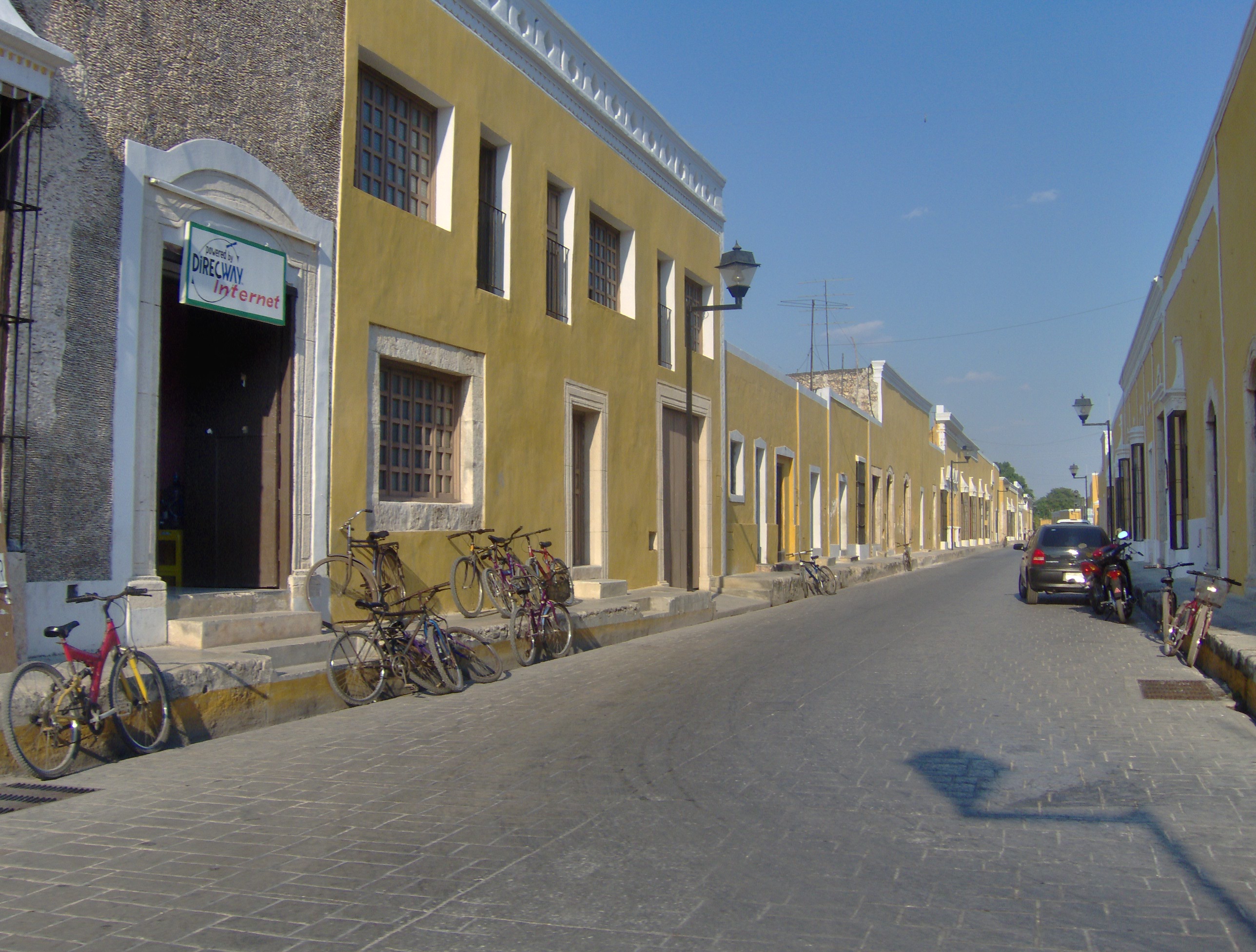
The streets of Izamal

The streets of Izamal

It was Sunday September 7th. We had been driving that morning to Izamal, a village about an hour outside of Mérida in order to attend the district-wide prayer meeting, when Kelly asked me about a passage that she had been reviewing for an upcoming women’s meeting. With Mexico’s Independence Day celebration upcoming, she had settled upon Galatians 5:13: “You, my brothers, were called to be free. But do not use your freedom to indulge the sinful nature ; rather, serve one another in love.”

Using the passage as a jumping-off point, I remember expressing an idea that came to my mind: “Being released from the bondage of sin, we are now free to humble ourselves and serve one another. Although the external circumstances would suggest a different reaction, we are free to love when before we were tied to serve only our own passions and interests.”

Little did I know, however, that what was then theoretical would become suddenly very concrete.

As we were leaving the city after the meeting, we had stopped at a stop sign and were beginning to continue when, unseen by us, a motorcycle carrying 3 teenagers attempted cross in front of us. They struck the front of the truck and fell against the curb of the opposite corner. All three weren’t wearing helmets.

Immediately, I got out of the truck to tell the boys to stay where they were. Soon, those that lived near the scene were out of their houses, and before long, the police and ambulance arrived. Those that were hurt were taken to the hospital, while we were escorted to the police station where I was detained for 33 hours, first at the station, and later at the Public Ministry building in Mérida.

Now, in the US, when an accident occurs, rarely does a person go to jail, but in Mexico, when there is doubt about payment, the person who causes the accident is detained for 48 hours until the situation is settled. If it is not settled in 48 hours, the driver goes to jail. Unfortunately, although we had Mexican Car Insurance it took the adjuster one hour to reach the scene, and it wasn’t until later that night that the lawyer arrived in order to begin the process to post bond so that I would be released.

Nevertheless, being placed in detention didn’t mean that I had been placed on a shelf. The words that I had spoken just hours before came back to me during my time alone. So I prayed. I prayed for the injured boys. I prayed for Kelly and the kids, and I prayed that God would use me. I knew that, even though I had been detained by the authorities, I was free to serve.

Merida Public Ministry Building

Merida Public Ministry Building

In Mérida, I was made to wait in a room with three benches and an air conditioner that had seen its best days perhaps 10 years ago, but I was not alone. It “just so happened” that, there with me in the “waiting room” was a man who we’ll call José. He had arrived the day before, having crashed his car while driving drunk on his way home from work on the other side of the peninsula, but that wasn’t the whole story. He was also a prodigal son.

He had once had a vibrant relationship with the Lord and had been an active member of the Christian community, but his work had isolated him, and in his isolation his bad choices multiplied. The crash was the end of a slippery slope that had left more than his car in a wreck, but sometimes it takes hitting bottom before we begin to look up.

José told me his story, and I told him mine, but I didn’t end it with the story of the accident. I told him that although God hadn’t caused my accident, that my meeting with him was certainly more than coincidental. I told him of the Father that welcomes home all who return to Him, and I invited him to start the journey back. We prayed, and in that detention center, we felt the presence of God. We knew that even though it seemed that our immediate future was out of our hands, we knew the hands that held our eternity.

José wasn’t the only one in the room with me. There were two youth who had been detained for driving drunk, and two others who were in the middle of a dispute between their respective insurance companies. While we waited for news about our situation, we formed a community: we talked about our families and our faith, we shared everything from the food that was brought to us to the floor that we slept on, but what filled me with the most joy was our last moments together.

When word came that was to be released, I asked if they would mind that I prayed. Given permission, we all bowed our heads and I began. I prayed for their safety and the resolution of their situations. I prayed for their families and their future, but, most of all, I prayed that each one of them might know Jesus, the only one who, in whatever situation, can set us free.

As I walked out of that room and into Kelly’s arms, I was thankful to be reunited with my family. I was thankful for the beginning of the resolution of circumstances surrounding our accident, but I wasn’t thankful for being set free. Instead, I was thankful for being taught the true meaning of freedom–that, no matter what the circumstances say, Christ has set me free, free to follow Him and free to serve others in the hope they they too will taste the freedom that I have been privileged to
experience.

In wrapping up this lengthy post, I want you to know that we are well. Although the accident has certainly left a mark on us, with God’s strength we are returning to “normal life” here on the mission field. We have definitely been the beneficiaries of the blessing of the Body of Christ in action through it all. From the prayers of the saints to the selfless help of our church friends and district officials, we have been cared for throughout this entire situation. Blessings on all of you who have been a part of this comfort that we have received.

Furthermore, it has been reported that all who were injured will make a full recovery. They have received the medical attention necessary and are now receiving spiritual care on behalf of the local A/G congregation. It is my prayer that this temporary setback will serve to redirect their lives toward a relationship with the one who can guide them through their eternity.

As for José, we were released together and are planning to get together soon to celebrate our freedom, freedom that God redefined for us in the middle of our captivity.

Photo of the Public Ministry building from Yucatan Living.com. You can read about their experience here: https://www.yucatanliving.com/yucatan-survivor/yucatan-license-plates.htm

Tags: ,

When I tried to understand all this,
it was oppressive to me
till I entered the sanctuary of God;
–Psalm 73:16-17

Over the past week, we’ve been hit with news of tragedy. One friend lost an unborn child, what was to be his first. Another passed away during a stem cell transplant procedure that was supposed to save him, and now we have received news that yet another of our friends is struggling for his life after cancer surgery.

All of these friends are committed Christians, two of them missionaries. The baby, Hannah, had never seen the light of day. Just weeks from being born, she was taken. Joe, a campus missionary, had only a few years ago left the US to take on the challenge of introducing the atheistic Scottish university community to Jesus. Though his ministry had already touched a generation of college students in the US, it was clear that he felt that there was much more work to be done. Doug, who is currently in the hospital, is a missionary to Africa. Having fought and beaten cancer before they had returned to the field only to see the cancer come back and with it a need to fight once more.

In each circumstance I am left asking, “Why?” Certainly I have explanations. I understand that we live in a sin-stained world, one in which the righteous suffer along with the wicked. I also know that “to be absent from the body is to be present with the Lord,” but the reality of it all is simply overwhelming, impossible to comprehend. Like the psalmist, I am left groping for answers.

But in my search for answers, I find myself seeking the presence of the Lord. Recently, I picked up my guitar and sang, hearing the words of the worship songs anew and allowing them to carry me to a place where I could focus solely on the Lord. I cried, I prayed, and I cried some more. At the end of that time, I had no more answers, but my perspective had changed. Focusing on the magnificence of God, I understood that He is not wringing His hands at the recent turn of events, but rather is still firmly in control. And experiencing those moments, alone in His presence, helped me to understand that He is still very much concerned and involved with each of us who cry out to Him.

So like the mason, who must brick-by-brick continue the work though he may not have access to the master plan, we continue on here knowing only in part. Still, I am thankful that He who alone is all-knowing has allowed to meet with Him, where we find that our need for His presence is greater than our need to know why.

Preaching Friday night, teaching Saturday morning, a week long class next week, the schedule keeps on piling up. The difference is, I’m not the one who’s dealing with it, it’s Kelly. Being invited to preach in a youth service, leading a Saturday Morning Kid’s Service, and teaching during our church’s Vacation Bible School has kept Kelly occupied, planning and preparing. So much so that I’ve decided to take some flying lessons. No, not that type of flying.

Actually, flying is a clever way of talking about housekeeping that Marla Cilley a.k.a “the FlyLaydy” invented to encourage those who would like to keep a clean house, but were never “born-organized” to achieve that dream. With my Kelly out of the picture for long stretches, I needed a little bit of motivation to help me pick up the slack around the house. So I turned to the site for tips and routines that would help me keep the house up, while enabling me to devote time my kids, who just got out of school last week. Fortunately, although FlyLady.net is definitely geared to the feminine audience, I found lots of time saving techniques that have helped me to let Kelly devote herself to her preparation, while keeping me from a nervous breakdown.

In fact, as I have been swishing toilets and scrubbing pans, I found myself thinking of the spirituality of it all. No, I’m not saying that doing the dishes is helping me get closer to God, but switching roles has helped me understand a bit more about ministering as a missionary couple. Ephesians 5:22-33 is the classic passage on the husband and wife relationship. Wives are to submit, while husbands are to love. What many of us miss, however, is that Paul, in verse 21, commands all to submit to one another out of reverence for Christ.

Now, I am not saying that Kelly is now ordering me around or leaving honey-do lists on my pillow in the morning, but what I am saying is that there are times in ministry, and I could say in secular life as well, that the husband is up front, doing the public relations and making the decisions. There are also times when that shoe is on the other foot, and the wife takes the lead. Perhaps this is what Paul was saying when he recommended Phoebe to the Romans saying, “After all, she has proved to be a respected leader for many others, including me.” (Romans 16:2 CEV)

So this week, Kelly has become the face of our public ministry. She’s been the one up front, going to meetings and making the decisions, and that’s a good thing. I’ve submitted to what the Lord is doing through her during this time knowing that He’s called us both to serve Him here in Mexico.

Speaking of what the Lord is doing, I’d like to request that you say a prayer for Kelly this weekend, and if you can, remember her throughout next week. I’m sure she’d appreciate that, and while you’re at it you can pray for me as well–dishpan hands can be really annoying.

Tags: , ,

« Older entries § Newer entries »