Ministry

You are currently browsing the archive for the Ministry category.

With the close of the year comes the barrage of top fives, tens, twenties… and while most of the lists are the best of (insert item here). I thought that you’d might enjoy another look at some of our favorite posts over the last year. They may not be the most popular, but they’re definitely worth another look:

In the personal reflection category among my favorites are:

Bicentennial ManOh the Humanity: This personal reflection on the mystery of God’s involvement with our humanness came through a time of prolonged sickness. It’s words continue to ring true especially during this season as we celebrate the incarnation of our Lord.

Tope ThumbnailTopes: With insight into Mexican culture, and cross-cultural ministry in general, this post reminds me that God is in control.

From the out of the ordinary category I would have to note:

Mouse-Shaped Tooth HolderA Visit From the Tooth Mouse: This tongue-in-cheek post presents the Latin alternative to the tooth fairy as well as some of the difficulties we face as we live in the city of Mérida.

Erie Merida ConnectionCoincidence or Confirmation: This post takes you through some of the “coincidences” that we’ve experienced in the journey to the mission field.

In the final missions category three of my favorites include:

Hands ThumbnailConversations: is a reflection on what missions means to this missionary. It’s received a bit of attention, and I hope that it serves to help us, as Byron Klaus says: “Keep the main thing the main thing.”

Antorchista ThumbnailDia de la Virgen and Our Missionary Methods: just happens to be one of my latest offerings. It’s a wondering post, asking questions and providing little in the way of answers, but more than that, it’s an invitation to open discussion about what we’ve done and what we should plan to do as missionaries.

Mun Ha ThumbnailBack with a Story to Tell: is the first in a series of posts that details, day-by-day, the impact of a short term missions trip.

We hope these posts will serve as a representative look back on our year in ministry, while they inspire you to dream, pray, and get involved in what God is doing in you, in your community, and in the world.

Prospero Año Nuevo!

Tags: , ,

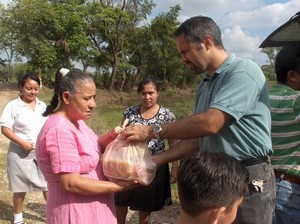
Dave distributing a despensaWe’ve returned from our 3 day trip to Tabasco, the region of Mexico that had experienced devastating floods in late October through early November. We loaded up two SUV loads of toys, vitamins, diapers, and powdered milk and drove the 8 hours from Mérida, Yucatán to Villahermosa, Tabasco to bring relief to families, especially those with small children.

Entering the city, we found that life had returned to its hectic pace with people and cars everywhere. The only visible remains of the inundation was the construction taking place to repair and clean roads affected by the floodwaters. Still, the stories we heard were incredible. People told us that many had remained in their homes, thinking this to be just a routine occurrence during the Tabasco rainy season, but that, as the floodwaters rose, they found themselves waiting on rooftops for helicopter rescue. The pastor’s home where we stayed took on more than 5 feet of water. He and his family stayed in the upper level and were able to save the majority of their appliances and furniture, but mold on the walls and ruined tile floors spoke of the work ahead to restore what the flood had ruined.

The countryside surrounding the city was a different story as floodwater remained on the roads and in the low lying areas that surrounded the houses. While no longer threating homes and schools, the stagnant water poses a health threat especially to the small children who choose to play in the contaminated pools and through mosquito borne illnesses. This is where we focused our efforts.

Entering Tabasco on Thursday night, we pooled together with Pastor Ruben, his family and several members of the church to put together relief packages with food, vitamins, diapers, milk and other essentials for the residents of these needy areas. It was touching to see the desire of these people, who were themselves victims, giving of their time and effort to help those who had needs greater than their own.

The following day, we handed out the supplies and toys to the children and their parents. It was for them clearly a “big deal” as at one point we were accompanied by one of their local government representatives. We were given complete access, even the ability to interrupt the activities of a elementary school to meet with the students.

Food was distributed, toys were given away, and much needed supplies were handed out, but something much bigger was accomplished. These victims received a much needed infusion of hope. They received it realizing that they were not alone in their struggle.

There is something amazing in the fact that God touches people to go and share his love with those who most need to experience it. At one point in the distribution, Paul Kazim, a fellow missionary, prayed. I think it was then that the reality of what we were doing came into focus: Jesus ministered to the people in Mark 6:30-44. He did that even though he was experiencing the loss of his cousin and herald, John the Baptist. He did it because he had compassion. In Tabasco, fellow citizens were putting their lives on hold, lives that had themselves been completely changed by the floods, to reach out to those with greater needs. What was the reason? I believe it to be nothing less than the same compassion that Christ portrayed to the 5,000 that were fed in the Galilean countryside.

We’re planning to go back to Tabasco January 10-13 to provide medical treatment and spiritual counseling to the needy suffering in Tabasco, to the people now being overlooked as efforts are being made to restore a sense of normalcy in the region. We as missionaries will take part, but I think the most effective counselors will be those who have lived through these floods. Those who, because of the compassion that only God can provide, have thought of others as better than themselves.

(You can see more of our recent trip by clicking on the picture above or through this link.)

Tags: , ,

We’re on our way for a three-day relief trip to Tabasco with no time to type. What could be a faster way to relay the story? How about a video blog? Take a look at this latest offering and please remember to pray for those affected by the flood in Tabasco.

Tags: , ,

September marked for us the end of one year of ministry here in the Yucatán, and to celebrate, we brought back a best of disciplemexico.org so that you could revisit some of the highlights of our journey thus far:

Dead of the Dead Thumbnail1. Day of the Dead–Written as a response to a request of an friend, this post is by far our most popular post of the past year, and, with the celebration of this event less than a month away the hits are building again. This piece reveals the difficulty that we have as we try to understand the culture of the Yucatán and their ancient traditions.

Bicentennial Man2. Oh the Humanity!–is a piece I wrote about how God uses our humanness, something very evident to me as I suffered through a prolonged sinus infection, to reveal his perfect power.

Bike Lesson Thumbnail3. Like riding a bicycle–is a family update/reflection on what it is that we do as missionaries. By the way, mastery of the bicycle is something that our kids are still working on. Come to think of it, we’ve still got a lot to learn about missions as well.

Tope Thumbnail4. Topes–Life has a way of springing surprises on you, much like speed bumps that seem to appear when you least expect them on roads here in Mexico, but, as this post suggests, the jolts bring with them valuable learning experiences.

Erie Merida Connection5. Coincidence or Confirmation?–This post about our providential guidance on the way to Mérida generated some lively if not completely related discussion.

As I look through these posts, one thing becomes increasingly clear. The job that we have been called to is not an easy one, but the God that has called us continues to guide and form us so that we can accomplish His work.

Conversations

CelestunThe definition of missions is changing. I recently returned from the Mission Exchange fall retreat where it was obvious that the upcoming generation of leaders thinks differently about the way cross-cultural ministry should be done. One speaker put it plainly. “To me a missionary was a guy in a four pocket shirt (guayabera) who traveled with snake skins and a slide projector.” He couldn’t relate. In a context of rapid globalization, where the world seems to be shrinking by the day, more and more students and professionals are saying, “Missions? Hey, I can do that!” They’re an eager workforce looking for the right project or missions-sending agency with which to partner, and when they can’t find one, they’re making their own. One pastor, Matt Chandler from the Village Church, looking to implement a business as mission model grew impatient with his denominational organization and started his own organization which is funding 14 missionaries and a handful of missions projects in several countries.

“To God be the glory, more workers in the harvest!” might be the reaction to the current situation, but such trends give this missionary pause for thought. The church today has, to a certain extent, adopted the current business mentality. For a project to be successful, it needs to produce quick and substantial results. ROI, or Return on Investment, a term ripped out of the business manager’s handbook, was thrown around a bit at the retreat. Donors are looking to see their dollars make a tangible impact on a community, so the funding of hospitals, feeding programs, orphanages, and even the establishment of Christian Businesses are becoming increasingly popular. Still, the question remains, “Is this the best way?”

My time here in the Yucatán has shown me that the work of a missionary is never quick nor easy. What may be able to be started through a project or an event must be continued through sustained process–biblical concepts applied to the cultural situation. This requires someone on the ground, an interpreter. This role was the one that the missionary traditionally occupied–studying the language and culture in order to reveal Christ and the Christian message through concepts that could be understood and adopted. I don’t put myself at this level yet. We have much to learn to fully understand the culture in which we are ministering, but I feel that we are making progress.

For example, these past two weeks I’ve carried on redemptive conversations in three separate settings, one a meeting to minister to a hurting woman, another a conversation about discipleship over lunch, and finally an impromptu chat with a carpenter at the local library. In each setting, through an understanding of the linguistic, cultural, social context, I was able to determine the relationship that the individual had with Christ, move them further along in the discipleship process, and, because I live here, follow up with them to clear up uncertainties or integrate them into the local Christian community. This doesn’t bring about the headline worthy results of a evangelistic crusade or a medical missions team, and often a cup of coffee or a chat on the beach doesn’t “look” like ministry, but statistics show that, over the long run, this is the most effective strategy (McIntosh, Finding Them Keeping Them, 1992:45). In reality, this is where cultural exchange happens, where we can study, share, and begin to understand one another. This is not to say that we are no longer preaching, teaching, or planning events, but we find that it is in the follow-up, the relationships that we find that we make the most progress toward discipling Mexico.

The “new” trend in doing ministry has its place, but we must understand the risks involved:

  • Disaster relief, though a biblical mandate can lead to the creation of “Rice Christians” those that proclaim Christianity as long as the hand-outs keep coming.
  • The construction of hospitals and schools require funding and resources that the host nation usually cannot provide and government instability can lead to such properties becoming pawns in a civil war.
  • Business as mission, or the creation of Christian businesses overseas as a means of witnessing through Biblical business practices runs the risk of tying Christianity to capitalism and the possibility of major problems in the event that the realities of business causes the mission to pull up its roots and abandon the country in search of a more profitable location.

The reality is that incarnational ministry, “walking among the people” is the only real method to effect change in a culture. Programs pass away, and events come and go, but it is my hope that the presence of the missionary and the example of the ambassador of Christ in the cross-cultural context will remain.

Golgota ConstructionOur missions organization, Assemblies of God World Missions (AGWM), promote a missions policy that seeks to create and nurture an indigenous national church. Therefore, we as missionaries are charged with the task of forming or motivating national churches that are to be self-propagating, self-governing, and self-supporting. What does this mean you ask? Simply, our job is to partner with the church in Mexico–working, modeling, and training, so that they can, with their own people and resources, evangelize the lost and disciple new believers, administrate the work, and fund the church.

If you noticed, the order is intentional. Often, a new work moves forward quickly in the area of propagation. New believers are eager to share with others about the new-found freedom that they have in Christ. Leaders are harder to come by. Time and training are required to cultivate those who would guide the fledgling work. Still more challenging though is reaching the point of self-support. In developing countries like Mexico wages are low (the minimum wage here in Mérida is $5 a day), and the requirements of ministry can be quite high, especially if the church wishes to take an active part in evangelization and outreach to the community in which it is located. Therefore, missionaries often find themselves called upon to lend a hand when it comes to stimulating the work.

This is the reason that I am writing today. Our home church is in need of a helping hand to meet its needs as it expands to reach out to the community. Pastored by Orlando Vazquez, El Centro Cristiano Gólgota, is located in a strategic area of the city, but it’s current size is affecting its ability to minister effectively. Therefore, the church has been expanding its facilities to keep pace with its vision.

The $55,000 expansion began in mid-April with about $10,000, not even a fifth of the required need, but, through the sacrifice of the congregation and the response of friends and the community, Gólgota has finished walling in, roofing and is currently using the lower portion of the expansion where the sanctuary sits. It indeed has been a blessing to see the response of the people as they have challenged themselves to move forward. Still, about half of the work remains, including classrooms to minister to the bulging children’s Sunday School classes.

That’s where we are asking you to consider pitching in. Kelly and I have seen the kind of contagious motivation and sacrifice that the congregation has displayed, and we would like to offer you a chance to participate. So we have created, as a project with AGWM, a fund in order to receive offerings from those who would like to help Pastor Orlando fulfill his dream of seeing the church built.

If you would like to donate directly to this work, you can give through this secure web-server by entering your offering and the project name and number “EXPANSION OF CHURCH BULIDING GOLGOTA #14290.”

Prayer PresentationFor those of you who prayed and have been waiting for my schedule to break in order to give you an update, I want to say thanks. The Prayer Wall presentation was overwhelmingly received here in the Yucatán. We had a full house in the church “Cordero de Dios” as well as our superintendent and assistant superintendent present.

Phil presented his vision for a continuous wall of prayer across Mexico as I interpreted. The photo to the left shows one of our more in sync moments. It was a stretching experience for me to be sure, but it was extremely rewarding as well as tens of volunteers signed up to be a part of a 230 strong group of prayer warriors interceding 24/7 for Mexico.

Again thank you for your prayers and notes of encouragement as I stepped out in this ministry.

Phil BennettIn May, I received a phone call from Phil Bennett (pictured to the left), a minister from Concord First Assembly in North Carolina, concerning extending his “Watchman Prayer Ministry” to the Yucatán. The ministry consists of recruiting 168 people to pray one hour each week for the needs of the area. Here in Mexico, he’s been active in Mexico City, Tlaxcala, and Veracruz. Knowing that prayer is vital for our ministry and that our superintendent, Raul Sanchez, has been emphasizing prayer in the district, I asked him if he would be interested in having Phil come to share about this ministry. Three months later, this idea is being brought into reality. Phil and his team will be here in Mérida tomorrow at 7:00 PM. I’d appreciate your prayers concerning the reception of this program.

I’d also appreciate your prayers concerning the event itself. I will be serving as a translator for Phil as he shares with an exclusively Spanish-speaking group. The only other opportunity that I have had came during an impromptu gift-exchange during my brother Mike’s visit to Muna back in March. So as we take a step forward in prayer, I’ll be taking a step forward in my abilities as a missionary. Pray that I’ll be able to use my nervousness as a tool to listen and correctly convey the message he will bring.

ISUM SmallThe close of June brought about the end of ISUM, the month-long ministerial advancement seminary held here in Mérida. As we near mid July, I’ve had some time to reflect on the experience and think about my re-entry into the normal missionary life.

ISUM is known by it’s grueling schedule and intense homework. The deadlines seemed to stack on top of each other as we prepared for 5 class periods each evening. Exhaustion was our common enemy as we fought back sleep in order to complete all of our tasks. Still, the struggle had a comfortableness about it. Being a to-do list writer, I found great satisfaction in marking off each assignment as I completed it, and although I routinely hit the pillow around 1:00 or 2:00 AM I did so with a feeling of accomplishment.

The return to normalcy, although less demanding on the schedule, didn’t come with the neat guidelines. A team to receive in late July, finding a house to move into by the middle of July, a youth retreat in August and the accumulation of work needing my attention while I was in ISUM each bring conflicting priorities and a collective clamoring for attention. There are no convenient class plans to follow and no instant feedback in the form of quizzes and tests along the way. These realities pose a problem for my order hungry mentality.

I would say that this may be the life that we all lead. We shout for independence as a youth, but we long for the simplicity of our childhood as adults. We have arrived at the place where we are free to determine our lives but we tire of the responsibilities, the leadership, and the need to hold everything together, and we long for someone to just tell us what to do.

And yet, this is our situation in our walk with the Lord. We face difficult decisions daily. We pray with fervency for direction, but rarely does the answer come in the form of a carefully worded class syllabus or a turn-by-turn Google Map. It’s then that we need to apply the knowledge that we’ve learned in the School of the Spirit of God’s Word, when we need to move from the parable to the person on the street, and that is where we most often fail.

The disciples coming off of a successful tour of ministry, casting out demons and healing the sick, failed the test of the Lord when facing the need of the multitude. “You give them something to eat,” he said. They reached for their calculators instead of their faith. Lk. 9:13

So is our daily struggle, rarely hectic to the point of the exhaustion of ISUM, but rarely as neat and tidy as the daily plan of activities that we received for each class. Still I’m glad we serve a patient Lord. Jesus did come through for the disciples. And, as we continue in our daily training, being formed into more into the image of our Master, I’m glad to know that our rate of success increases.

Pastor Julian Puc and DaveThis past March, we had the opportunity to work in Muna, a small town south of Mérida. We arrived with a group of American University Chi Alpha students who were dedicating their Spring Break to help make a difference in the lives of the residents of this community.

Just two weeks ago, I had the opportunity to head back to Muna as part of a class trip of sorts for students involved in ISUM. We took in the pyramids at Uxmal, and also got a chance to stop for panuchos at the church where we worked. I got a chance to greet those who were hosting the students as well as view the progress that has been made on the church and the pastor’s home where we worked.

Click on the picture to view an album of the progress.

« Older entries § Newer entries »